



01. Edit your 3520 2017 online
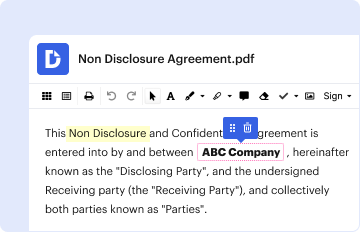
Type text, add images, blackout confidential details, add comments, highlights and more.

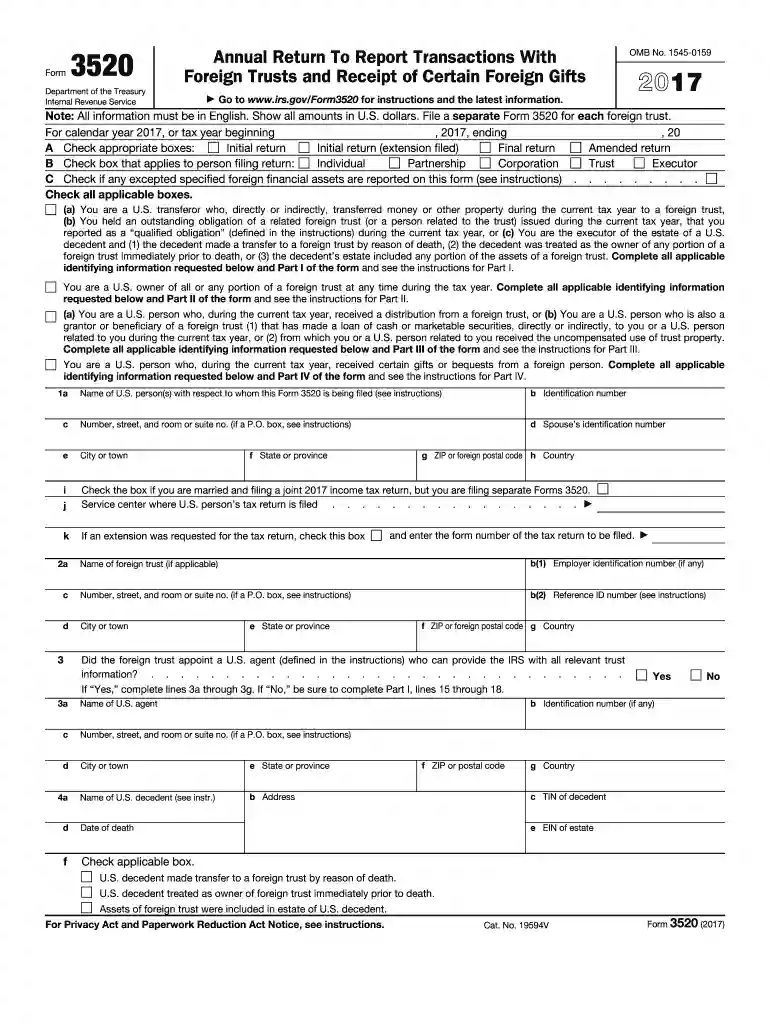
Type text, add images, blackout confidential details, add comments, highlights and more.
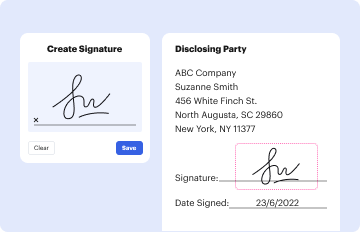
Draw your signature, type it, upload its image, or use your mobile device as a signature pad.

Send 3520 form via email, link, or fax. You can also download it, export it or print it out.
Form 3520, officially titled the "Annual Return To Report Transactions With Foreign Trusts and Receipt of Certain Foreign Gifts," serves as a reporting mechanism for U.S. persons who engage in transactions with foreign trusts or receive foreign gifts. The form aims to provide the Internal Revenue Service (IRS) with necessary information about these transactions to ensure compliance with U.S. tax laws. Specifically, it requires detailed reporting from individuals who have transferred money or property to foreign trusts, received distributions from such trusts, or obtained gifts from foreign entities or individuals.
Form 3520 is relevant for individuals who engage in cross-border financial activities involving trusts or foreign gifts. U.S. persons, including citizens and certain non-citizens who reside in the U.S., must file this form if they are responsible for creating or transferring assets to a foreign trust, own equivalent financial interests, or receive gifts exceeding specific thresholds from foreign sources. While the form tailors to individuals, businesses such as LLCs or partnerships with relevant foreign interactions may also find it applicable in ensuring comprehensive reporting to the IRS.
U.S. individuals can access Form 3520 for the 2017 tax year through the official IRS website, where a downloadable PDF version is available for those who prefer to fill out a physical copy. Additionally, tax preparation software such as TurboTax and QuickBooks may offer electronic versions integrated into their platforms, assisting users in aligning their forms with other tax filings. It's crucial to use the correct tax year version to avoid discrepancies during submission and review.
Form 3520 consists of several essential sections designed to capture detailed data about the filer’s financial activities with foreign entities. These include:
Understanding specific terms is crucial:
Form 3520 must be filed alongside the U.S. individual’s tax return by the April filing deadline, typically April 15, unless an extension is granted. If extended, the form is due on October 15. Missing these deadlines can result in penalties categorized under non-compliance.
Failure to file Form 3520 accurately and timely may lead to significant penalties, including:
Submitters can send completed Form 3520 via mail to the IRS service center designated for their state. Digital submissions are recommended through authorized channels that comply with IRS protocols, ensuring minimal errors and secure data handling.
We've got more versions of the 3520 2017 form. Select the right 3520 2017 version from the list and start editing it straight away!
| Versions | Form popularity | Fillable & printable |
|---|---|---|
| 2023 | 4.9 Satisfied (32 Votes) | |
| 2022 | 4.5 Satisfied (49 Votes) | |
| 2021 | 4.8 Satisfied (105 Votes) | |
| 2020 | 4.3 Satisfied (48 Votes) | |
| 2019 | 4.3 Satisfied (101 Votes) | |
| 2018 | 4.3 Satisfied (103 Votes) | |
| 2017 | 4.2 Satisfied (63 Votes) | |
| 2016 | 4.4 Satisfied (595 Votes) | |
| 2015 | 4.1 Satisfied (31 Votes) | |
| 2014 | 4 Satisfied (28 Votes) | |
| 2013 | 4 Satisfied (27 Votes) | |
| 2012 | 3.8 Satisfied (41 Votes) | |
| 2010 | 4 Satisfied (39 Votes) |
At DocHub, your data security is our priority. We follow HIPAA, SOC2, GDPR, and other standards, so you can work on your documents with confidence.
For calendar year 2017, or tax year beginning. , 2017, ending. , 20. A Check appropriate boxes: Initial return. Initial return (extension filed). Final return.Read more
Form 3520. ○. Used to report certain foreign gifts. Forms. What must be 08-15-2017. Assuming W substantially complies with the requirements of theRead more
Mar 18, 2021 Title of each class. Trading Symbol. Name of each exchange on which registered. Common Stock, par value $0.10 per share.Read more


