







Definition and Purpose of IRS Form 3520
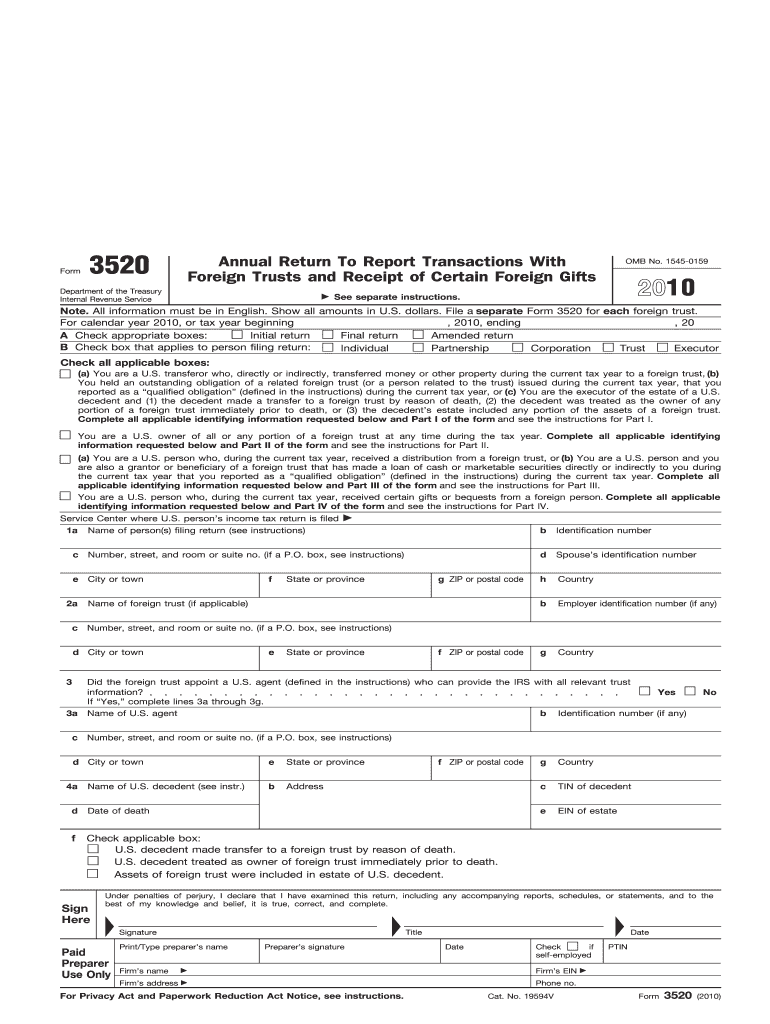
The 2010 IRS Form 3520 is an annual return used by U.S. persons to report certain transactions involving foreign trusts and the receipt of certain foreign gifts. This document is not a tax return but a report required by the Internal Revenue Service (IRS) to ensure compliance with U.S. tax reporting requirements. It is crucial for taxpayers to accurately report these interactions to avoid penalties and to remain compliant with U.S. laws regarding foreign financial interests.
Key Uses of Form 3520
- Reporting transfers to foreign trusts.
- Disclosing distributions received from foreign trusts.
- Listing all foreign gifts or bequests received exceeding specific thresholds set by the IRS.
How to Obtain the 2010 Form 3520
Obtaining the 2010 IRS Form 3520 is a straightforward process. The form can be downloaded directly from the IRS website in a PDF format.
Steps to Download
- Visit the IRS official website.
- Navigate to the "Forms and Instructions" section.
- Search for "Form 3520" using their database.
- Download the 2010 version to ensure you have the correct year's form.
Steps to Complete the 2010 Form 3520
Filling out the 2010 Form 3520 involves a series of detailed steps to ensure all parts of the form are completed accurately.
Detailed Steps
- Fill out Part I: General information including your name, taxpayer identification number (TIN), and address.
- Complete Part II: Report transfers to foreign trusts, specifying the trust information, the value of the transfer, and relevant details.
- Work on Part III: For foreign trust distributions received, detail the nature and value of distributions.
- Address Part IV: Disclose foreign gifts or bequests received that are above the reporting threshold.
Common Mistakes to Avoid
- Failing to disclose all qualifying foreign transactions.
- Incorrectly calculating the value of foreign transactions or gifts.
- Omitting supplementary information required in the schedules attached.
Filing Deadlines and Important Dates
The deadline for submitting the 2010 Form 3520 aligns with the tax filing deadlines for the applicable tax year, typically April 15. However, extensions can be filed along with requests for extensions on individual tax returns.
Adjustments and Extensions
- If an extension is granted for your tax return, the same extension typically applies to Form 3520.
- Always ensure to file for an extension if sufficient time to complete the form is not available, as missing deadlines result in significant penalties.
Legal Implications and Penalties for Non-Compliance
Non-compliance with Form 3520 reporting requirements can lead to severe penalties. Accurate filing of this form is critical to avoid fines and legal consequences.
Key Penalties
- Initial penalties can be up to 35% of the gross reportable amount related to the transaction.
- Additional consequences include increased scrutiny by the IRS in subsequent fiscal periods.
IRS Guidelines for Completing Form 3520
The IRS provides comprehensive guidelines and instructions for completing Form 3520, ensuring that filers understand all requirements.
Accessing Guidance
- Detailed instructions accompany the form on the IRS's website.
- Tax professionals often refer to the IRS's published guidelines to assist taxpayers in accurately filling out the form.
Who Typically Uses the 2010 Form 3520
This form is principally utilized by U.S. persons—including citizens, resident aliens, and domestic entities—engaged in certain transactions with foreign entities.

Distinctive User Groups
- Individuals who have created or funded a foreign trust.
- Recipients of funds or property from foreign trusts.
- Beneficiaries of significant foreign gifts or bequests.
Digital vs. Paper Version of Form 3520
Submitting Form 3520 can be done either electronically or via paper submission, depending on the personal preference or resources available to the individual.
Differences and Considerations
- Digital Submission: Offers quicker processing times and immediate confirmation of receipt.
- Paper Submission: Preferred by those who maintain physical records or have limited access to digital tools.
Compatibility Considerations
Ensure compatibility with various software like PDF readers when choosing to complete the form digitally.




