




01. Edit your form online
Type text, add images, blackout confidential details, add comments, highlights and more.

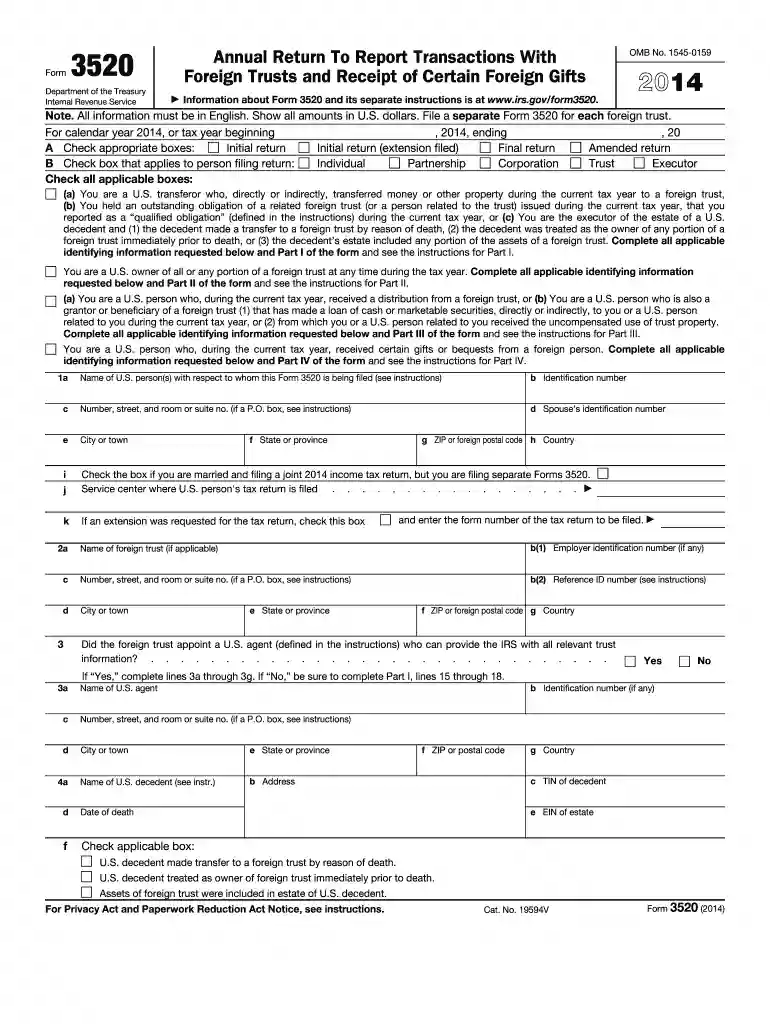
Type text, add images, blackout confidential details, add comments, highlights and more.

Draw your signature, type it, upload its image, or use your mobile device as a signature pad.

Send it via email, link, or fax. You can also download it, export it or print it out.
Form 3520 is a report required by the IRS for U.S. persons who engage in certain financial transactions with foreign entities. Specifically, the form is used to report transactions with foreign trusts, including transfers to and distributions from these trusts, as well as the receipt of large gifts or bequests from foreign persons. Understanding its purpose is essential for U.S. taxpayers who have foreign financial interests to ensure proper compliance with IRS regulations.
When filing Form 3520, all sections must be completed accurately, showcasing transactions in U.S. currency. Even minor misreporting can lead to significant consequences, making thorough understanding indispensable.
Form 3520 consists of several parts designed for reporting different types of transactions:
Form 3520 should generally be filed by the 15th day of the fourth month following the end of the U.S. person's tax year, typically April 15 for individuals. Extensions align with tax return extensions, but this must be requested explicitly.
Failing to comply with Form 3520 requirements carries strict penalties. The following are key repercussions:
Ensure digital accessibility if downloading online, ensuring that all needed software to open PDF documents, like Adobe Reader, is available.
Complete disclosure is required on the form, with emphasis on:
All submitted information is safeguarded by IRS confidentiality rules, ensuring disclosed data is only used for tax compliance and legal purposes.
We've got more versions of the 2014 form 3520 form. Select the right 2014 form 3520 version from the list and start editing it straight away!
| Versions | Form popularity | Fillable & printable |
|---|---|---|
| 2023 | 4.9 Satisfied (32 Votes) | |
| 2022 | 4.5 Satisfied (49 Votes) | |
| 2021 | 4.8 Satisfied (105 Votes) | |
| 2020 | 4.3 Satisfied (48 Votes) | |
| 2019 | 4.3 Satisfied (101 Votes) | |
| 2018 | 4.3 Satisfied (103 Votes) | |
| 2017 | 4.2 Satisfied (63 Votes) | |
| 2016 | 4.4 Satisfied (595 Votes) | |
| 2015 | 4.1 Satisfied (31 Votes) | |
| 2014 | 4 Satisfied (28 Votes) | |
| 2013 | 4 Satisfied (27 Votes) | |
| 2012 | 3.8 Satisfied (41 Votes) | |
| 2010 | 4 Satisfied (39 Votes) |
At DocHub, your data security is our priority. We follow HIPAA, SOC2, GDPR, and other standards, so you can work on your documents with confidence.
(iii) The Form 8938 filed by the specified person for the taxable year reports the filing of the Form 3520 and Form 3520-A. 12, 2014]. CFR Toolbox. LawRead more
All information must be in English. Show all amounts in U.S. dollars. File a separate Form 3520 for each foreign trust. For calendar year 2014, or tax yearRead more
Mar 18, 2021 Title of each class. Trading Symbol. Name of each exchange on which registered. Common Stock, par value $0.10 per share.Read more


