




01. Edit your form 3520 example online
Type text, add images, blackout confidential details, add comments, highlights and more.

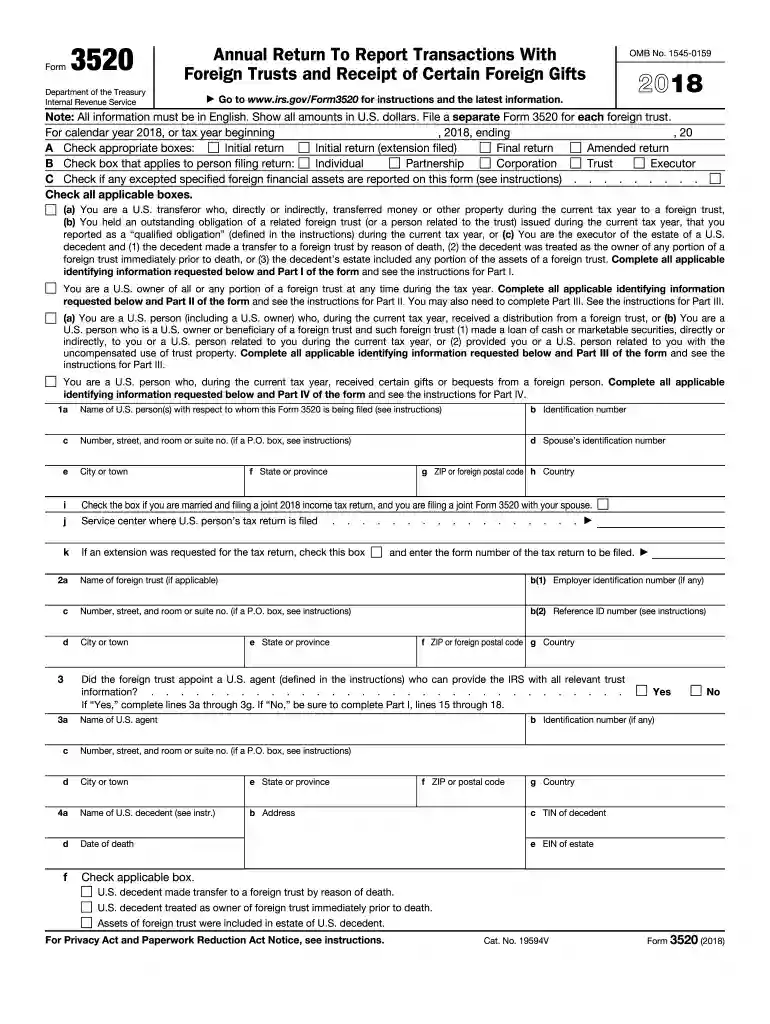
Type text, add images, blackout confidential details, add comments, highlights and more.

Draw your signature, type it, upload its image, or use your mobile device as a signature pad.

Send form 3520 part iv example via email, link, or fax. You can also download it, export it or print it out.
IRS Form 3520 is an essential document required by the Internal Revenue Service for U.S. persons to report certain transactions involving foreign trusts and the receipt of foreign gifts. The primary aim of this form is to ensure transparency in disclosing financial activities that have international ramifications. It includes sections for reporting transfers to foreign trusts, distributions from these trusts, and receipts of substantial gifts or bequests from non-U.S. persons. This comprehensive approach assists the IRS in monitoring compliance with U.S. tax regulations and in identifying any potential tax liabilities associated with such transactions.
The form is structured into several critical parts that capture detailed information about the involved transactions and entities. These parts include:
Each section requires precise details, such as the identity of the trust, the nature of the gift, and any financial implications. It is crucial for individuals to accurately fill out each part to avoid misunderstandings or penalties.
Completing IRS Form 3520 involves meticulous attention to detail and adherence to IRS guidelines. Here's a step-by-step process:
Each step should be executed carefully to ensure compliance and to accurately represent all relevant financial transactions.
For individuals, IRS Form 3520 is typically due on the same day as the income tax return, including extensions. Here are some critical deadlines:
Meeting these deadlines is crucial to avoid substantial penalties, which the IRS imposes for delayed submissions.
Non-compliance with Form 3520 can lead to punitive measures. Failure to file or submitting incorrect information can result in the following penalties:
Understanding and avoiding these financial penalties necessitate complete adherence to filing requirements.
Typically, this form is used by:
These groups need to report transactions that exceed specified thresholds to stay compliant with IRS stipulations.
Consider a U.S. individual who establishes a trust in another country. This individual must report the transfer of assets using Form 3520. Alternatively, if a U.S. resident receives a substantial sum as a gift from a foreigner, this must also be reported on Form 3520 to comply with U.S. tax law.
Filing IRS Form 3520 requires a collection of supporting documents, including:
Accurate and thorough documentation ensures that all aspects of the form are supported and verifiable.
Adhering to IRS guidelines is essential for the proper completion of Form 3520. Essential guidelines include:
These guidelines ensure that all reporting is in line with federal requirements, helping individuals and entities maintain good standing with the IRS.
We've got more versions of the form 3520 example form. Select the right form 3520 example version from the list and start editing it straight away!
| Versions | Form popularity | Fillable & printable |
|---|---|---|
| 2023 | 4.9 Satisfied (32 Votes) | |
| 2022 | 4.5 Satisfied (49 Votes) | |
| 2021 | 4.8 Satisfied (105 Votes) | |
| 2020 | 4.3 Satisfied (48 Votes) | |
| 2019 | 4.3 Satisfied (101 Votes) | |
| 2018 | 4.3 Satisfied (103 Votes) | |
| 2017 | 4.2 Satisfied (63 Votes) | |
| 2016 | 4.4 Satisfied (595 Votes) | |
| 2015 | 4.1 Satisfied (31 Votes) | |
| 2014 | 4 Satisfied (28 Votes) | |
| 2013 | 4 Satisfied (27 Votes) | |
| 2012 | 3.8 Satisfied (41 Votes) | |
| 2010 | 4 Satisfied (39 Votes) |
At DocHub, your data security is our priority. We follow HIPAA, SOC2, GDPR, and other standards, so you can work on your documents with confidence.
Jan 23, 2026 U.S. persons (and executors of estates of U.S. decedents) file Form 3520 to report: Certain transactions with foreign trusts.Read more
Mar 18, 2021 Title of each class. Trading Symbol. Name of each exchange on which registered. Common Stock, par value $0.10 per share.Read more
Attach an explanation of the facts and law (including the section of the Internal Revenue Code) that establishes that the foreign trust (or portion of theRead more


