




01. Edit your tax form 2014 online
Type text, add images, blackout confidential details, add comments, highlights and more.

Type text, add images, blackout confidential details, add comments, highlights and more.

Draw your signature, type it, upload its image, or use your mobile device as a signature pad.

Send 2014 estimated tax via email, link, or fax. You can also download it, export it or print it out.
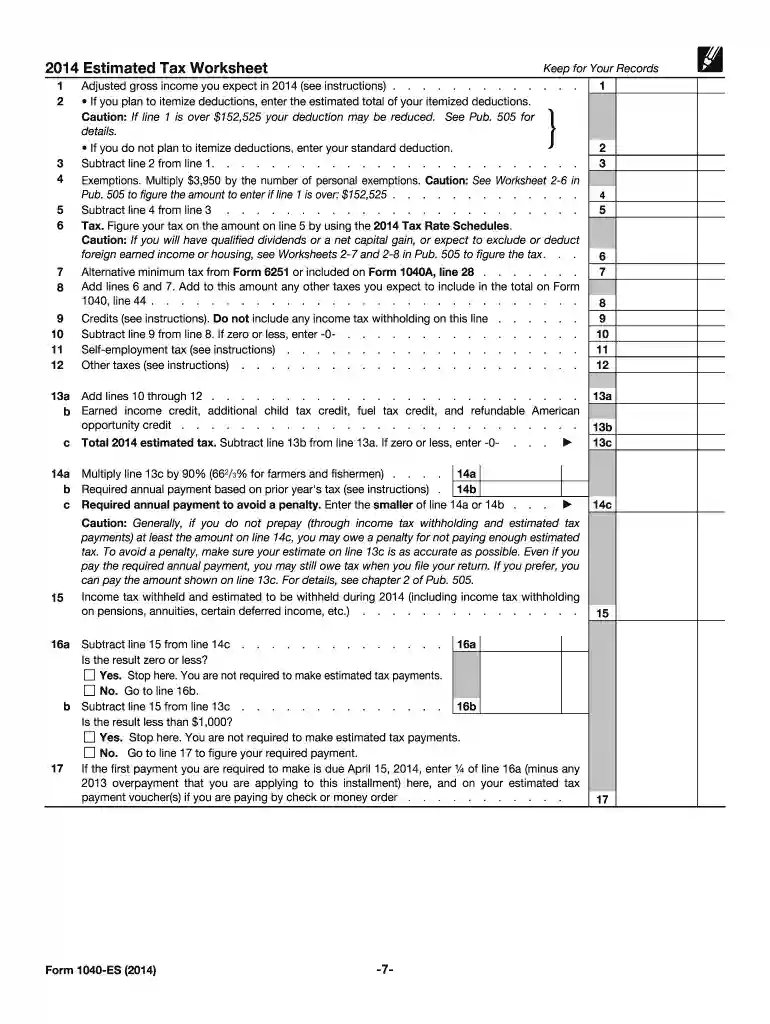
Form 1040-ES for the year 2014 is an estimated tax payment form used by individuals in the United States to report and pay their quarterly estimated taxes. It is primarily used by those who do not have their tax withheld automatically by an employer, such as self-employed individuals, retirees, or those with significant non-wage income.
Using the 2014 version of Form 1040-ES involves several steps, ensuring correct estimation and timely payment of taxes.
Getting a copy of the 1040-ES form for 2014 is a straightforward process.
To accurately fill out Form 1040-ES 2014, follow these critical steps:
Form 1040-ES 2014 is geared towards individuals and entities who need to make quarterly tax payments due to non-wage income.


The IRS provides specific guidelines for the use of Form 1040-ES 2014 to ensure compliant submission and payment processes.
It is crucial to adhere to the deadlines associated with filing Form 1040-ES to avoid penalties.
Before completing the form, gather all relevant documents to support your estimated tax calculations.
By comprehensively understanding, preparing, and filing the 2014 Form 1040-ES through these steps and requirements, taxpayers can better manage their obligations, remain compliant with IRS regulations, and avoid potential complications related to underpayment of estimated taxes.
We've got more versions of the tax form 2014 form. Select the right tax form 2014 version from the list and start editing it straight away!
| Versions | Form popularity | Fillable & printable |
|---|---|---|
| 2024 | 4.4 Satisfied (57 Votes) | |
| 2023 | 4.9 Satisfied (33 Votes) | |
| 2022 | 4.6 Satisfied (20 Votes) | |
| 2021 | 4.8 Satisfied (206 Votes) | |
| 2020 | 4.3 Satisfied (178 Votes) | |
| 2019 | 4.2 Satisfied (113 Votes) | |
| 2018 | 4.3 Satisfied (87 Votes) | |
| 2017 | 4.4 Satisfied (1245 Votes) | |
| 2016 | 4.4 Satisfied (70 Votes) | |
| 2015 | 4.1 Satisfied (40 Votes) | |
| 2014 | 4.1 Satisfied (35 Votes) | |
| 2013 | 4.1 Satisfied (54 Votes) | |
| 2012 | 4.4 Satisfied (68 Votes) | |
| 2011 | 4.3 Satisfied (40 Votes) | |
| 2010 | 4 Satisfied (39 Votes) |
At DocHub, your data security is our priority. We follow HIPAA, SOC2, GDPR, and other standards, so you can work on your documents with confidence.
Feb 8, 2018 If you file Form 1040, to lower your taxable income you generally can claim the standard deduction or itemize your deductions, such as medicalRead more
Jan 29, 2014 Use Form 1040-ES to figure and pay your estimated tax for 2014. Estimated tax is the method used to pay tax on income that is not subject toRead more


