




01. Edit your 2013 form online
Type text, add images, blackout confidential details, add comments, highlights and more.

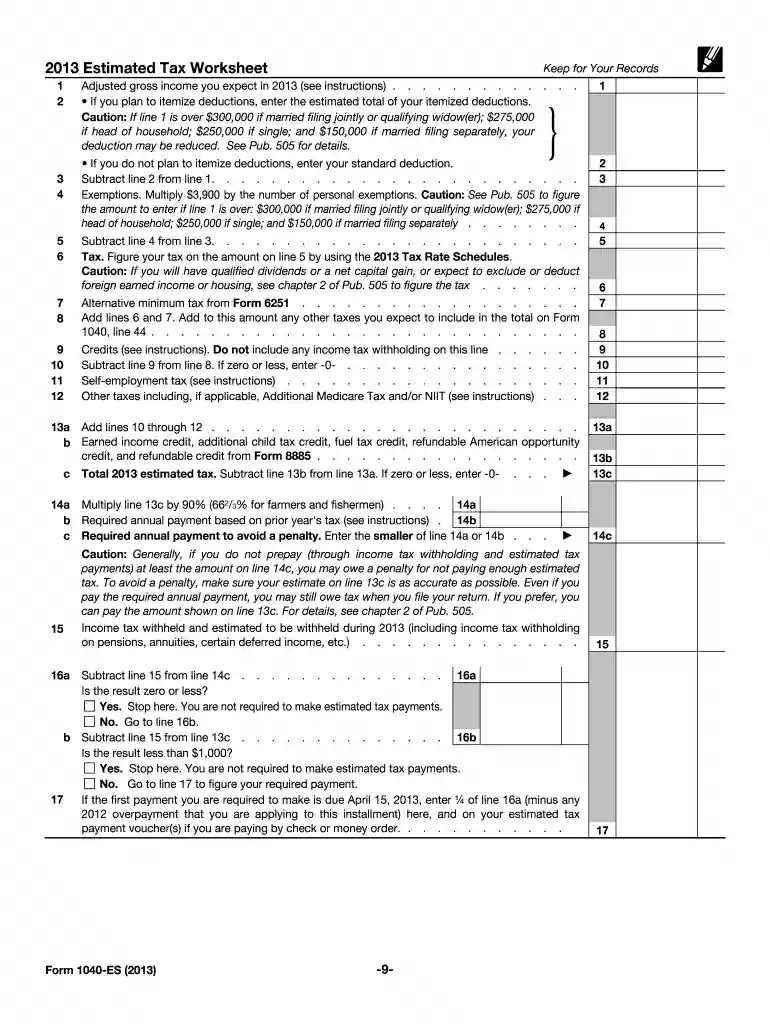
Type text, add images, blackout confidential details, add comments, highlights and more.

Draw your signature, type it, upload its image, or use your mobile device as a signature pad.

Send it via email, link, or fax. You can also download it, export it or print it out.
The 2013 Form 1040-ES is an essential tax document issued by the Internal Revenue Service (IRS). It is used by individuals in the United States to calculate and make estimated tax payments. This form is especially important for those whose income isn't subject to withholding tax, such as self-employed individuals, retirees, and certain investors. The 2013 version of this form reflects the tax laws and requirements specific to that tax year, aiding taxpayers in complying with federal tax obligations.
Using the 2013 Form 1040-ES involves calculating your expected income and determining the amount of tax you are required to pay throughout the year. It requires an estimation of income, deductions, and credits. Taxpayers must:
Make payments quarterly by the specified deadlines to avoid penalties for underpayment. The IRS provides detailed instructions accompanying the form, making it easier for taxpayers to understand the necessary calculations.
Completing the 2013 Form 1040-ES is a step-by-step process:
The IRS provides specific guidelines for those using the 2013 Form 1040-ES. These include details about who must pay estimated taxes and special considerations for certain taxpayers. For instance:
Instructions also outline how to amend estimates if financial circumstances change during the tax year.
The 2013 Form 1040-ES has specific quarterly payment due dates:
These dates are critical as late payments can result in penalties. The IRS may offer exceptions under certain circumstances, but adherence to these deadlines is generally required to avoid penalties.
Before filling out the 2013 Form 1040-ES, gather the necessary financial documents, such as:
Accurate and thorough documentation helps ensure correct computation of estimated tax liabilities.
Failure to comply with the 2013 Form 1040-ES filing requirements can lead to penalties. Common penalties include:
However, the IRS may waive penalties for reasonable causes or if certain circumstances apply.
Several scenarios illustrate the use and importance of the form:
By understanding these practical applications, taxpayers can better manage their tax responsibilities using the 2013 Form 1040-ES.
We've got more versions of the 2013 form form. Select the right 2013 form version from the list and start editing it straight away!
| Versions | Form popularity | Fillable & printable |
|---|---|---|
| 2024 | 4.4 Satisfied (57 Votes) | |
| 2023 | 4.9 Satisfied (33 Votes) | |
| 2022 | 4.6 Satisfied (20 Votes) | |
| 2021 | 4.8 Satisfied (206 Votes) | |
| 2020 | 4.3 Satisfied (178 Votes) | |
| 2019 | 4.2 Satisfied (113 Votes) | |
| 2018 | 4.3 Satisfied (87 Votes) | |
| 2017 | 4.4 Satisfied (1245 Votes) | |
| 2016 | 4.4 Satisfied (70 Votes) | |
| 2015 | 4.1 Satisfied (40 Votes) | |
| 2014 | 4.1 Satisfied (35 Votes) | |
| 2013 | 4.1 Satisfied (54 Votes) | |
| 2012 | 4.4 Satisfied (68 Votes) | |
| 2011 | 4.3 Satisfied (40 Votes) | |
| 2010 | 4 Satisfied (39 Votes) |
At DocHub, your data security is our priority. We follow HIPAA, SOC2, GDPR, and other standards, so you can work on your documents with confidence.
Form 1040A (2013). Page 2. Tax, credits, and payments. 22. Enter the amount from Firms name ▷. Firms address ▷. Firms EIN ▷. Phone no. Form 1040A (2013)Read more
Retirees, former employees and others must use form UBEN 117 (Designation of BeneficiaryRetirees, Former. Employees and Others) to name UCRP beneficiaries.Read more
Attach this form and a copy of federal Form 4562 to your New York State corporation franchise tax return.Read more


