




01. Edit your 2019 form online
Type text, add images, blackout confidential details, add comments, highlights and more.

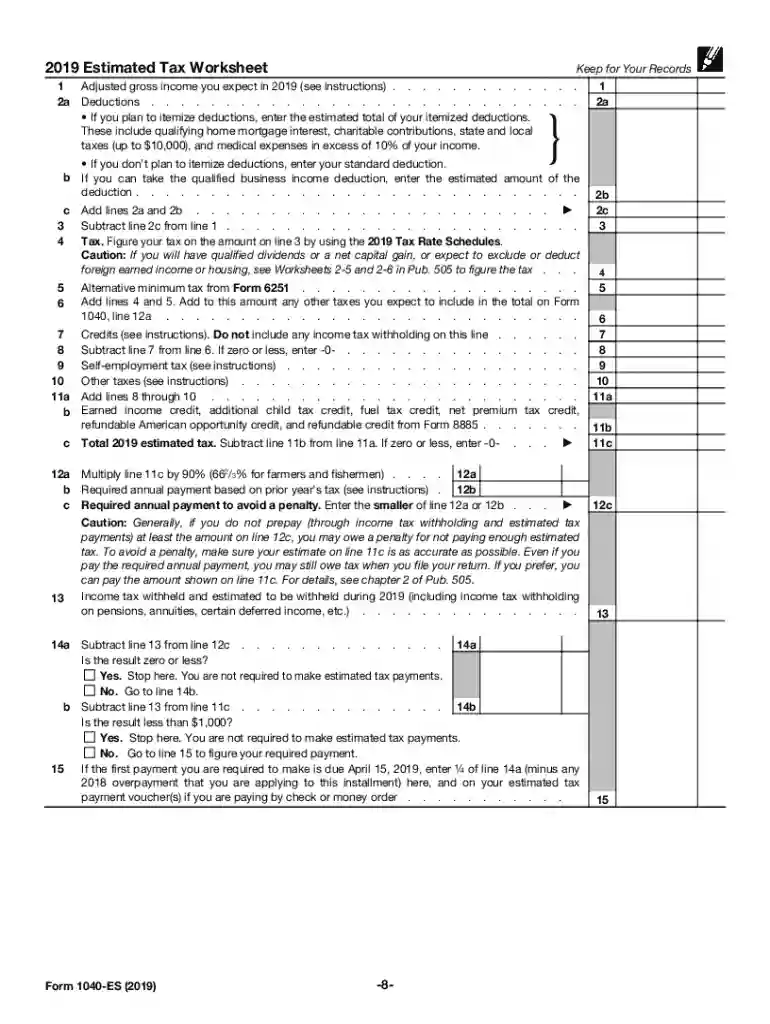
Type text, add images, blackout confidential details, add comments, highlights and more.

Draw your signature, type it, upload its image, or use your mobile device as a signature pad.

Send 1099 form 2019 via email, link, or fax. You can also download it, export it or print it out.
The 1040-ES form for 2018 is an IRS tax document used by individuals to estimate their tax payments for the year. This form is particularly essential for self-employed individuals or those not subject to withholding taxes, such as retirees and investors. The primary purpose of the 1040-ES is to help taxpayers calculate quarterly estimated tax payments to avoid any underpayment penalties. Estimated taxes cover not only income tax but also self-employment tax and alternative minimum tax. Precise calculations on this form help ensure that individuals pay enough tax throughout the year, minimizing any end-of-year surprises.
Using the 1040-ES form requires understanding expected income, deductions, and credits for the year. Begin by completing the included worksheet that helps determine estimated tax liability. It’s crucial to have your previous year’s tax return handy for reference. Once calculations for the total estimated tax for the year are done, divide this by four to find the quarterly payment amount. The 1040-ES package includes payment vouchers for sending in these payments. For those with fluctuating income, such as seasonal workers, it may be beneficial to calculate estimates each quarter to adjust payments accordingly.
Completing the 1040-ES requires careful attention to detail to ensure each part is filled correctly.
This form is often used by:


Understanding IRS guidelines helps ensure compliance and avoid penalties.
Failure to make necessary estimated tax payments can result in penalties. The IRS imposes underpayment penalties when taxpayers do not pay enough taxes due through withholding and timely estimated tax payments. Penalties are calculated based on the difference between owed tax and timely payments. Taxpayers may fill out IRS Form 2210 to explain payment shortfalls due to unequal income receival throughout the year, potentially mitigating penalties.
Compatible software options streamline the tax filing process for the 1040-ES form.
The need for the 1040-ES form varies based on taxpayer circumstances.

We've got more versions of the 2019 form form. Select the right 2019 form version from the list and start editing it straight away!
| Versions | Form popularity | Fillable & printable |
|---|---|---|
| 2024 | 4.4 Satisfied (57 Votes) | |
| 2023 | 4.9 Satisfied (33 Votes) | |
| 2022 | 4.6 Satisfied (20 Votes) | |
| 2021 | 4.8 Satisfied (206 Votes) | |
| 2020 | 4.3 Satisfied (178 Votes) | |
| 2019 | 4.2 Satisfied (113 Votes) | |
| 2018 | 4.3 Satisfied (87 Votes) | |
| 2017 | 4.4 Satisfied (1245 Votes) | |
| 2016 | 4.4 Satisfied (70 Votes) | |
| 2015 | 4.1 Satisfied (40 Votes) | |
| 2014 | 4.1 Satisfied (35 Votes) | |
| 2013 | 4.1 Satisfied (54 Votes) | |
| 2012 | 4.4 Satisfied (68 Votes) | |
| 2011 | 4.3 Satisfied (40 Votes) | |
| 2010 | 4 Satisfied (39 Votes) |
At DocHub, your data security is our priority. We follow HIPAA, SOC2, GDPR, and other standards, so you can work on your documents with confidence.


Feb 28, 2018 1. You expect to owe at least $1,000 in tax for 2018, after subtracting your withholding and refundable credits.
Jan 6, 2017 Pay all of your estimated tax by January 16, 2018. File your 2017 Form 1040 by March 1, 2018, and pay the total tax due. In this case, 2017Read more


