




01. Edit your form online
Type text, add images, blackout confidential details, add comments, highlights and more.

Type text, add images, blackout confidential details, add comments, highlights and more.

Draw your signature, type it, upload its image, or use your mobile device as a signature pad.

Send it via email, link, or fax. You can also download it, export it or print it out.
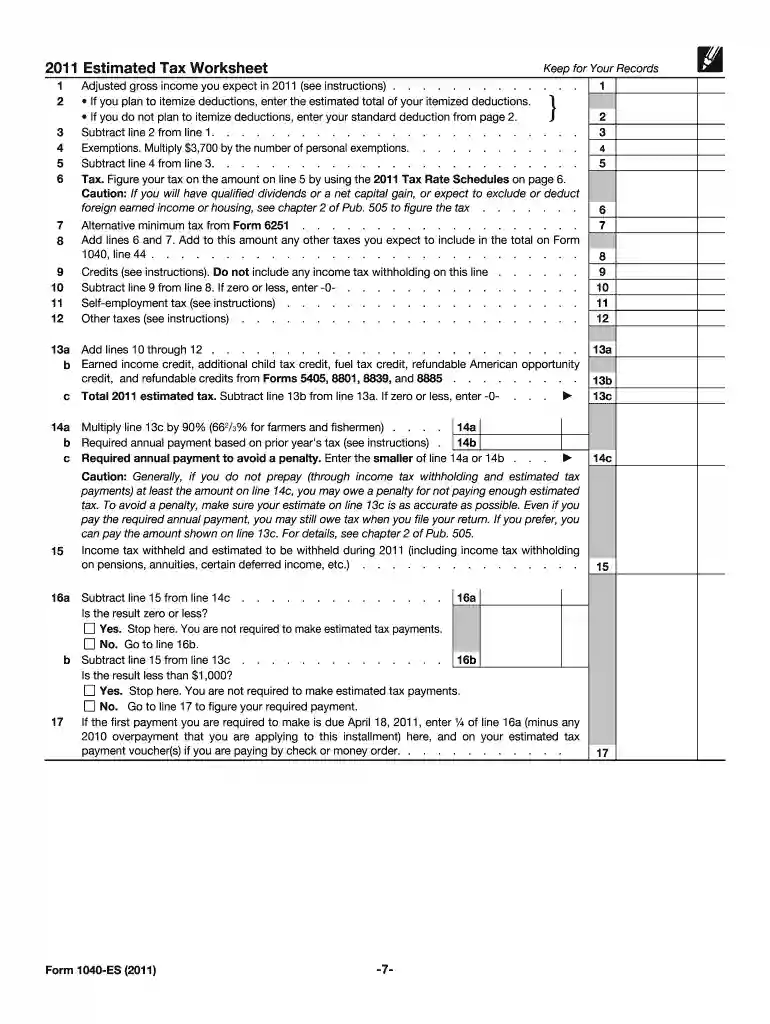
The 2011 Form 1040-ES is an estimation form provided by the Internal Revenue Service (IRS) that assists individuals in calculating and paying their federal estimated taxes for the year 2011. This form is particularly crucial for those whose earnings are not subject to withholding taxes. It applies to self-employed individuals, retirees, investors, and others who receive income from dividends, interest, alimony, rent, or gains from the sale of assets. The online version of the 2011 Form 1040-ES offers a streamlined approach for users to complete their tax obligations efficiently.
Using the 2011 Form 1040-ES online offers several advantages, including ease of access and increased efficiency. Taxpayers can conveniently calculate their quarterly estimated taxes without needing to print out and manually fill in forms. The online platform ensures that calculations are accurate and minimizes errors often associated with manual entries. Furthermore, the online submission of the form speeds up the filing process, ensuring that payments are received promptly by the IRS, thereby avoiding potential penalties.
Ensure that you are accessing the form from a legitimate source, particularly when using third-party platforms. Verification prevents issues related to data security and ensures compliance with IRS guidelines.
To accurately complete the 2011 Form 1040-ES, gather the following documents:
The IRS mandates quarterly payments for estimated taxes. For the 2011 tax year, the deadlines were typically set for April 15, June 15, September 15, and January 15 of the following year. Timely submission is crucial to avoid penalties and interest charges. These deadlines remain consistent in most tax years, providing a reliable schedule for taxpayers to follow.
Failure to submit the estimated tax payments on time may result in penalties. The IRS imposes interest on any unpaid taxes, which can accumulate quickly if left unresolved. Therefore, it is vital for taxpayers to adhere to the suggested guidelines and deadlines.
Each category of user benefits from accurately estimating their taxes using this form to ensure compliance and financial planning.


Certain states may have their own versions or requirements for estimated tax payments independent of the IRS's standards. It is important for taxpayers to check their state's tax department for specific rules or forms that complement the federal requirements. This ensures comprehensive tax compliance and helps in accurate financial forecasting.
We've got more versions of the 2011 form online form. Select the right 2011 form online version from the list and start editing it straight away!
| Versions | Form popularity | Fillable & printable |
|---|---|---|
| 2024 | 4.4 Satisfied (57 Votes) | |
| 2023 | 4.9 Satisfied (33 Votes) | |
| 2022 | 4.6 Satisfied (20 Votes) | |
| 2021 | 4.8 Satisfied (206 Votes) | |
| 2020 | 4.3 Satisfied (178 Votes) | |
| 2019 | 4.2 Satisfied (113 Votes) | |
| 2018 | 4.3 Satisfied (87 Votes) | |
| 2017 | 4.4 Satisfied (1245 Votes) | |
| 2016 | 4.4 Satisfied (70 Votes) | |
| 2015 | 4.1 Satisfied (40 Votes) | |
| 2014 | 4.1 Satisfied (35 Votes) | |
| 2013 | 4.1 Satisfied (54 Votes) | |
| 2012 | 4.4 Satisfied (68 Votes) | |
| 2011 | 4.3 Satisfied (40 Votes) | |
| 2010 | 4 Satisfied (39 Votes) |
At DocHub, your data security is our priority. We follow HIPAA, SOC2, GDPR, and other standards, so you can work on your documents with confidence.
Attach Form(s). W-2 here. Also attach Forms. W-2G and. 1099-R if tax was withheld. If you didRead more
Online Request: 1. Go to the IRS website at 2. Fill in tax filers SSN, date of birth, street address and zip code.
During FY 2011, the IRS updated forms to help taxpayers comply with filing requirements, converted forms for visually impaired taxpayers, translated moreRead more


