




01. Edit your 2016 form online
Type text, add images, blackout confidential details, add comments, highlights and more.

Type text, add images, blackout confidential details, add comments, highlights and more.

Draw your signature, type it, upload its image, or use your mobile device as a signature pad.

Send 1040es via email, link, or fax. You can also download it, export it or print it out.
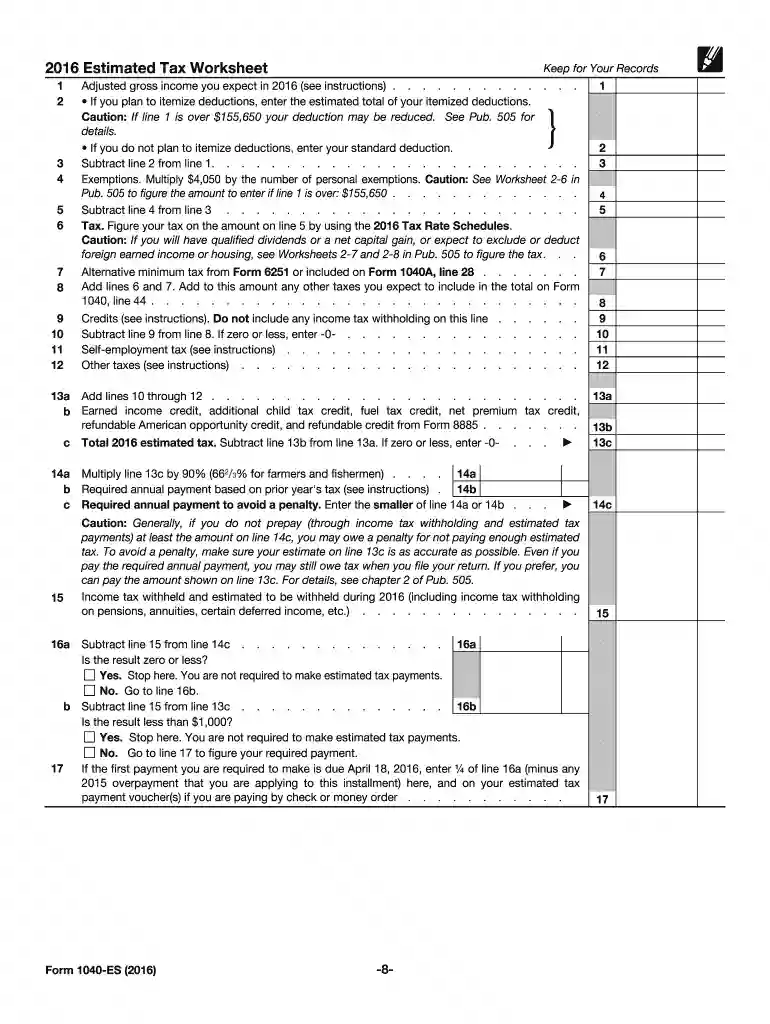
The 2016 Form 1040-ES, also known as Estimated Tax for Individuals, is a critical document for taxpayers who need to prepay a portion of their annual tax liabilities. It is primarily used by individuals whose income is not subject to automatic tax withholding, such as self-employed workers or investors. The form provides a structured approach to calculating quarterly estimated tax payments based on expected annual income, deductions, and credits. Its main goal is to prevent taxpayers from owing a large sum when annual taxes are due by ensuring that they pay the correct amount throughout the year. The form includes detailed instructions on how to calculate these payments, covering various income scenarios and applicable tax regulations.
Using the 2016 Form 1040-ES is essential for taxpayers who earn a significant portion of their income from sources where taxes are not withheld automatically. It allows individuals to comply with IRS requirements by making four estimated payments a year, reducing the possibility of penalties for underpayment. The form is particularly beneficial for:
Timely submission and accurate calculations using this form help avoid potential financial penalties and interest charges from the IRS.
Estimate Your Total Income for 2016:
Subtract Adjustments and Deductions:
Calculate Your Expected Tax Liability:
Factor in Tax Credits:
Determine Your Quarterly Payments:
The 2016 Form 1040-ES can be obtained from multiple sources, ensuring accessibility for all taxpayers. These sources include:
The 2016 Form 1040-ES includes several critical sections that guide taxpayers through the estimated tax process:
The IRS provides explicit guidelines to assist taxpayers in correctly completing and submitting their Form 1040-ES:
Meeting filing deadlines is crucial to avoiding penalties:
These deadlines ensure that estimated taxes are paid in a timely manner throughout the tax year.
Failing to submit estimated tax payments or underpaying can result in penalties:
By understanding and adhering to the guidelines, taxpayers can mitigate the risk of these financial penalties.
We've got more versions of the 2016 form form. Select the right 2016 form version from the list and start editing it straight away!
| Versions | Form popularity | Fillable & printable |
|---|---|---|
| 2024 | 4.4 Satisfied (57 Votes) | |
| 2023 | 4.9 Satisfied (33 Votes) | |
| 2022 | 4.6 Satisfied (20 Votes) | |
| 2021 | 4.8 Satisfied (206 Votes) | |
| 2020 | 4.3 Satisfied (178 Votes) | |
| 2019 | 4.2 Satisfied (113 Votes) | |
| 2018 | 4.3 Satisfied (87 Votes) | |
| 2017 | 4.4 Satisfied (1245 Votes) | |
| 2016 | 4.4 Satisfied (70 Votes) | |
| 2015 | 4.1 Satisfied (40 Votes) | |
| 2014 | 4.1 Satisfied (35 Votes) | |
| 2013 | 4.1 Satisfied (54 Votes) | |
| 2012 | 4.4 Satisfied (68 Votes) | |
| 2011 | 4.3 Satisfied (40 Votes) | |
| 2010 | 4 Satisfied (39 Votes) |
At DocHub, your data security is our priority. We follow HIPAA, SOC2, GDPR, and other standards, so you can work on your documents with confidence.
Jan 19, 2016 Use Form 1040-ES to figure and pay your estimated tax for 2016. Estimated tax is the method used to pay tax on income that is not subject toRead more
Jan 23, 2018 You must report your taxable disability payments as wages on line 7 of Form 1040 or Form. 1040A or on line 8 of Form 1040NR until you DocHub miniRead more
Complete the Ohio IT 1040 (checking the amended return box) and include this form with documentation to support any adjustments to line items on the return.Read more


