
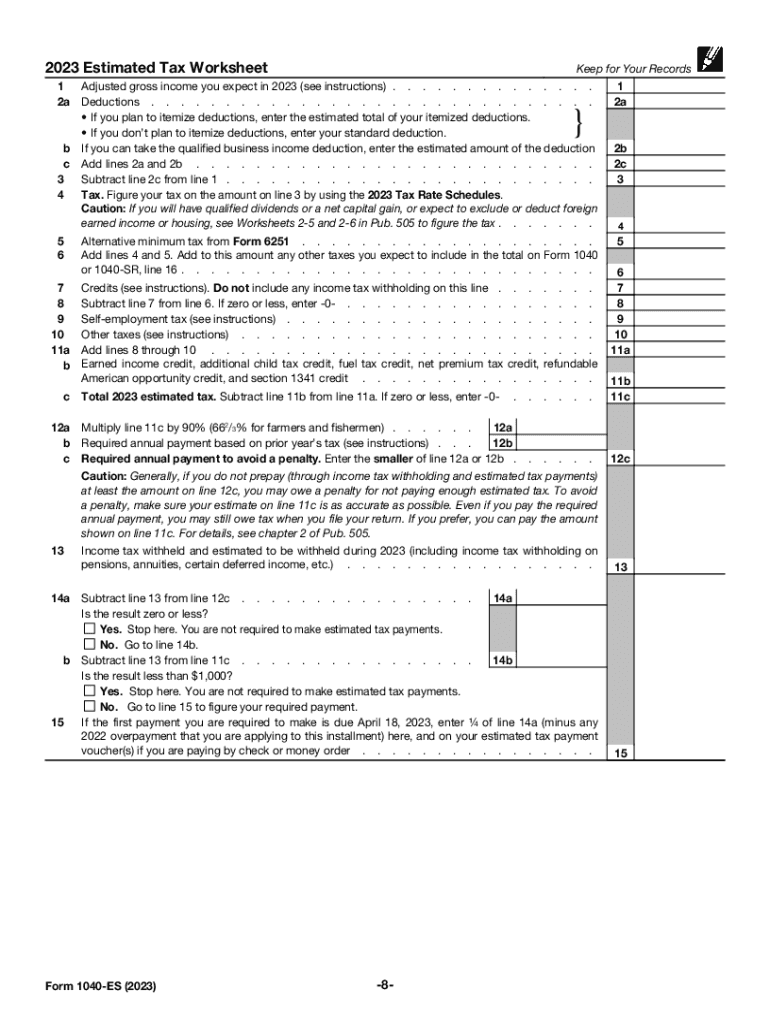







Definition and Purpose of 2023 Form 1040-ES
The 2023 Form 1040-ES is an essential tool provided by the Internal Revenue Service (IRS) for individuals required to make estimated tax payments throughout the year. This form is primarily designed for self-employed persons, retirees, landlords, and others whose income is not subject to tax withholding. By using Form 1040-ES, these taxpayers can determine their estimated tax liability, covering both income and self-employment taxes.
Key Features of Form 1040-ES:
- Estimated Tax Payments: Form 1040-ES helps calculate quarterly estimated tax payments to avoid underpayment penalties.
- Tax Calculation: Assists in computing taxes based on projected income, credits, and deductions.
- IRS Compliance: Ensures compliance with IRS requirements for those with income sources outside traditional employment.
How to Obtain the 2023 Form 1040-ES
Accessing the 2023 Form 1040-ES is straightforward. It is available for download on the IRS official website for free. Taxpayers can either print the form or fill it out digitally using compatible software.
Access Methods:
- IRS Website: The form and instructions can be directly downloaded from .
- Tax Software: Programs like TurboTax and QuickBooks often include this form within their systems.
- Physical Copies: Order via the IRS by phone if a paper version is preferred.
Steps to Complete the 2023 Form 1040-ES
Completing the 2023 Form 1040-ES involves several key steps to ensure accurate tax payment calculations:
- Estimate Total Income: Calculate expected revenue from all income sources for the year.
- Determine Deductions and Credits: Identify applicable deductions and credits that will reduce taxable income.
- Calculate Estimated Tax: Use the worksheet provided within the form to compute taxes based on income after deductions.
- Installment Payments: Divide the total estimated tax by four to determine quarterly payments.
- Submit Payments: Pay each installment by the due dates specified on the form to avoid penalties.
Example Calculation:
For a self-employed consultant anticipating $100,000 in annual income, after accounting for business expenses and applicable credits, they might owe approximately $20,000 in taxes. By using Form 1040-ES, they would plan to remit four payments of $5,000 each.
Who Typically Uses the 2023 Form 1040-ES
Form 1040-ES is most commonly used by individuals whose income is not subject to tax withholding. This includes:
- Self-Employed Individuals: Freelancers, consultants, and business owners who report income on a 1099 form.
- Retirees: Those receiving income from pensions, Social Security, or other non-tax-withheld sources.
- Investors: Individuals earning significant income from dividends, interest, and capital gains.
- Landlords: Property owners generating rental income.

Important Terms Related to Form 1040-ES
Understanding specific terminology is crucial for correctly completing the Form 1040-ES:
- Estimated Tax: The method used by taxpayers to pay tax on income that is not subject to withholding.
- Adjusted Gross Income (AGI): Total income minus specific deductions; a critical figure for tax calculations.
- Self-Employment Tax: Tax required on net earnings for self-employed individuals to fund Social Security and Medicare.
IRS Guidelines for Form 1040-ES
The IRS provides comprehensive guidelines for accurately using Form 1040-ES, offering clarity on:
- Payment Obligations: Determining whether estimated payments are necessary based on prior year liability and expected income.
- Penalty Avoidance: Making timely payments is emphasized to avoid penalties.
- Adjustment Seminars: Resources for adjusting payments if income changes significantly during the year.
Filing Deadlines and Important Dates
Managing deadlines is crucial for taxpayers utilizing Form 1040-ES to avoid penalties:
- Quarterly Deadlines: Generally, payments are due April 15, June 15, September 15, and January 15 of the following tax year.
- Tax Year Alignment: Align payments with the tax year to ensure compliance and avoid interest charges.
Penalties for Non-Compliance
Failure to accurately or timely fulfill estimated tax obligations can result in penalties, which could be a percentage of the underpaid amount. The IRS might also impose interest charges on unpaid taxes. Consistent assessment and payment adjustments can mitigate these risks and ensure financial compliance.
By understanding the intricacies of Form 1040-ES, taxpayers can manage their financial responsibilities effectively and ensure compliance with IRS requirements while avoiding unnecessary penalties.




