




01. Edit your estimated tax payments online
Type text, add images, blackout confidential details, add comments, highlights and more.

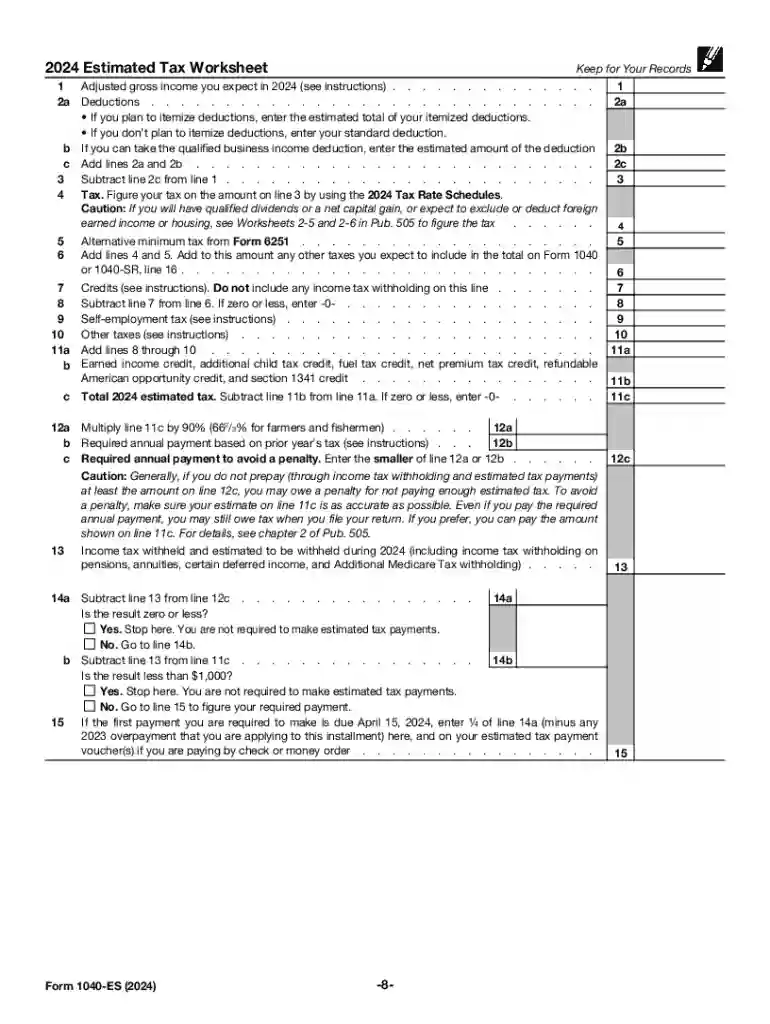
Type text, add images, blackout confidential details, add comments, highlights and more.

Draw your signature, type it, upload its image, or use your mobile device as a signature pad.

Send form 1040 es via email, link, or fax. You can also download it, export it or print it out.
Estimated tax payments refer to quarterly tax payments made by individuals or entities that don't have taxes withheld automatically from income. These payments typically apply to self-employed individuals, sole proprietors, partnerships, S-corporation shareholders, and others whose income isn't subject to withholding. The concept is designed to ensure that taxpayers who receive income outside of traditional salary structures still contribute to federal income taxes at appropriate intervals throughout the year.
The primary reason for making these payments is to comply with IRS regulations and avoid penalties for underpayment of taxes. If insufficient tax is withheld, or no tax is withheld from income such as investments, dividends, or rental income, estimated tax payments help cover the gap.
The IRS outlines specific guidelines in Form 1040-ES for calculating and submitting estimated tax payments. Taxpayers are expected to use this form to evaluate their expected income, deductions, credits, and taxes to determine their quarterly payment amounts.
Taxpayers should adhere to quarterly due dates set by the IRS to avoid penalties. Typically, the deadlines are April 15, June 15, September 15, and January 15 of the following year. If the 15th falls on a weekend or holiday, the due date may shift to the next business day.
Failing to make estimated tax payments can result in significant penalties. The IRS imposes penalties for underpayment, late payment, and non-payment of estimated taxes. These penalties can accrue over time, increasing taxpayer liabilities.
Various taxpayer scenarios necessitate consideration of estimated tax payments. For instance, a self-employed graphic designer or a retiree with significant investment income might need to make quarterly payments to align with IRS guidelines.


While federal guidelines govern estimated tax payments, state requirements can vary. Some states have their own estimated tax payment forms and processes. Taxpayers should consult state tax agencies to ensure full compliance.
Estimated tax payments can be filed electronically or via paper forms. Electronic filing is generally faster and more secure, offering immediate confirmation of receipt by the IRS.
We've got more versions of the estimated tax payments form. Select the right estimated tax payments version from the list and start editing it straight away!
| Versions | Form popularity | Fillable & printable |
|---|---|---|
| 2024 | 4.4 Satisfied (57 Votes) | |
| 2023 | 4.9 Satisfied (33 Votes) | |
| 2022 | 4.6 Satisfied (20 Votes) | |
| 2021 | 4.8 Satisfied (206 Votes) | |
| 2020 | 4.3 Satisfied (178 Votes) | |
| 2019 | 4.2 Satisfied (113 Votes) | |
| 2018 | 4.3 Satisfied (87 Votes) | |
| 2017 | 4.4 Satisfied (1245 Votes) | |
| 2016 | 4.4 Satisfied (70 Votes) | |
| 2015 | 4.1 Satisfied (40 Votes) | |
| 2014 | 4.1 Satisfied (35 Votes) | |
| 2013 | 4.1 Satisfied (54 Votes) | |
| 2012 | 4.4 Satisfied (68 Votes) | |
| 2011 | 4.3 Satisfied (40 Votes) | |
| 2010 | 4 Satisfied (39 Votes) |
At DocHub, your data security is our priority. We follow HIPAA, SOC2, GDPR, and other standards, so you can work on your documents with confidence.
To calculate your federal quarterly estimated tax payments, you must estimate your adjusted gross income, taxable income, taxes, deductions, and credits
Jun 28, 2026 Estimated tax is used to pay not only income tax, but other taxes such as self-employment tax and alternative minimum tax. If you dont payRead more


