




01. Edit your 2013 form 990 ez online
Type text, add images, blackout confidential details, add comments, highlights and more.

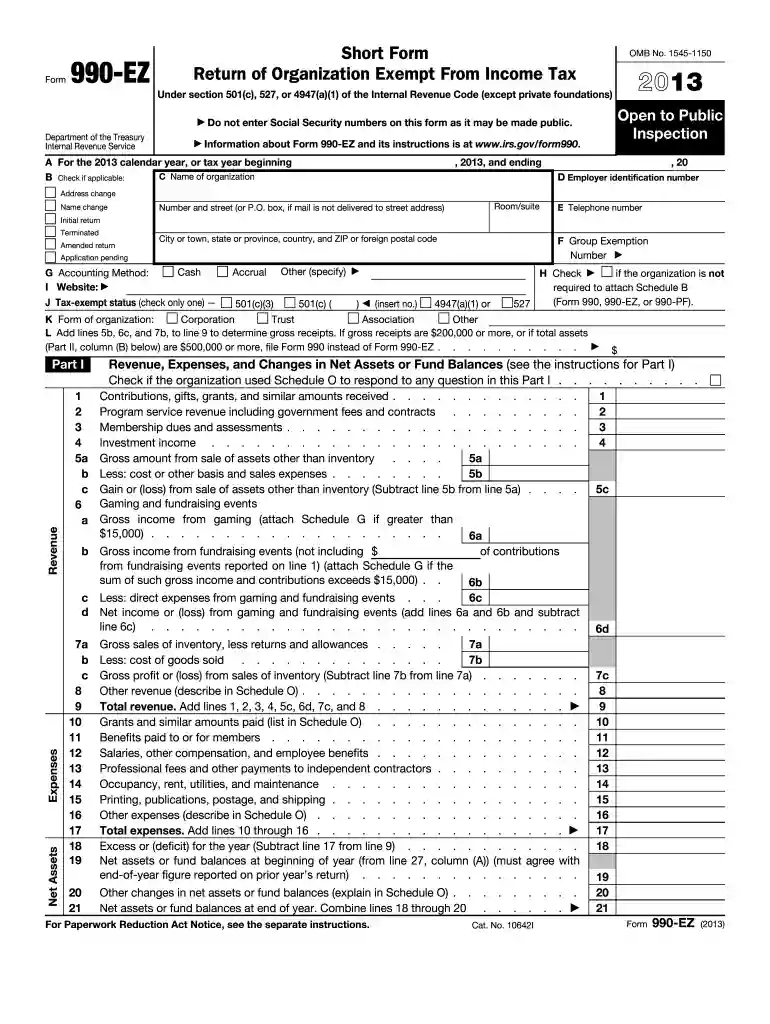
Type text, add images, blackout confidential details, add comments, highlights and more.

Draw your signature, type it, upload its image, or use your mobile device as a signature pad.

Send form 990 ez 2013 via email, link, or fax. You can also download it, export it or print it out.
The "EZ 2013 IRS form" typically refers to Form 1040-EZ, a simplified version of the standard federal income tax return form used in previous years. It was designed for taxpayers with straightforward tax situations. The form was used to report basic income, claim certain credits, and calculate owed taxes for the year 2013. This form was ideal for individuals with no dependents, simple taxable income, and those who did not itemize deductions. By offering a streamlined process, Form 1040-EZ reduced the complexity and time required for eligible taxpayers to file their federal taxes.
Determine Eligibility: Ensure you meet all requirements to use Form 1040-EZ. Key criteria include earning less than $100,000 annually, interest income of $1,500 or less, and filing as single or married filing jointly.
Collect Necessary Information: Gather your W-2 forms, interest statements, and any relevant tax documents.
Fill Out Personal Information: Provide your name, Social Security number, and filing status at the top of the form.
Enter Income Details: Input your total income, including wages, salaries, and taxable interest, in the appropriate sections.
Calculate Taxable Income: Subtract the standard deduction and personal exemption from your total income to arrive at your taxable income.
Determine Tax Liability: Use the accompanying tax tables to figure out your federal tax liability.
Input Credits and Payments: Include any eligible credits and payments you've made throughout the year.
Calculate Refund or Amount Owed: The difference between your tax liability and payments plus credits will determine if you receive a refund or owe additional taxes.
The Form 1040-EZ was primarily used by:
This form was particularly beneficial for individuals who fit these criteria, offering them an uncomplicated tax filing solution.


Start with Basic Information: Fill in your basic details, including names and Social Security numbers.
Record Income:
Apply the Standard Deduction and Exemption:
Calculate Taxes Owed:
Account for Tax Credits:
Finalize the Return:
Sign the Form: Ensure both you and your spouse (if filing jointly) sign the completed form before submission.
Submit the Form: Choose the appropriate submission method, either by mail or electronically.
Understanding these terms helps in accurately filling out the EZ 2013 form and ensuring compliance with tax regulations.
These examples illustrate the form's utility for diverse taxpayer profiles.
Understanding these dates ensures timely and accurate submission, avoiding penalties.
Knowledge of these elements is vital for preparing a precise tax return using the EZ form.
Each method has specific benefits depending on the taxpayer's preference for convenience or confirmation of receipt.
We've got more versions of the 2013 form 990 ez form. Select the right 2013 form 990 ez version from the list and start editing it straight away!
| Versions | Form popularity | Fillable & printable |
|---|---|---|
| 2024 | 4.2 Satisfied (38 Votes) | |
| 2023 | 4.6 Satisfied (31 Votes) | |
| 2022 | 4.9 Satisfied (42 Votes) | |
| 2021 | 4.9 Satisfied (29 Votes) | |
| 2020 | 4.4 Satisfied (91 Votes) | |
| 2019 | 4.3 Satisfied (118 Votes) | |
| 2018 | 4.3 Satisfied (55 Votes) | |
| 2017 | 4.3 Satisfied (161 Votes) | |
| 2016 | 4.4 Satisfied (139 Votes) | |
| 2015 | 4.2 Satisfied (63 Votes) | |
| 2014 | 4 Satisfied (27 Votes) | |
| 2013 | 4.2 Satisfied (58 Votes) | |
| 2012 | 4 Satisfied (42 Votes) | |
| 2011 | 4 Satisfied (39 Votes) | |
| 2010 | 4 Satisfied (42 Votes) |
At DocHub, your data security is our priority. We follow HIPAA, SOC2, GDPR, and other standards, so you can work on your documents with confidence.


Form 1040EZ (2013). Page 2. Form 1040EZ (2013). Page 2. Use this form if. Your filing status is single or married filing jointly. If you are not sure aboutRead more
Dec 29, 2017 A Comprehensive Example shows filled-in forms for a minister who has income taxed un- der SECA, other income taxed under FICA, and income taxRead more


