




01. Edit your 990 ez form 2021 online
Type text, add images, blackout confidential details, add comments, highlights and more.

Type text, add images, blackout confidential details, add comments, highlights and more.

Draw your signature, type it, upload its image, or use your mobile device as a signature pad.

Send 990 ez 2021 via email, link, or fax. You can also download it, export it or print it out.
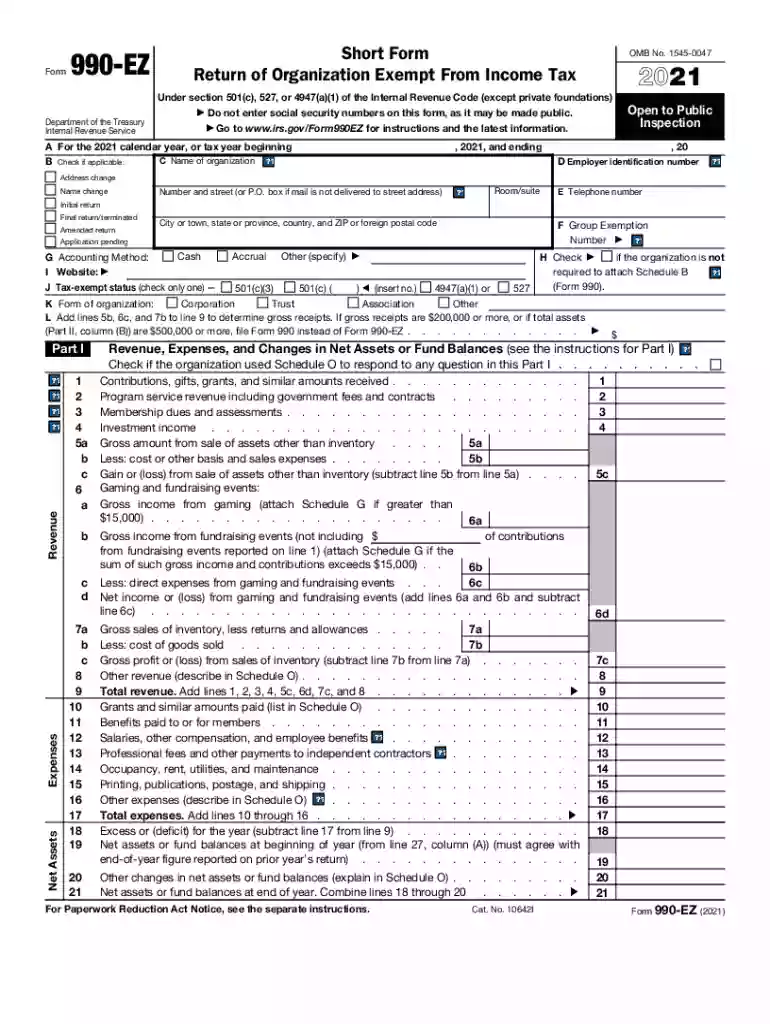
The 990-EZ Form serves as a short-form return for organizations operating as nonprofits under sections 501(c), 527, or 4947(a)(1) of the Internal Revenue Code. Primarily used by smaller organizations, this form simplifies the reporting process while maintaining compliance with IRS requirements. It collects financial information and records organizational activities and governance structures, ensuring transparency and accountability. The 990-EZ provides essential data about an organization’s revenue, expenses, net assets, and service accomplishments.
Organizations eligible to file the 990-EZ include nonprofit entities with annual gross receipts of less than $200,000 and total assets under $500,000. Organizations must ensure that they meet these financial thresholds to qualify for the simplified filing process. Larger entities are required to submit the more comprehensive Form 990 instead.


Filing the 990-EZ Form is critical for maintaining tax-exempt status. It demonstrates compliance with federal regulations and keeps the organization’s financial and governance practices transparent to the public. Failing to file or inaccuracies in filing can lead to penalties, fines, and potentially the loss of tax-exempt status.
The 990-EZ Form can be downloaded directly from the IRS website. Many tax software programs, such as TurboTax and QuickBooks, also offer support for completing and submitting the form electronically. Organizations may choose to complete the form online or print and send a paper version through the mail.
The IRS provides specific instructions and guidance on completing the 990-EZ Form. Adherence to these guidelines is crucial to prevent errors and ensure accurate reporting. Key areas include accurate income and expense reporting, proper categorization of financial information, and complete disclosure of governance practices.
The 990-EZ Form is due on the 15th day of the fifth month after the close of the organization’s fiscal year. For example, if the fiscal year ends on December 31, the form is due by May 15 of the following year. Organizations can request an automatic six-month extension by submitting Form 8868 before the original deadline.
Organizations failing to submit the 990-EZ Form on time may face financial penalties. The penalty starts at $20 per day for revenue under $1 million, up to a maximum of $10,000 or 5% of the organization’s gross receipts. Continual failure over three years may result in the revocation of tax-exempt status by the IRS.
We've got more versions of the 990 ez form 2021 form. Select the right 990 ez form 2021 version from the list and start editing it straight away!
| Versions | Form popularity | Fillable & printable |
|---|---|---|
| 2024 | 4.2 Satisfied (38 Votes) | |
| 2023 | 4.6 Satisfied (31 Votes) | |
| 2022 | 4.9 Satisfied (42 Votes) | |
| 2021 | 4.9 Satisfied (29 Votes) | |
| 2020 | 4.4 Satisfied (91 Votes) | |
| 2019 | 4.3 Satisfied (118 Votes) | |
| 2018 | 4.3 Satisfied (55 Votes) | |
| 2017 | 4.3 Satisfied (161 Votes) | |
| 2016 | 4.4 Satisfied (139 Votes) | |
| 2015 | 4.2 Satisfied (63 Votes) | |
| 2014 | 4 Satisfied (27 Votes) | |
| 2013 | 4.2 Satisfied (58 Votes) | |
| 2012 | 4 Satisfied (42 Votes) | |
| 2011 | 4 Satisfied (39 Votes) | |
| 2010 | 4 Satisfied (42 Votes) |
At DocHub, your data security is our priority. We follow HIPAA, SOC2, GDPR, and other standards, so you can work on your documents with confidence.
Complete to provide information for responses to specific questions on. Form 990 or 990-EZ or to provide any additional information. Attach to Form 990 or FormRead more
L Add lines 5b, 6c, and 7b to line 9 to determine gross receipts. If gross receipts are $200,000 or more, or if total assets.Read more
Jan 23, 2026 Tax-exempt organizations, nonexempt charitable trusts, and section 527 political organizations file Form 990-EZ to provide the IRS with the informationRead more


