




01. Edit your form 990 ez 2012 online
Type text, add images, blackout confidential details, add comments, highlights and more.

Type text, add images, blackout confidential details, add comments, highlights and more.

Draw your signature, type it, upload its image, or use your mobile device as a signature pad.

Send it via email, link, or fax. You can also download it, export it or print it out.
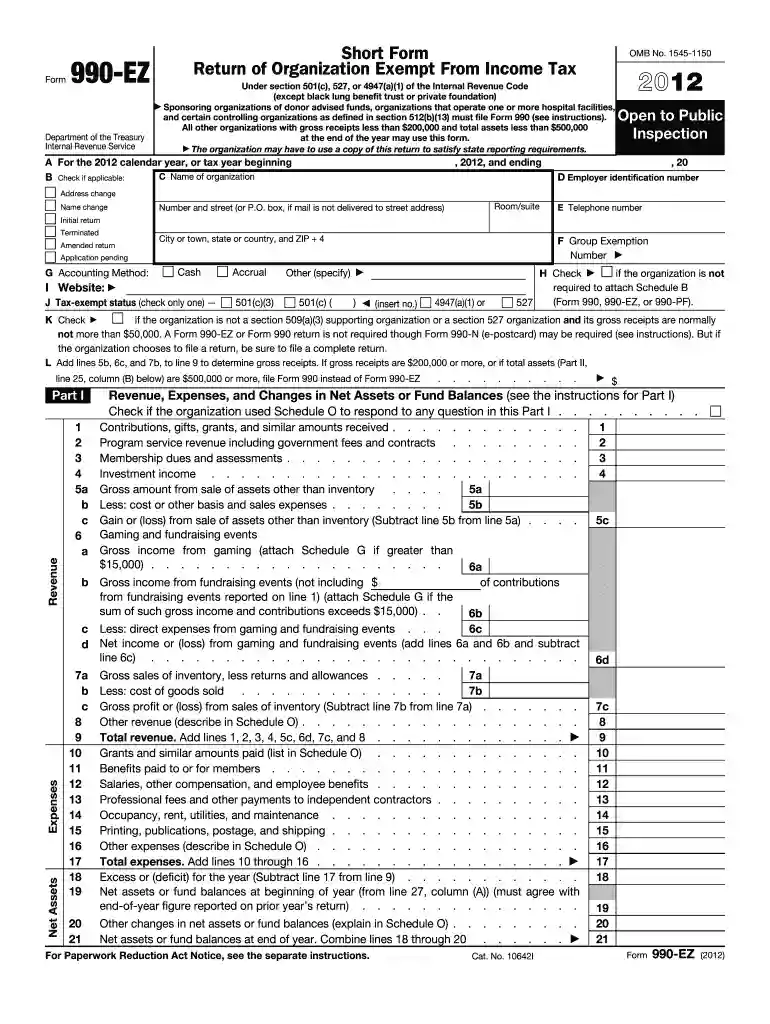
The EZ 2012 Form is a simplified tax return document intended for smaller organizations that are exempt from income tax under the Internal Revenue Code. Specifically, it is used by entities with gross receipts under $200,000 and total assets below $500,000. The form is designed to capture essential financial and operational data in a concise format, providing the IRS with a snapshot of the organization's financial health and compliance with tax regulations.
There are several ways to obtain the EZ 2012 Form. You can download it directly from the IRS website, where it is available in PDF format. Additionally, tax preparation software packages such as TurboTax and QuickBooks often include the form as part of their federal tax filing options, allowing you to fill it out electronically. For those who prefer paper versions, the form can be requested by mail through the IRS order form service.
The form includes several critical sections that organizations must complete. These include:
Filling out the EZ 2012 Form involves several steps. First, gather all necessary financial documents, such as receipts, bank statements, and invoices, to ensure accurate reporting of income and expenses. Then, carefully fill out each section of the form:
Typically, the form is used by smaller, tax-exempt organizations, such as non-profits, charities, and some churches. These entities often have limited administrative resources, making the streamlined nature of the EZ 2012 form advantageous. Organizations undergoing their first few years of operation frequently utilize this form due to its simplicity compared to more extensive tax documents.
Organizations can submit the EZ 2012 Form through various channels:
In some cases, tax professionals may offer to file the form on an organization's behalf.
Compliance with legal standards is crucial when handling the EZ 2012 Form. The data reported must be accurate and truthful, as discrepancies can lead to penalties from the IRS. It's advisable for organizations to consult with a tax professional to ensure their filings meet all legal requirements and to assist with any complexities that might arise during the process.
Many types of organizations take advantage of the EZ 2012 form:
We've got more versions of the form 990 ez 2012 form. Select the right form 990 ez 2012 version from the list and start editing it straight away!
| Versions | Form popularity | Fillable & printable |
|---|---|---|
| 2024 | 4.2 Satisfied (38 Votes) | |
| 2023 | 4.6 Satisfied (31 Votes) | |
| 2022 | 4.9 Satisfied (42 Votes) | |
| 2021 | 4.9 Satisfied (29 Votes) | |
| 2020 | 4.4 Satisfied (91 Votes) | |
| 2019 | 4.3 Satisfied (118 Votes) | |
| 2018 | 4.3 Satisfied (55 Votes) | |
| 2017 | 4.3 Satisfied (161 Votes) | |
| 2016 | 4.4 Satisfied (139 Votes) | |
| 2015 | 4.2 Satisfied (63 Votes) | |
| 2014 | 4 Satisfied (27 Votes) | |
| 2013 | 4.2 Satisfied (58 Votes) | |
| 2012 | 4 Satisfied (42 Votes) | |
| 2011 | 4 Satisfied (39 Votes) | |
| 2010 | 4 Satisfied (42 Votes) |
At DocHub, your data security is our priority. We follow HIPAA, SOC2, GDPR, and other standards, so you can work on your documents with confidence.




Caution. If the tax transcript is being mailed to a third party, ensure that you have filled in line 6 before signing. Sign and date the form once you have.
Form 1040EZ (2012) Mail your return by April 15, 2013. Mail it to the address shown on the last page of the instructions. Form 1040EZ (2012). 950.00.Read more


