




01. Edit your 2019 990 ez online
Type text, add images, blackout confidential details, add comments, highlights and more.

Type text, add images, blackout confidential details, add comments, highlights and more.

Draw your signature, type it, upload its image, or use your mobile device as a signature pad.

Send 990 ez 2019 via email, link, or fax. You can also download it, export it or print it out.
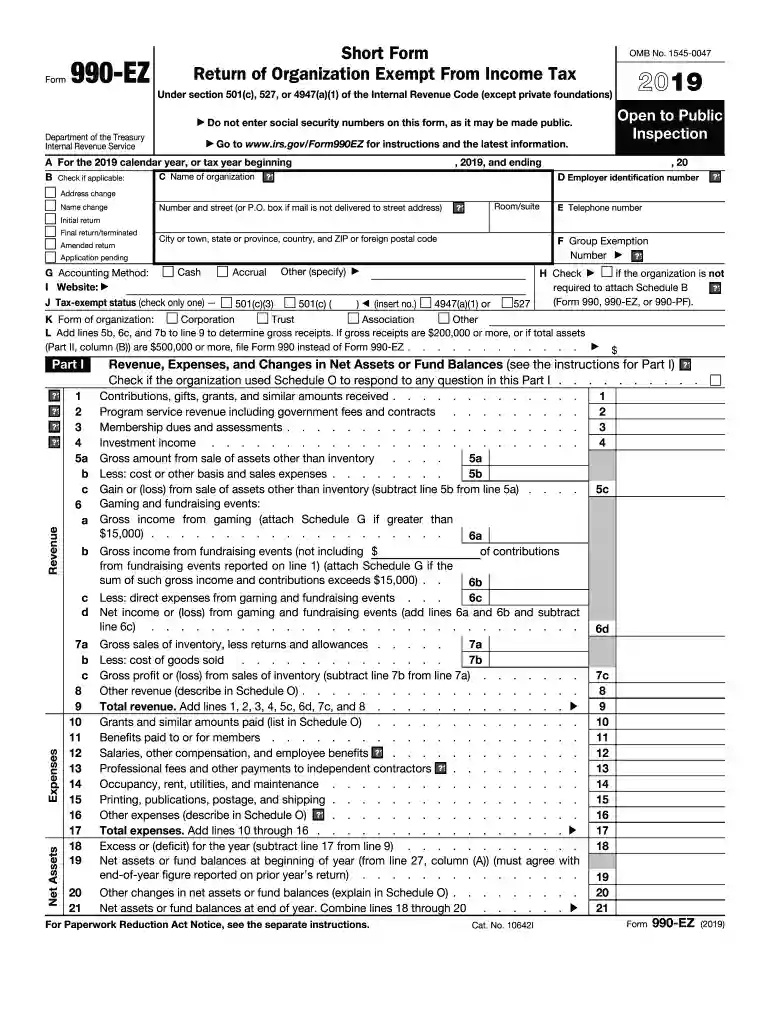
Form 990-EZ is a streamlined version of the full Form 990, which is used by tax-exempt organizations to file their annual financial information with the Internal Revenue Service (IRS). This form is specifically designed for smaller tax-exempt entities whose annual gross receipts are below a certain threshold, typically $200,000, and whose total assets are less than $500,000 at the end of the tax year. The 990-EZ serves as a financial disclosure document, providing the IRS with critical insights into the organization's financial activities, governance practices, and compliance with federal tax requirements.
Most organizations that are exempt under sections such as 501(c), 527, or 4947(a)(1) are required to file either Form 990, 990-EZ, or 990-N, depending on their size and activities. The 990-EZ assists the IRS in monitoring compliance and determining an organization's eligibility to maintain tax-exempt status. It includes sections on revenue, expenses, changes in net assets, and provides information on mission-related activities.
Obtain the Latest Form: Start by obtaining the most recent version of Form 990-EZ from the IRS website or through authorized tax software solutions.
Identify Necessary Information: Gather all financial records including income statements, balance sheets, and other necessary documents that outline revenue, expenses, and net assets for the filing year.
Complete Identification Portion: Fill out basic organizational information, such as name, address, tax year, and employer identification number (EIN).
Summarize Revenue and Expenses: Provide a detailed account of the organization's financial activities by reporting total revenues and expenses. This should include program services, fundraising events, and administrative costs.
Report Net Assets: Disclose changes in net assets and fund balances, indicating any significant changes from the previous filing period.
Detail Program Service Accomplishments: Describe the organization’s mission and the significant activities conducted during the year to further its exempt purposes.
Review and Sign: Ensure all sections are complete and accurate, then have the return signed by an authorized officer of the organization.
The primary criterion for filing Form 990-EZ hinges on financial thresholds and organizational type. An organization can file the 990-EZ if it:
Types of organizations eligible to file this form include smaller public charities, certain larger nonprofits that do not exceed these financial thresholds, and churches that elect to do so for disclosure purposes (though they are not required under law to file any version of the 990).


Filing the 990-EZ is not just a matter of fulfilling IRS obligations, but it also legalizes the organization's operations under federal guidelines for tax-exempt status. Failing to file the appropriate version of Form 990 for three consecutive years leads to automatic revocation of tax-exempt status. Therefore, complying with the annual reporting requirements is crucial for maintaining transparency and public trust, as well as preserving tax-advantaged status.
Maintaining meticulous records and ensuring they align with reported figures will aid in passing potential audits and inquiries from the IRS. Additionally, public disclosure of filed 990-EZ forms can influence donor decisions and affect the organization's reputation.
The deadline for filing the IRS Form 990-EZ is the 15th day of the fifth month after the close of the organization's fiscal year. For calendar year filers, this typically falls on May 15th. Extensions for filing can be requested through Form 8868, granting additional time if needed.
To maintain compliance, it's important for organizations to mark these deadlines meticulously and plan accordingly, as late filings can result in penalties and affect the organization’s public image.
The IRS provides extensive guidelines for completing Form 990-EZ, including instructions for each section. Correctly following these instructions is necessary to ensure the return is complete and accurate. Sections that detail significant changes in operations or governance, compensation to key employees, and lobbying activities are areas that require extra attention due to IRS scrutiny.
Organizations must also be aware of any recent changes or updates in tax laws that might affect disclosure requirements or forms. Keeping abreast of these regulatory changes can help avoid non-compliance or procedural errors when filing.
Filing Form 990-EZ can be completed either electronically or through a paper submission. Filing electronically tends to be more efficient and secure, offering immediate confirmation of receipt by the IRS. Electronic filing is highly recommended as it reduces the potential for errors and expedites processing times.
Organizations can use authorized e-filing services or IRS-approved tax software that complies with IRS electronic standards. While paper filing is still allowed, it requires more time for mail delivery and manual processing, posing a risk for delays.
Organizations must choose the method that best suits their operational capabilities and timeline concerns, with electronic filing being the preferred method for most.
We've got more versions of the 2019 990 ez form. Select the right 2019 990 ez version from the list and start editing it straight away!
| Versions | Form popularity | Fillable & printable |
|---|---|---|
| 2024 | 4.2 Satisfied (38 Votes) | |
| 2023 | 4.6 Satisfied (31 Votes) | |
| 2022 | 4.9 Satisfied (42 Votes) | |
| 2021 | 4.9 Satisfied (29 Votes) | |
| 2020 | 4.4 Satisfied (91 Votes) | |
| 2019 | 4.3 Satisfied (118 Votes) | |
| 2018 | 4.3 Satisfied (55 Votes) | |
| 2017 | 4.3 Satisfied (161 Votes) | |
| 2016 | 4.4 Satisfied (139 Votes) | |
| 2015 | 4.2 Satisfied (63 Votes) | |
| 2014 | 4 Satisfied (27 Votes) | |
| 2013 | 4.2 Satisfied (58 Votes) | |
| 2012 | 4 Satisfied (42 Votes) | |
| 2011 | 4 Satisfied (39 Votes) | |
| 2010 | 4 Satisfied (42 Votes) |
Upload your 990 ez form 2019 to DocHub (after you’ve set up an account for this). If you need to fill out fields in it, use proper tools from the top pane. For instance, add Signature Fields, assign each to a particular party, and click on Sign → Request signatures from others. Customize your message for your recipients and click Send Request. You can also send your document by fax or as a Signing link instead of using email (you’ll locate these options by navigating to the Menu → Send)
When you edit your ez 2019 990 with DocHub, you merely require a steady internet connection and virtually any web browser installed on your device. No need to set up any third-party applications or research tutorials. Simply open a tab with DocHub, drag and drop your file, and modify it immediately.
At DocHub, your data security is our priority. We follow HIPAA, SOC2, GDPR, and other standards, so you can work on your documents with confidence.




Dec 8, 2022 Form 990-EZ is an annual information return required to be filed with the IRS by many organizations exempt from income tax under section 501(a),Read more
Complete if the organization is a section 501(c)(3) organization or a section 4947(a)(1) nonexempt charitable trust. Attach to Form 990 or Form 990-EZ. Go toRead more
Tax-exempt organizations, nonexempt charitable trusts, and section 527 political organizations file Form 990-EZ to provide the IRS with the informationRead more


