01. Edit your form online
Type text, add images, blackout confidential details, add comments, highlights and more.

Type text, add images, blackout confidential details, add comments, highlights and more.

Draw your signature, type it, upload its image, or use your mobile device as a signature pad.

Send it via email, link, or fax. You can also download it, export it or print it out.
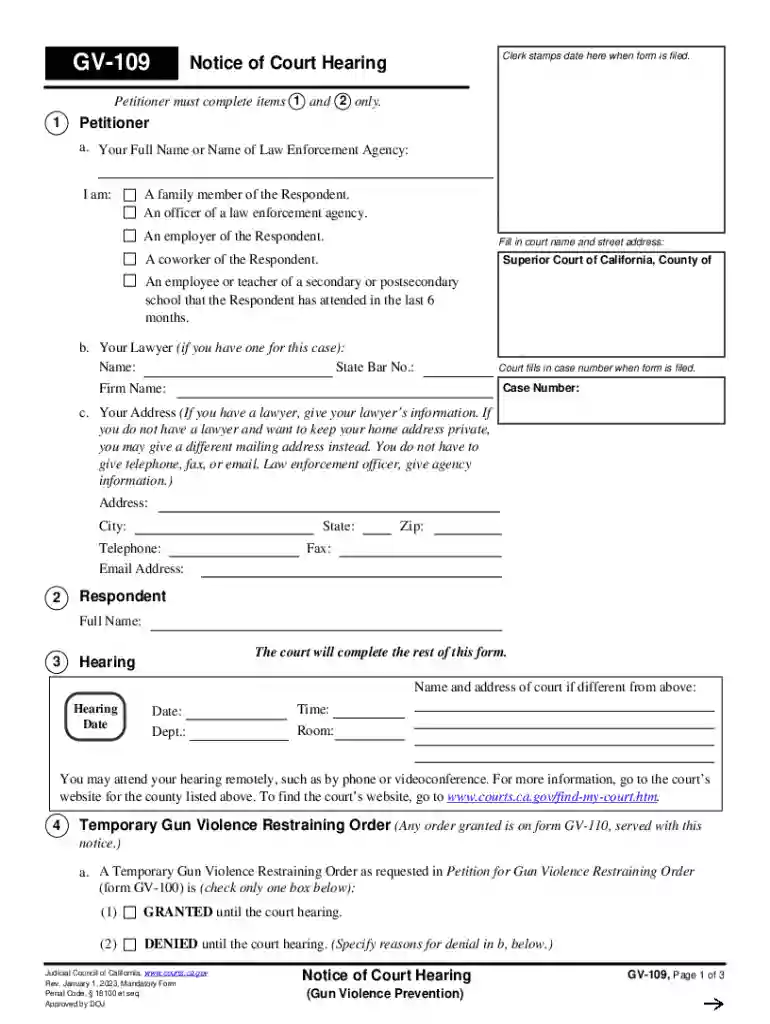
The GV-109, or Notice of Court Hearing, is an official legal document used in California concerning Gun Violence Restraining Orders (GVRO). It serves to notify involved parties—primarily the petitioner and the respondent—of a scheduled court hearing. This form plays a critical role in the judicial process as it outlines the specific details of the hearing, ensuring both parties are aware of when and where it will take place. By delivering clear information about court proceedings, the GV-109 helps safeguard legal rights and ensure due process is upheld.
The GV-109 form includes several essential elements that provide structure and clarity for all parties involved. These elements are:
Petitioner Information: The form requires details about the individual or entity requesting the restraining order. This section captures personal and contact information, allowing the court to address any questions or correspondence properly.
Respondent Information: This section collects the respondent's details, including personal information and any relevant identifying factors. Accurate information here ensures the respondent receives proper notification.
Hearing Details: The form includes the date, time, and location of the court hearing. These specifics are crucial for both parties to attend and participate appropriately.
Temporary Restraining Order Details: The form specifies whether a temporary restraining order has been granted or denied, which can significantly affect the hearing's implications.
To effectively use the GV-109 form, parties should follow a series of steps to ensure proper completion and submission:
Review Court Notifications: Carefully examine the form upon receipt to understand the upcoming hearing's details.
Verify Personal Information: Ensure that all personal information is correct to avoid any miscommunication or errors in the legal process.
Understand Temporary Orders: Check if any temporary orders are in place, as this will inform legal strategies and preparations before the hearing.
Attend the Scheduled Hearing: Make arrangements to be present at the hearing on the listed date, time, and place.
Respond Appropriately: If you are the respondent, it is crucial to understand your rights and act accordingly at the court hearing.
The GV-109 form is typically used by parties involved in a Gun Violence Restraining Order case, including:
Petitioners: Those who seek legal protection via a restraining order against someone perceived as a threat due to gun violence.
Respondents: Individuals who have been served with a restraining order notice and are required to appear in court to respond to allegations.
Legal Representatives: Attorneys and legal advisors use this form to prepare their clients for court proceedings and ensure compliance with judicial requirements.


Completing the GV-109 form correctly is essential to ensure that it is accepted by the court:
Gather Necessary Information: Collect all relevant details including names, contact information, and any case numbers or legal identifiers.
Fill Out Petitioner and Respondent Sections: Ensure that the names and addresses are correctly entered to avoid any delay in court proceedings.
Review Court Details: Double-check the date, time, and location of the hearing for accuracy.
Check Temporary Order Status: Verify whether a temporary restraining order has been granted and understand its implications.
Submit Documentation on Time: Ensure the completed form is filed with the court by the specified deadline to maintain compliance.
Understanding the terminology used in the GV-109 form is crucial for effective navigation of the legal process:
Petitioner: The individual or entity filing the motion for a court hearing.
Respondent: The party against whom the restraining order is sought.
Temporary Restraining Order: A short-term protection order that may be issued pending the court hearing.
Gun Violence Restraining Order (GVRO): A judicial order to temporarily remove firearms from an individual deemed a potential threat to themselves or others.
The GV-109 form is governed by California state laws, which dictate specific rules and procedures for its use:
California Law Compliance: The GV-109 must comply with California statutes concerning gun violence and restraining orders, ensuring that all entries are valid under state jurisdiction.
Notification Requirements: California law mandates that all involved parties receive timely and accurate notice of court hearings to uphold due process.
Service of Documents: The petitioner must serve the respondent with the GV-109 notice in accordance with legal standards, ensuring proper notification.
The GV-109 serves a legal function by:
Facilitating Court Proceedings: It provides a structured notification system for court dealings, ensuring both parties are informed of their rights and responsibilities.
Establishing Legal Record: It documents the formal notification of a court hearing, which is a crucial element in any legal proceeding involving restraining orders.
Supporting Judicial Decision-Making: By outlining the specifics of a hearing, the GV-109 helps judges evaluate the necessity and implications of a restraining order efficiently.
We've got more versions of the GV-109 Notice of Court Hearing form. Select the right GV-109 Notice of Court Hearing version from the list and start editing it straight away!
At DocHub, your data security is our priority. We follow HIPAA, SOC2, GDPR, and other standards, so you can work on your documents with confidence.