




01. Edit your form online
Type text, add images, blackout confidential details, add comments, highlights and more.

Type text, add images, blackout confidential details, add comments, highlights and more.

Draw your signature, type it, upload its image, or use your mobile device as a signature pad.

Send it via email, link, or fax. You can also download it, export it or print it out.
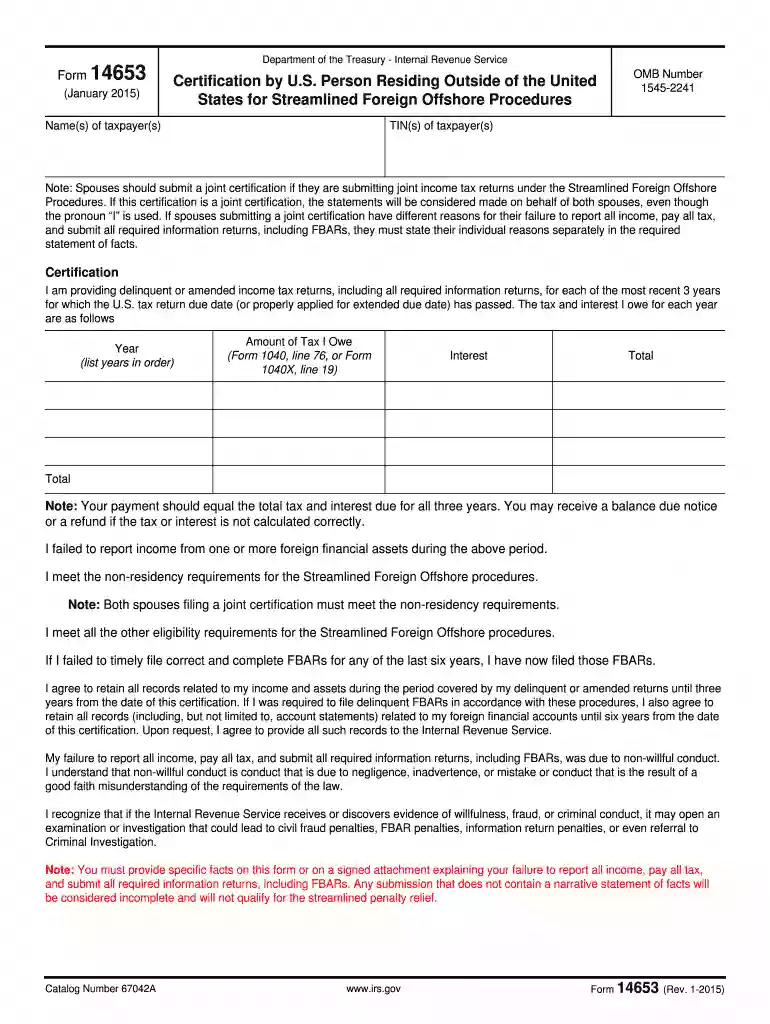
Form 14653, known officially as the Certification by U.S. Person Residing Outside of the United States for Streamlined Foreign Offshore Procedures, is a crucial document designed for U.S. taxpayers living overseas. Its primary purpose is to allow these individuals to certify their non-willfulness in failing to report income from foreign financial assets, thereby enabling their participation in the IRS's Streamlined Foreign Offshore Procedures. This program offers a simplified path to rectify past tax oversights without incurring substantial penalties.
To utilize Form 14653 effectively, taxpayers begin by certifying their eligibility for the streamlined procedures. This involves detailing the reasons for not meeting standard reporting requirements, emphasizing that any omissions were not deliberate. The form requires a comprehensive explanation supporting claims of reasonable cause, ensuring all sections are filled meticulously. Finally, taxpayers attach the completed form to their delinquent or amended tax returns.
Gather Documentation: Collect all relevant financial documents that pertain to foreign assets and tax returns for the years in question.
Fill Out Certification Details: Enter personal information, including name, address, and Social Security number. Provide a thorough explanation for the oversight of foreign income reporting.
Highlight Non-Willfulness: Furnish compelling evidence and reasoning to demonstrate non-willful conduct in failing to comply with reporting obligations.
Attach Required Documents: Ensure all necessary supporting documents, such as tax returns and foreign asset statements, are included.
Review and Submit: Double-check all entries for accuracy before submitting the form with the associated tax returns to the IRS.
Eligibility for Form 14653 centers around the taxpayer not residing in the United States when most non-compliance occurred. The individual must not have been subject to any IRS examination or criminal investigation for the years applicable. Additionally, participants should have lived outside the U.S. for at least 330 days in one of the recent three years.


The IRS provides explicit guidelines to ensure taxpayers understand the steps to rectify past omissions. Key areas include the need for all certifications to be truthful and complete, the requirement to follow stated deadlines, and the necessity to submit all forms through designated IRS channels. The IRS guidelines are non-negotiable, and adhering to them is crucial to successful participation in the streamlined program.
Legally, Form 14653 serves as a taxpayer’s certification of non-willful conduct related to undeclared offshore assets. The IRS expects detailed explanations to support claims of non-willful failure to comply with tax obligations. This legal attestation is vital as it plays a significant role in the taxpayer’s ability to avoid severe penalties typically associated with offshore non-compliance.
Failing to complete and submit Form 14653 appropriately can result in significant penalties and interest on unreported offshore income. Taxpayers may also face criminal charges if their omissions are deemed willful. Thus, accurate and truthful completion of the form is crucial to avoid such outcomes.
A typical scenario involves an expatriate With U.S. citizenship who neglected to report overseas income from investments. By using Form 14653, they can provide detailed reasoning for their oversight, highlighting non-willfulness due to misunderstanding reporting rules or oversight. This can help mitigate penalties typically associated with unreported foreign income.
Timely submission of Form 14653 is critical, as it coincides with the deadlines for amended or delinquent tax returns. Taxpayers are urged to be mindful of these dates to ensure compliance and to avoid potential last-minute issues that could arise from rushed, inaccurate filings.
Form 14653 mandates full disclosure of foreign financial accounts and income. This encompasses all assets held outside the U.S., ensuring that every financial asset that resulted in income complies with the tax reporting standards set forth by the IRS. Comprehensive accuracy in disclosure is crucial to successfully navigate the streamlined process without penalties.
We've got more versions of the form 14653 2015 form. Select the right form 14653 2015 version from the list and start editing it straight away!
At DocHub, your data security is our priority. We follow HIPAA, SOC2, GDPR, and other standards, so you can work on your documents with confidence.
Form 14653 Certification by U.S. Person Residing Outside of the United States for Streamlined Foreign Offshore Procedures The certification to be used for
Complete and sign Form 14653, Certification by U.S. Person Residing Outside of the United States for Streamlined Foreign Offshore Procedures (shown later).


