






Definition and Purpose of the 2015 W-2 Form
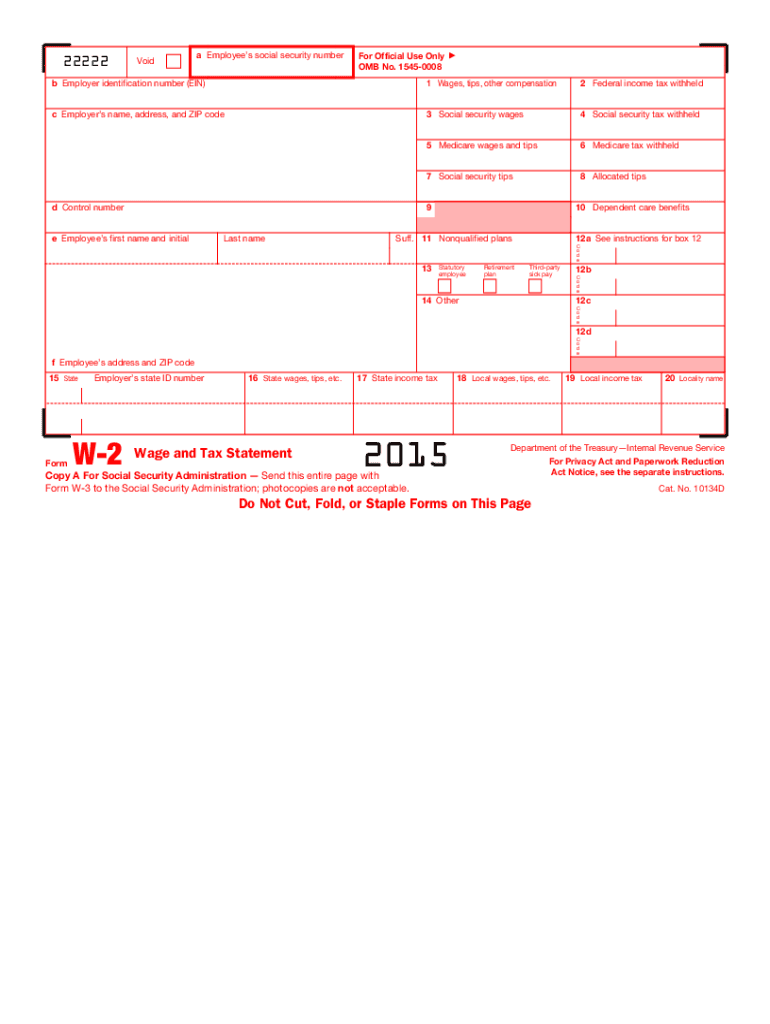
The 2015 W-2 form, also known as the Wage and Tax Statement, is a document used in the United States to report an employee's annual wages and the amount of taxes withheld from their paycheck. Employers are required to complete this form for each of their employees to communicate important financial information to both the worker and the Internal Revenue Service (IRS). The form is a vital part of the tax filing process, as it guides individuals in reporting their income during the year and determining tax liabilities or refunds.
How to Use the 2015 W-2 Form
Employees receive the W-2 form in January following the end of the tax year. It includes crucial information necessary for completing tax returns, such as:
- Total wages, tips, and other compensation.
- Federal income tax withheld.
- Social Security wages and taxes withheld.
- Medicare wages and taxes withheld.
Individuals use this information to file their tax return with the IRS by the April deadline. The form assists in calculating the tax owed or the refund due. Having a complete and accurate W-2 form ensures that taxpayers report their income correctly and avoid any discrepancies with the IRS.
Obtaining the 2015 W-2 Form
Employers must provide the 2015 W-2 form to employees by January 31 of the following year. If an employee does not receive their W-2 form by this date, they should follow these steps:
- Contact the Employer: Inquire if the form was sent or if it was misplaced.
- Check the Mailing Address: Verify that the employer has the correct mailing address on file.
- Contact the IRS: If the form is still not received by mid-February, individuals can contact the IRS for assistance.
- File Without the W-2: Use Form 4852, a substitute for the W-2, if necessary for filing taxes on time.
Steps to Complete the 2015 W-2 Form
Employers need to follow specific steps to accurately complete the 2015 W-2 form:
- Gather Employee Information: Obtain the employee's personal and contact information, Social Security number, and taxable wage information.
- Calculate Tax Withholdings: Determine the amount of federal and state taxes withheld during the year.
- Fill Out Form Fields Required by the IRS: Enter accurate wage data, taxes withheld, and other relevant information.
- Distribute Copies: Provide copies of the W-2 form to the employee and state tax department. Submit a copy to the IRS using Forms W-2 and W-3.
Importance of the 2015 W-2 Form
The W-2 form serves several essential purposes for both employees and the IRS:
- Ensures employees understand how much income tax was withheld.
- Provides documentation for tax filings.
- Assists the IRS in tracking taxable income and ensuring tax compliance.
- Facilitates accurate Social Security and Medicare tax contributions.
Without the W-2 form, assessing and reporting income accurately would be challenging for both taxpayers and tax authorities.
Key Elements of the 2015 W-2 Form
The W-2 form contains multiple boxes dedicated to specific information:
- Box 1: Total wages, tips, and compensation.
- Box 2: Federal income tax withheld.
- Boxes 3 and 4: Social Security wages and tax withheld.
- Boxes 5 and 6: Medicare wages and tax withheld.
- Box 12: Additional compensation, such as retirement plan contributions or health savings account deductions.
Understanding each component is crucial for both employers completing the form and employees using it for filing tax returns.
IRS Guidelines and Filing Deadlines
The IRS mandates that employers must file the W-2 forms for each employee by January 31. Employees should receive their copies by the same date to ensure timely tax return preparation. Employers are encouraged to file electronically as it reduces processing errors and expedites the filing process.
Penalties for Non-Compliance
Employers who fail to issue W-2 forms on time may incur penalties. The IRS imposes fines based on the duration of the delay and the number of missing forms. Both employers and employees are urged to ensure timely distribution and receipt of the W-2 forms to avoid such complications.
State-Specific Rules for the 2015 W-2 Form
While the federal W-2 form is standardized across the United States, individual states may have their own requirements. Some states require additional state tax information on the form, while others might need separate forms for state taxes. It is critical for employers to verify the requirements specific to their state to ensure compliance.
By understanding and adhering to these guidelines, both employees and employers can ensure an accurate and smooth tax filing process. Each element plays a vital role in maintaining compliance and facilitating ease of financial reporting.