
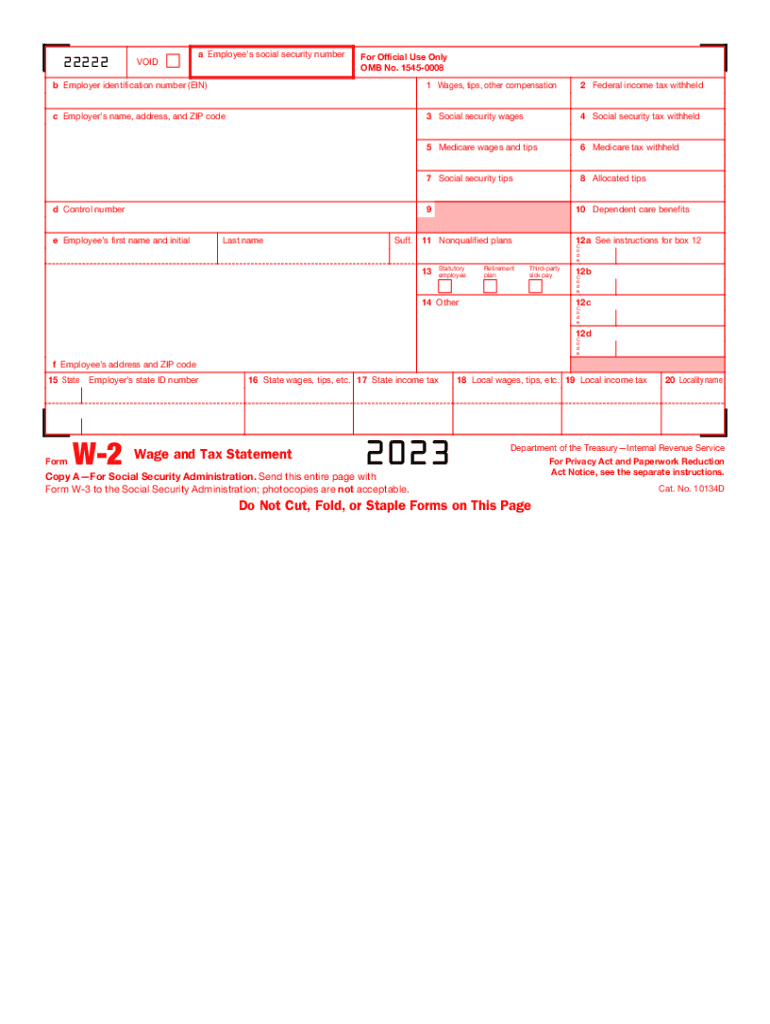







Definition & Meaning
The 2023 Form W-2 Wage and Tax Statement is a critical tax document used by employers to report wages paid to employees and taxes withheld during the calendar year. In the United States, the IRS mandates this form for each employee compensated with wages subject to Social Security and Medicare taxes. It provides key information, including the total amount of money earned, withheld tax amounts, and other benefits related to employment. The data recorded on the Form W-2 is essential for employees when filing their annual income tax returns and ensures compliance with federal tax regulations.
Form Components
- Employee's Earnings: Includes regular wages, bonuses, and other forms of compensation.
- Withheld Taxes: Displays federal, state, and local income taxes withheld from pay, as well as Social Security and Medicare tax details.
- Other Deductions: May include contributions to retirement plans or health savings accounts.
- Employer Information: Contains the employer's details necessary for tax reporting, such as the Employer Identification Number (EIN).
How to Use the 2023 Form W-2 Wage and Tax Statement
Employers must accurately complete and distribute Form W-2 to employees by January 31, ensuring that all financial data recordings align with their payroll records. Employees, however, utilize Form W-2 to fill out necessary sections on their federal and state income tax returns. Each box on the form contains specific information relevant to either taxpayers or tax authorities for verifying the accuracy of the reported income and taxes paid.
Steps for Employees
- Check Personal Information: Verify all personal details for accuracy.
- Report Income: Use the wage information as the base for calculating taxable income.
- Verify Tax Payments: Ensure tax withholding amounts align with year-to-date pay stubs or personal records.
- File with Tax Return: Attach Form W-2 copies to tax filings as evidence of earnings and withholding.
Filing Deadlines / Important Dates
Meeting filing deadlines is crucial for the completion of tax-related obligations. The Form W-2 must be provided to employees by January 31, and employers must also submit it to the SSA by the same date. Failure to meet these deadlines can result in penalties and fines. To streamline processes, electronic filing options are encouraged for both efficiency and timeliness.
Key Dates
- January 15: Employers begin preparing Forms W-2.
- January 31: Final deadline for distributing Forms W-2 to employees and filing with the SSA.
- April 15: Deadline for employees to submit their federal tax returns, accompanied by Forms W-2.
Steps to Complete the 2023 Form W-2 Wage and Tax Statement
Completing this form involves several specific steps designed to ensure accurate reporting of employee wages and withheld taxes. Employers often use payroll software systems to automate many of these processes, reducing the risk of errors.
Procedures
- Gather Employee Data: Ensure all personal, earnings, and tax withholding information is up-to-date.
- Fill Out Required Boxes: Accurately report each employee's earnings in the designated fields.
- Verify Employer Identification: Include the correct Employer Identification Number and business name.
- Review and Distribute: Double-check information for accuracy before sending copies to employees and the SSA.
IRS Guidelines
The IRS provides comprehensive guidelines for Form W-2 to assist both employers and employees with compliance and proper handling. These guidelines include specific instructions for filling out, correcting errors, and understanding the implications of each section on the form.
Key Points
- Use Scannable Forms: Ensure forms are scannable to facilitate electronic processing by the IRS and SSA.
- Correcting Errors: Submit a Form W-2c if corrections to the original W-2 are necessary.
- Recordkeeping: Maintain copies of Forms W-2 and relevant records for at least four years.
Penalties for Non-Compliance
Strict adherence to deadlines and accuracy requirements is necessary to avoid penalties. Employers who fail to provide timely or accurate Forms W-2 can face significant fines from the IRS. Penalties vary depending on the timing and degree of compliance failure and may increase if corrective actions are delayed.
Penalty Guidelines
- Delayed Submission: Fines escalate with the length of the delay beyond the submission deadline.
- Incorrect Information: Penalties apply for any inaccuracies or omissions in provided information.
- Failure to File: Severe fines are imposed for not filing forms at all.
State-Specific Rules for the 2023 Form W-2 Wage and Tax Statement
While Form W-2 is a federal requirement, individual states may have additional reporting requirements and differing deadlines. Employers need to consult state tax authorities to ensure that any specific adjustments are made according to local statutes.
Examples of State Variability
- State-Specific Identification Codes: Some states require additional identification numbers on Forms W-2.
- Varying Tax Credits: State tax rules may impact the amount of wages subject to withholdings.
- Specific Submission Deadlines: States may mandate different due dates for employer submissions compared to federal deadlines.
Software Compatibility
Modern tax preparation software, such as TurboTax and QuickBooks, is designed to integrate seamlessly with Form W-2 documentation. These tools simplify the process of importing, reviewing, and submitting tax data, making it easier for both businesses and individuals to meet their filing obligations efficiently.
Software Features
- Data Importation: Automatically transfers W-2 information into the appropriate fields on tax returns.
- Error Checking: Offers validation checks to ensure accuracy of reported data.
- Filing Assistance: Guides users through electronic submission processes for both federal and state requirements.




