




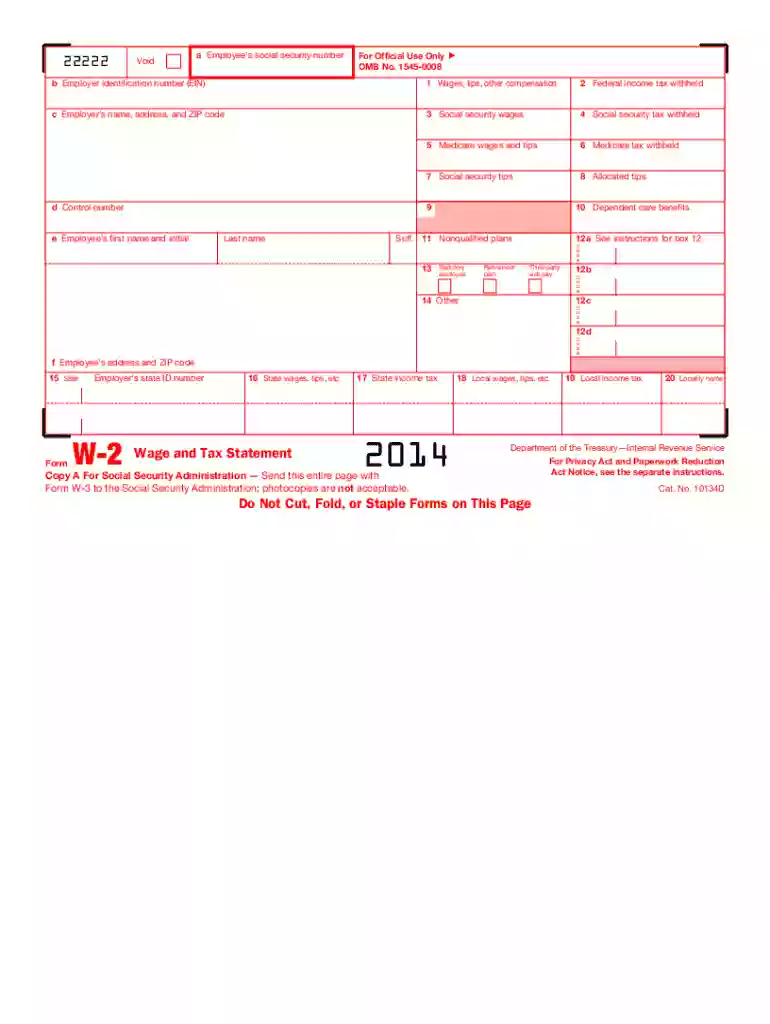
01. Edit your w2 form 2014 online
Type text, add images, blackout confidential details, add comments, highlights and more.

Type text, add images, blackout confidential details, add comments, highlights and more.

Draw your signature, type it, upload its image, or use your mobile device as a signature pad.

Send 2014 w2 via email, link, or fax. You can also download it, export it or print it out.
The IRS Form W-2, officially titled "Wage and Tax Statement," is a crucial document used by employers in the United States to report the wages paid and the taxes withheld from their employees’ paychecks. For the tax year 2014, the W-2 form served as a comprehensive record summarizing an individual’s employment income. It's used by employees to prepare their federal income tax returns. The form also contains important information about Social Security and Medicare contributions.
The 2014 W-2 form comprises several boxes, each capturing specific details about an employee’s income and withheld taxes:
These elements aid in understanding tax liabilities and ensuring accurate tax filings.
Employers typically issue W-2 forms to employees by January 31st of the following year. If you're an employee who worked in 2014, you should have received this form from your employer. In case the form is misplaced or not received, employees are advised to contact their employer's HR department to request a duplicate. For those who need an official copy for filing purposes, obtaining one directly from the IRS is possible via Form 4506-T, Request for Transcript of Tax Return.
Completing a W-2 form involves several detailed steps to ensure accuracy:
Employers must file Copy A of the W-2 form with the Social Security Administration by February 28th if filing by mail or by March 31st if filing electronically. However, the form must be provided to employees by January 31st. Adhering to these deadlines is critical to avoid penalties.
Non-compliance with W-2 form regulations may lead to significant penalties. Late submission of W-2 forms, either to the SSA or employees, incurs fines that increase the longer the delay. Moreover, inaccuracy in reporting or failure to file regularly flagged forms may result in additional scrutiny or penalties by the IRS. Employers are encouraged to maintain detailed records to ensure precision and timeliness.
Different taxpayer scenarios affect how 2014 W-2 forms are handled:
Understanding these various scenarios guides proper tax filing practices.


For employees, W-2 forms are instrumental in preparing federal and state tax returns. They help calculate how much tax is owed or refunded by comparing taxes withheld with taxes due. For employers, the forms are a legal obligation to ensure accurate reporting of employee compensation and tax withholdings. They play a vital role in auditing and offers legal protection in case of discrepancies or disputes with taxing authorities.
By embracing these comprehensive sections, users gain a deep understanding of how to properly access, complete, and utilize the 2014 W-2 forms, while ensuring compliance with IRS guidelines.
We've got more versions of the w2 form 2014 form. Select the right w2 form 2014 version from the list and start editing it straight away!
| Versions | Form popularity | Fillable & printable |
|---|---|---|
| 2024 | 4.7 Satisfied (35 Votes) | |
| 2023 | 4.4 Satisfied (26 Votes) | |
| 2022 | 4.7 Satisfied (59 Votes) | |
| 2021 | 4.8 Satisfied (120 Votes) | |
| 2020 | 4.4 Satisfied (218 Votes) | |
| 2019 | 4.4 Satisfied (910 Votes) | |
| 2018 | 4.4 Satisfied (233 Votes) | |
| 2017 | 4.2 Satisfied (267 Votes) | |
| 2016 | 4.4 Satisfied (882 Votes) | |
| 2015 | 4.3 Satisfied (259 Votes) | |
| 2014 | 4.2 Satisfied (43 Votes) | |
| 2013 | 3.9 Satisfied (53 Votes) | |
| 2013 | 4 Satisfied (60 Votes) | |
| 2012 | 4 Satisfied (53 Votes) | |
| 2011 | 4.2 Satisfied (74 Votes) |
You should use only trusted software solutions with strong data protection compliance to sign your documents electronically. DocHub is just the type of software you need! It stores data on Amazon Web Servers and complies with all required security criteria and eSignature laws, so it’s a trusted way to electronically sign your 2014 w2 form pdf or other documents with this tool.
Document editing with DocHub is equally convenient on desktop and mobile devices. You just need an internet browser to revise your w 2 form 2014 on Android. Open our site and sign in to access the instruments you need. Add your document and introduce your intended modifications. Next, you can keep your form in your document storage or send it out instantly.
At DocHub, your data security is our priority. We follow HIPAA, SOC2, GDPR, and other standards, so you can work on your documents with confidence.






May 2, 2017 Form W-2AS is used to report American Samoa wages paid by American Samoa employers, Form W-2CM is used to report the. Commonwealth of theRead more
Be sure to get your copies of Form W-2c from your employer for all corrections made so you may file them with your tax return. If your name and SSN are correctRead more
Specific information needed to complete Form W-2 is available in a separate booklet titled the 2014 General Instructions for. Forms W-2 and W-3. You canRead more


