




01. Edit your w2 2017 form online
Type text, add images, blackout confidential details, add comments, highlights and more.

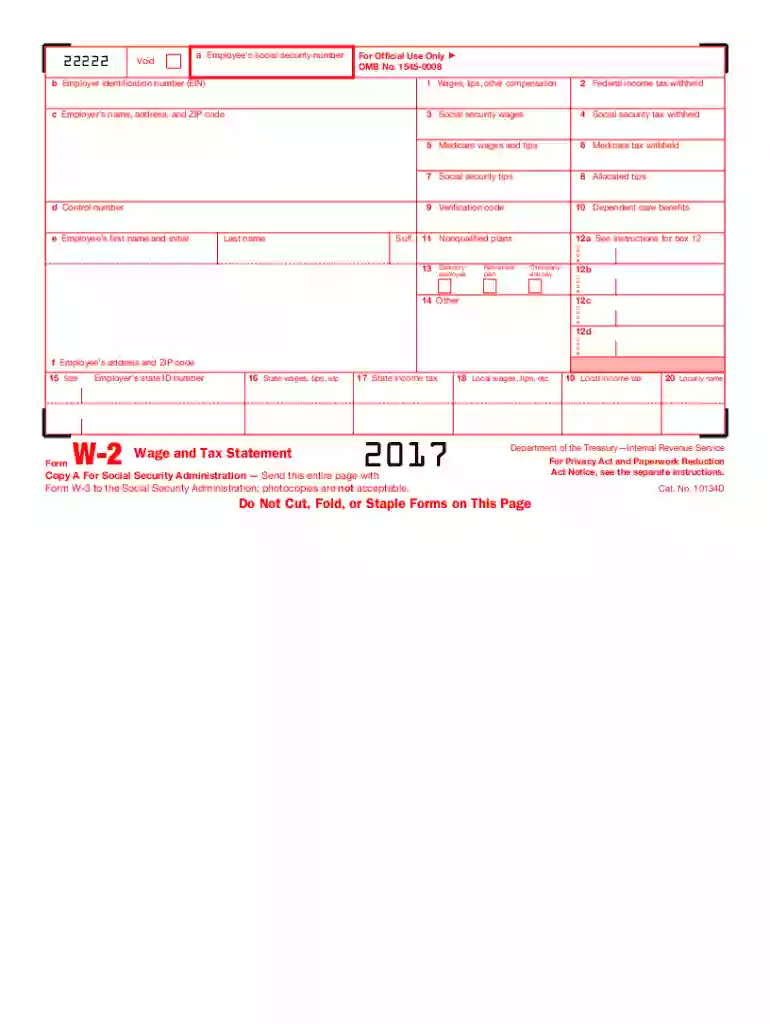
Type text, add images, blackout confidential details, add comments, highlights and more.

Draw your signature, type it, upload its image, or use your mobile device as a signature pad.

Send how to get copy of 2017 w2 via email, link, or fax. You can also download it, export it or print it out.
The IRS W-2 Form, officially known as the Wage and Tax Statement, is a crucial document that employers must complete and distribute annually to each employee and the Internal Revenue Service (IRS). It provides a detailed breakdown of the employee's annual wages and the taxes withheld from their paycheck. The W-2 Form serves as a significant reference for employees when filing their annual tax returns, ensuring accurate calculations of tax obligations and potential refunds. Given its role, the document is integral to both the employer's payroll processes and the employee's tax filing responsibilities.
Completing the IRS W-2 Form involves several meticulous steps to ensure accuracy and compliance.
Employees generally receive their IRS W-2 Form from their employer. The distribution deadline is January 31, following the end of the tax year. Employers can provide the form either in physical copy or electronically, depending on their mode of operation. For those employers opting for electronic distribution, they must ensure it's accessible and complies with privacy standards. If employees do not receive their W-2 by mid-February, they should contact their employer to request a copy or seek guidance from the IRS directly.
The IRS W-2 Form is primarily used by employees who have earned wages or salaries during the tax year. It is particularly relevant for:
Additionally, employers of these employee categories are responsible for generating and completing this form, which they use to document wage and tax withholding information.


Understanding the terminology associated with the IRS W-2 Form is essential for correctly interpreting its data:
These terms are fundamental to navigating and utilizing the information contained within the W-2 properly.
The IRS W-2 Form is composed of several key sections, which capture comprehensive financial data:
Each section provides specific numeric data and codes that help employees process their tax-related documentation correctly.
The IRS provides comprehensive guidelines on how the W-2 Form should be prepared, distributed, and utilized. These guidelines emphasize that:
Understanding these guidelines is crucial for ensuring both compliance and protection of employee data.
Failure to comply with IRS regulations regarding the W-2 Form can result in penalties for employers. These penalties range according to the severity and timing of the infraction:
Employers should be diligent in their preparation and submission of W-2 Forms to avoid these penalties.
Adhering to important tax filing deadlines ensures compliance:
These dates require close attention to avoid fines or processing issues.
Employers can submit W-2 Forms online or via mail to the SSA:
Choosing the appropriate submission method can affect the speed and efficiency of compliance.
Though the IRS W-2 Form is standardized at a federal level, individual states may have specific requirements or variations:
Adhering to both federal and state-specific rules is essential for complete compliance. Employers should verify individual state requirements to accommodate all necessary differences when completing these forms.
We've got more versions of the w2 2017 form form. Select the right w2 2017 form version from the list and start editing it straight away!
| Versions | Form popularity | Fillable & printable |
|---|---|---|
| 2024 | 4.7 Satisfied (35 Votes) | |
| 2023 | 4.4 Satisfied (26 Votes) | |
| 2022 | 4.7 Satisfied (59 Votes) | |
| 2021 | 4.8 Satisfied (120 Votes) | |
| 2020 | 4.4 Satisfied (218 Votes) | |
| 2019 | 4.4 Satisfied (910 Votes) | |
| 2018 | 4.4 Satisfied (233 Votes) | |
| 2017 | 4.2 Satisfied (267 Votes) | |
| 2016 | 4.4 Satisfied (882 Votes) | |
| 2015 | 4.3 Satisfied (259 Votes) | |
| 2014 | 4.2 Satisfied (43 Votes) | |
| 2013 | 3.9 Satisfied (53 Votes) | |
| 2013 | 4 Satisfied (60 Votes) | |
| 2012 | 4 Satisfied (53 Votes) | |
| 2011 | 4.2 Satisfied (74 Votes) |
Upload your w2 2017 online to DocHub (after you’ve set up an account for this). If you need to fill out fields in it, use proper tools from the upper pane. For example, drop Signature Fields, assign each to specific party, and click on Sign → Request signatures from others. Personalize your message for your recipients and click Send Request. You can also send your document by fax or as a Signing link instead of using email (you’ll locate these options by navigating to the Menu → Send)
You can easily edit fill out your 2017 w2 form on any iOS gadget. Open an internet browser of your choice, go to the DocHub site, authorize or create a new account, upload your file for editing, and make your required adjustments. Our service is mobile-friendly, so using its features on your phone will be a no-brainer, even on the first try.
At DocHub, your data security is our priority. We follow HIPAA, SOC2, GDPR, and other standards, so you can work on your documents with confidence.
May 2, 2017 Do not use these forms to report wages subject to U.S. income tax withholding. Instead, use Form W-2 to show U.S. income tax withheld. TreatmentRead more
Mar 30, 2026 Important information on employment tax withholding obligations and Form W-2 filing obligations of federal employers with employees who work in theRead more


