




01. Edit your 2013 w2 form online
Type text, add images, blackout confidential details, add comments, highlights and more.

Type text, add images, blackout confidential details, add comments, highlights and more.

Draw your signature, type it, upload its image, or use your mobile device as a signature pad.

Send 2013 w2 via email, link, or fax. You can also download it, export it or print it out.
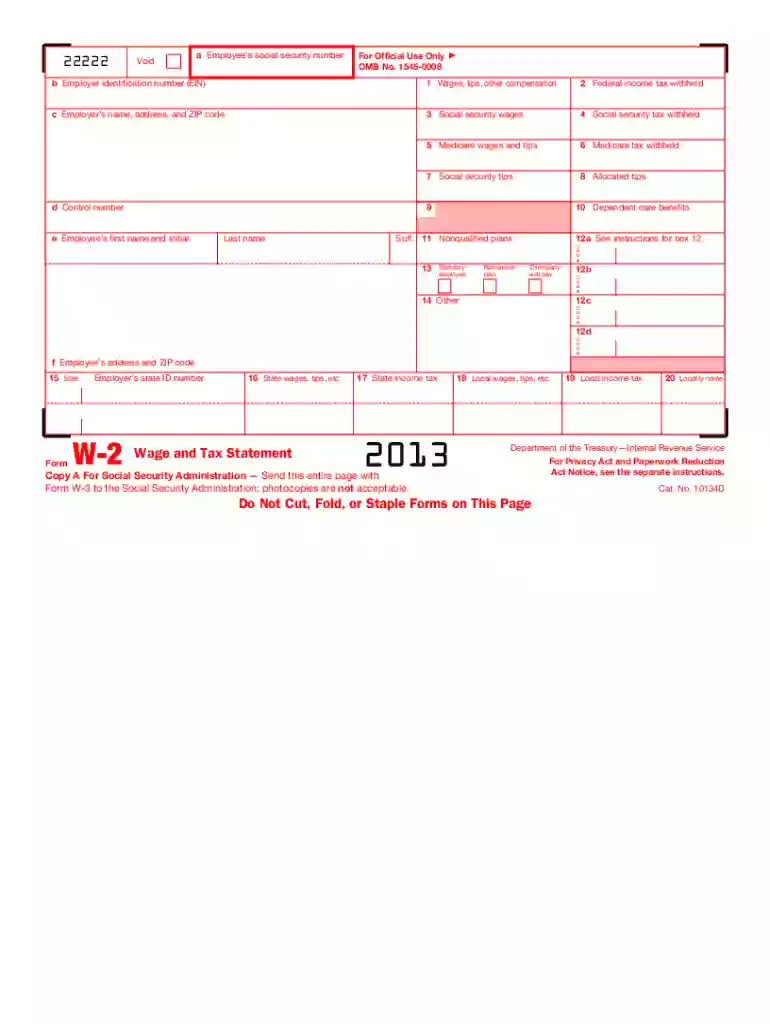
The W-2 Form, officially known as the Wage and Tax Statement, is a critical document used by the IRS to capture details about employees' earnings and the taxes withheld throughout the tax year. The 2013 version of the W-2 Form is specific to wage and tax information from that year, helping both employees and employers ensure accurate reporting for tax purposes. Employers supply their employees with the W-2 Form to report wages, tips, and other compensation, allowing employees to file their annual taxes efficiently. This document includes crucial data such as federal income tax withholding, Social Security wages, Medicare wages, and other compensation details.
To obtain a copy of the W-2 Form for 2013, an employee should first contact their employer's payroll or human resources department. Employers are required by law to provide employees with a copy of their W-2 Form for the previous tax year by January 31. If the form is lost, or the employer fails to provide it, the employee can also request a transcript from the IRS using Form 4506-T. Employers can obtain official copies to distribute to employees by ordering from the IRS or using IRS-approved payroll software, which ensures that all IRS standards are met.
Employer Details: Start with the employer's name, address, and EIN. This information needs to be precise as it identifies the payer on the form.
Employee Identification: Include the employee's name, address, and SSN. Ensure that all details are correct to avoid discrepancies in reporting.
Wage Information: Fill out Box 1 with total wages, tips, and payment compensation, excluding elective deferrals. In Box 2, enter the total amount of federal income tax withheld from the employee's pay.
Social Security and Medicare: Report Social Security wages and the amount withheld in Boxes 3 and 4, and similarly for Medicare in Boxes 5 and 6.
State and Local Tax Information: Complete Boxes 15 through 20 as applicable for state and local tax reporting, including state identification number and income tax withheld.
The W-2 Form is primarily used by employees and employers within the United States. Employers are obligated to complete and distribute this form to all employees—those who earn wages subject to tax withholding—by the end of January. Employees utilize this form to accurately report their earned income and withheld taxes when filing their annual federal and state tax returns. Additionally, this form is useful for tax professionals and advisors who assist clients with tax preparation and filing, providing a comprehensive overview of a client's earnings and deductions for the particular tax year.


Form W-2 is a legally mandated document used to report employees' wages and tax withholdings to the IRS. It is essential for ensuring compliance with federal tax laws. The information provided on a W-2 Form must be accurate and timely, as it directly impacts the calculation of tax liabilities. Employers who fail to file W-2 Forms with the IRS or distribute them to employees by the specified deadlines may face penalties. For legal compliance, employers should retain copies of all submitted W-2 Forms for at least four years after the tax year in question.
The IRS outlines specific guidelines for completing and filing the W-2 Form, including adherence to deadlines and accuracy of reported figures. Employers must file copies of the W-2 Forms with the Social Security Administration by February 28 if filing by paper or March 31 if filing electronically. The guidelines also demand employers use IRS-approved formats to mitigate errors in data transcription, which can harm administrative efficiency and result in fines.
Employees must keep their W-2 Forms with their personal tax records to file their tax return. During tax filing, other supportive documents may include previous year tax returns, other income statements, deductible expense records, and relevant Social Security or Medicare-related documents. Employers should retain copies of all W-2 Forms issued and received as well as payroll records that substantiate the figures reported on the W-2.
Employers can submit W-2 Forms to the IRS and deliver them to employees through various methods:
Employers who fail to comply with W-2 distribution or filing requirements face significant penalties. These can range from $50 per form if the failures are corrected within 30 days, to $270 per form for failures that remain uncorrected after August 1. Intentional disregard for timely and accurate filing can attract higher penalties. Compliance involves strict observance of deadlines and the accuracy of the information provided.
Employees, whether full-time, part-time, or temporary, will receive a W-2 Form if taxes were withheld from their pay. In contrast, self-employed individuals do not receive W-2 Forms; instead, they report income on Form 1099. Students and part-time workers who meet specific income thresholds will also receive W-2 Forms and should use them for their tax returns. Retirees will no longer receive W-2 Forms for retirement income but might receive them if they engaged in part-time or consulting work post-retirement.

The IRS allows submission of both digital and paper versions of the W-2 Form, provided standards are met. Electronic filing is increasingly encouraged due to its efficiency, cost-effectiveness, and error reduction. However, paper versions are still permissible, fulfilling the needs of businesses or individuals with limited access to digital solutions. Employers using electronic filing must ensure accurate software is employed and IRS-approved formats are retained.
We've got more versions of the 2013 w2 form form. Select the right 2013 w2 form version from the list and start editing it straight away!
| Versions | Form popularity | Fillable & printable |
|---|---|---|
| 2024 | 4.7 Satisfied (35 Votes) | |
| 2023 | 4.4 Satisfied (26 Votes) | |
| 2022 | 4.7 Satisfied (59 Votes) | |
| 2021 | 4.8 Satisfied (120 Votes) | |
| 2020 | 4.4 Satisfied (218 Votes) | |
| 2019 | 4.4 Satisfied (910 Votes) | |
| 2018 | 4.4 Satisfied (233 Votes) | |
| 2017 | 4.2 Satisfied (267 Votes) | |
| 2016 | 4.4 Satisfied (882 Votes) | |
| 2015 | 4.3 Satisfied (259 Votes) | |
| 2014 | 4.2 Satisfied (43 Votes) | |
| 2013 | 3.9 Satisfied (53 Votes) | |
| 2013 | 4 Satisfied (60 Votes) | |
| 2012 | 4 Satisfied (53 Votes) | |
| 2011 | 4.2 Satisfied (74 Votes) |
Yes, a typed name is accepted as a legitimate electronic signature when you create it on your form utilizing a compliant solution like DocHub. Simply add your 2013 w 2 form to our editor, click Sign in the top tool pane → Create your signature → Type your name in the proper tab, and decide how it will appear on your document.
If you choose analog methods of completing your form w 2 2013, it is simple to download your file for printing. Search DocHub’s Forms & Templates catalog to locate the exact file template you need and open it for editing or download it on your gadget in the format of your choice. It is easy to complete your form electronically and put your handwritten signature on it after printing or eSign your file with DocHub.
At DocHub, your data security is our priority. We follow HIPAA, SOC2, GDPR, and other standards, so you can work on your documents with confidence.


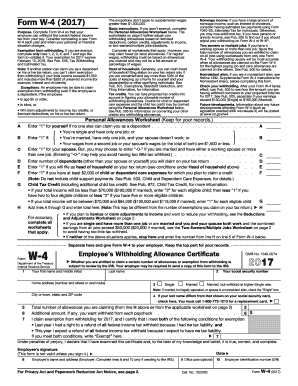

May 2, 2017 Do not use these forms to report wages subject to U.S. income tax withholding. Instead, use Form W-2 to show U.S. income tax withheld. TreatmentRead more
Feb 4, 2014 Box 1 reports your total taxable wages or salary for federal income tax purposes. This figure includes your wages, salary, tips you reported, bonuses and otherRead more
Specific information needed to complete Form W-2 is available in a separate booklet titled the 2013 General Instructions for. Forms W-2 and W-3. You canRead more


