




01. Edit your schedule se form 1040 2021 online
Type text, add images, blackout confidential details, add comments, highlights and more.

Type text, add images, blackout confidential details, add comments, highlights and more.

Draw your signature, type it, upload its image, or use your mobile device as a signature pad.

Send 2021 1040 se via email, link, or fax. You can also download it, export it or print it out.
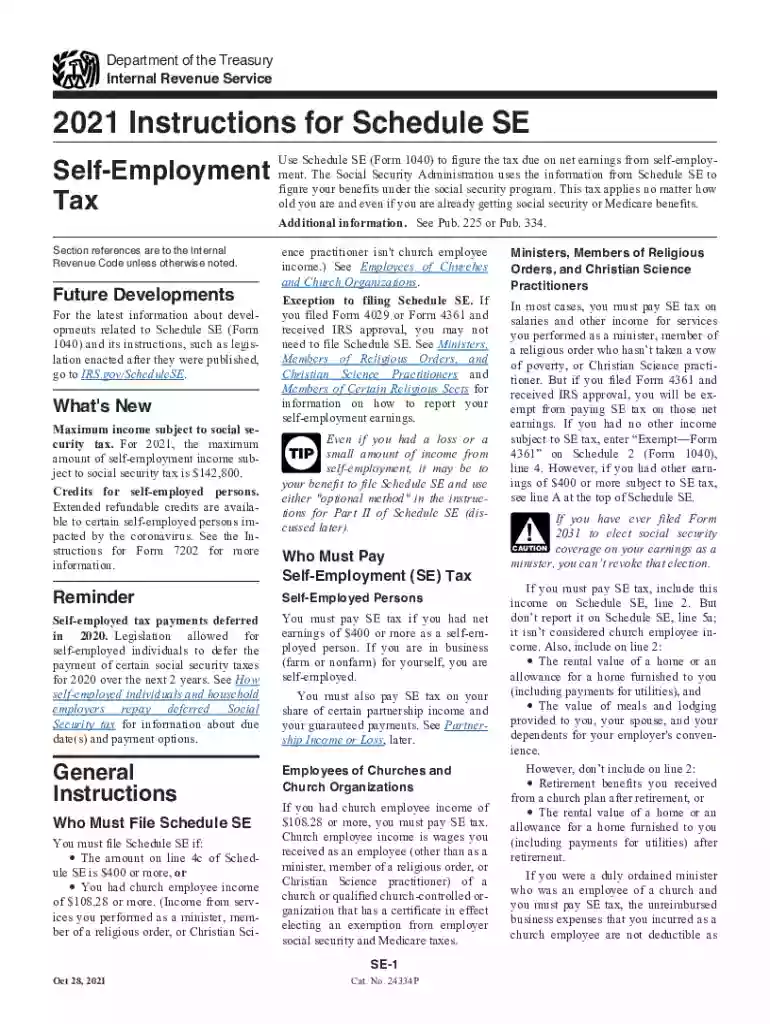
Schedule SE (Form 1040) is used by individuals to calculate the self-employment tax they owe based on their net earnings. This tax primarily funds Social Security and Medicare. Self-employed individuals use this form when their net earnings meet or exceed a specific amount set by the IRS. The form ensures that those who work for themselves contribute to Social Security and Medicare similarly to traditional employees.
Determine Your Net Earnings: Calculate your total income from self-employment activities, subtracting any allowable business expenses.
Identify the Applicable Tax Rate: The IRS sets a percentage used to calculate self-employment tax; typically, this includes contributions to both Social Security and Medicare.
Complete Part I: Input your net earnings for further calculations. Part I will guide you through determining your self-employment tax liability, factoring in Social Security bases and Medicare percentages.
Consider Optional Methods: Occasionally, lower-income earners can opt for alternative calculation methods found in Part II or Part III to potentially reduce tax burdens. These methods are particularly prevalent for farmers and certain ministers or church employees.
Finalize and Submit: Use the results from Schedule SE to adjust your tax owed or refund on Form 1040. Submit Schedule SE with your other tax documents by the deadline.
Self-Employed Entrepreneurs: Those who run their own business or receive income from freelance work must file Schedule SE if their net earnings are significant enough.
Partners in a Business: Individuals in a partnership may need to calculate self-employment tax on their distributed income using this form.
Ministers and Religious Workers: Often, exempt from some employment taxes, certain religious vocations must calculate their share for retirement benefits through this form.
The IRS provides detailed instructions on how to process self-employment tax calculations accurately. These include clarifications on deductible expenses, Social Security base limits, and specific instructions for married couples filing jointly. Understanding these guidelines helps avoid errors and possible penalties.
Net Earnings: Gross income from self-employment minus business expenses. This figure is crucial in determining self-employment tax.
Adjusted Gross Income (AGI): An income measure used to determine tax liability, including the self-employment tax calculated on Schedule SE.
Self-Employment Tax: This tax supports Social Security and Medicare systems and applies to self-employed individuals’ net earnings.
Failing to properly file Schedule SE can result in penalties from the IRS. These penalties may include fines for underpayment, late filing, or misreported income amounts. Understanding filing deadlines and accurately completing the form are essential steps in compliance.
The information from Schedule SE is pivotal in calculating self-employment contributions to federal retirement systems. Accurate filings ensure one’s entitlement to Social Security benefits and Medicare upon reaching eligibility age. Misreporting can adversely affect these future benefits.
Consider a freelance writer who earns $80,000 a year and reports $20,000 in business expenses, resulting in $60,000 in net earnings. This individual will utilize Schedule SE to determine their total self-employment tax owed based on these earnings, ensuring compliance and future Social Security contribution accuracy.
Self-employed individuals must adhere to IRS deadlines, typically coinciding with Form 1040 submissions. Schedule SE can be filed electronically or via mail. It is crucial to meet these deadlines to avoid fines and to ensure all tax obligations are met punctually.
We've got more versions of the schedule se form 1040 2021 form. Select the right schedule se form 1040 2021 version from the list and start editing it straight away!
| Versions | Form popularity | Fillable & printable |
|---|---|---|
| 2025 | 4.4 Satisfied (30 Votes) | |
| 2024 | 4.5 Satisfied (46 Votes) | |
| 2023 | 4.5 Satisfied (22 Votes) | |
| 2022 | 4.6 Satisfied (48 Votes) | |
| 2021 | 4.8 Satisfied (129 Votes) | |
| 2020 | 4.1 Satisfied (73 Votes) | |
| 2019 | 4.4 Satisfied (177 Votes) | |
| 2018 | 4.4 Satisfied (169 Votes) | |
| 2017 | 4.4 Satisfied (64 Votes) | |
| 2016 | 4.3 Satisfied (330 Votes) | |
| 2015 | 4 Satisfied (36 Votes) | |
| 2014 | 4 Satisfied (23 Votes) | |
| 2012 | 4 Satisfied (56 Votes) | |
| 2011 | 4.4 Satisfied (376 Votes) | |
| 2007 | 4.9 Satisfied (55 Votes) |
Electronic signatures are a perfect replacement for traditional signing, as they save time, effort, and money people spend on printing, scanning, and paper delivery. You can electronically sign your self employment tax form 2021 utilizing a trustworthy and powerful online document processing tool like DocHub. It complies with primary eSignature standards (ESIGN and UETA), so all documents approved there are legally binding and have the same validity as manually signed ones.
You can complete and sign your se 2021 form online, even on a tight deadline. All you need to access high quality editing instruments on any device is a DocHub profile, which you can sign up in a couple of moments. After you sign up, upload your file or find what you are looking for in our catalog, complete it using the editing instruments you want, and put your electronic signature on it at the end.
At DocHub, your data security is our priority. We follow HIPAA, SOC2, GDPR, and other standards, so you can work on your documents with confidence.
You can manually link to external sources for additional information that might not fit here but are useful such as BIOS image dumps, firmware, etc! iPhone SE
Selenium is a chemical element with symbol Se and atomic number 34. Classified as a nonmetal, Selenium is a solid at 25C (room temperature).
Southeastern Oklahoma State University is a public four-year university located in Durant, Oklahoma, offering a wide array of unique programs from Aviation


