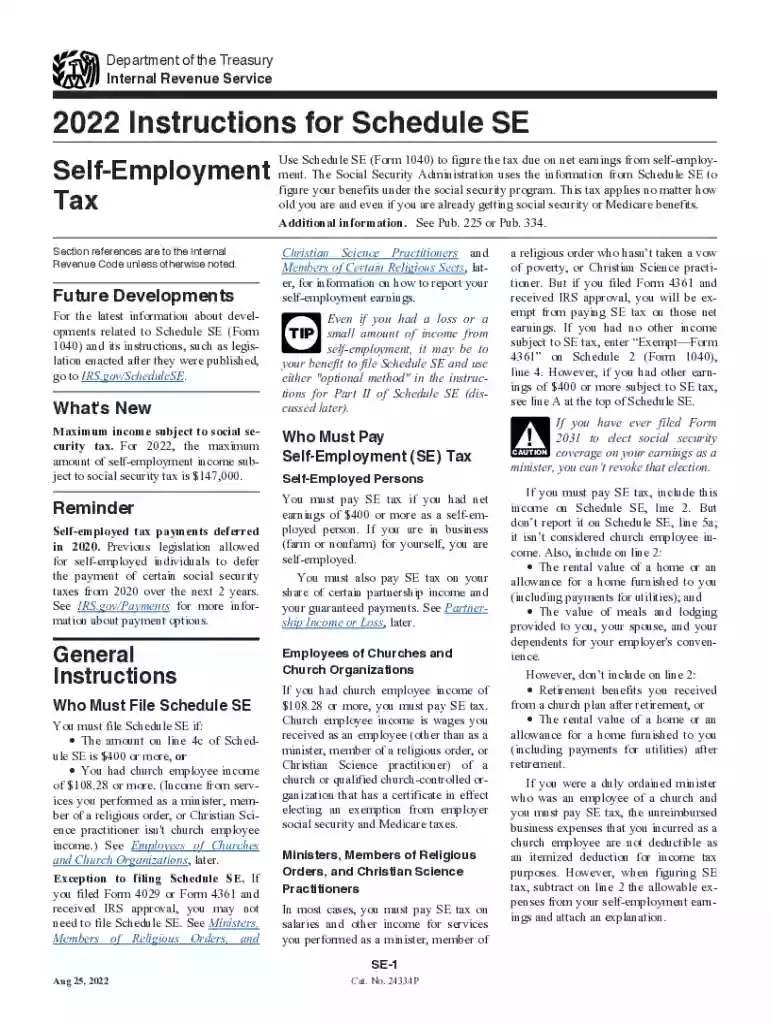
Instructions for IRS Form 1040 Schedule SE "Self-employment Tax"-2026

Get Form
schedule se form 1040 2022 Preview on Page 1

Here's how it works

01. Edit your schedule se form 1040 2022 online
Type text, add images, blackout confidential details, add comments, highlights and more.

02. Sign it in a few clicks
Draw your signature, type it, upload its image, or use your mobile device as a signature pad.

03. Share your form with others
Send nys tax forms 2022 via email, link, or fax. You can also download it, export it or print it out.

Definition and Purpose of IRS Form 1040 Schedule SE

IRS Form 1040 Schedule SE, titled "Self-Employment Tax," is a form used by self-employed individuals to calculate their Social Security and Medicare taxes based on net earnings. The self-employment tax is similar to the payroll tax used by employees and employers to fund these programs, but it applies to those earning income independently. Self-employed individuals must understand the purpose of this form to ensure accurate tax reporting and compliance.

  • Social Security and Medicare Contributions: The self-employment tax accounts for the individual's contributions to Social Security and Medicare. This is crucial for securing benefits in retirement.
  • Net Earnings: The calculation hinges on net business earnings, which deduct business expenses from gross receipts.

Utilizing the Instructions for IRS Form 1040 Schedule SE

The instructions for IRS Form 1040 Schedule SE are a critical guide for taxpayers navigating the complexities of self-employment tax calculations. These instructions provide necessary details for accurately completing the form.

  • Detailed Steps: The instructions break down each part of the form, showing where and how to enter earnings and deductions.
  • Special Scenarios: They address cases such as optional methods and specific rules for church employees, providing essential clarity for affected individuals.

Obtaining the Instructions for IRS Form 1040 Schedule SE

Obtaining the instructions for Form 1040 Schedule SE is the first step in the tax preparation process for self-employed individuals. These can be accessed through several means:

  • IRS Website: Directly downloaded as a PDF from the official IRS website, ensuring the most current version.
  • Libraries and Post Offices: Some physical locations offer printed copies during tax season.
  • Tax Preparation Software: Many platforms include direct links to the latest instructions, providing immediate access during form completion.

Steps to Complete IRS Form 1040 Schedule SE

Completing Form 1040 Schedule SE requires a systematic approach to accurately report and calculate self-employment tax.

  1. Gather Required Information: Compile records of all earnings and expenses related to self-employment.
  2. Fill Out Part I: Calculate net earnings and list revenues, subtracting any business expenses.
  3. Proceed to Part II: Determine the actual self-employment tax by applying the tax rate to net earnings, using any applicable optional methods.
  4. Transfer Result for Overall Tax Calculation: Transfer completed figures to the taxpayer’s main 1040 form for integration into the overall tax liability.

Important Terms Related to IRS Form 1040 Schedule SE

Special terminology within the instructions is vital for comprehending the requirements and calculations of the self-employment tax.

  • Net Profit: This refers to total earnings after deducting business expenses. Accurate reporting here is essential for calculating tax liability.
  • Optional Methods: Allowances that may simplify the calculation of net earnings for certain taxpayers, which can impact the tax burden and benefit eligibility.
  • Tax Rate: The percentage of income subject to self-employment tax; this typically includes both the Social Security and Medicare portions.

IRS Guidelines for Self-Employment Tax

The IRS provides specific guidelines for the administration and calculation of the self-employment tax, essential for maintaining compliance.

  • Eligibility: Defines who must file based on income thresholds, ensuring only qualified individuals use the form.
  • Calculation Methodology: Offers a structured approach to calculating the tax, reducing errors in reporting.
  • Filing Exceptions: Some taxpayers, due to exemptions or other regulatory considerations, may have different filing requirements or methods.

Filing Deadlines for IRS Form 1040 Schedule SE

Timely submission of Schedule SE is important for avoiding penalties and ensuring compliance.

  • Annual Submission: Typically due alongside Form 1040, by April 15, unless an extension is granted.
  • Extensions and Adjustments: In some cases, extensions might be necessary, requiring taxpayers to file a request by the standard deadline.

Required Documents for Filing Schedule SE

Successfully preparing and filing Schedule SE hinges on having the correct documentation.

  • Income Records: Comprehensive documentation of all self-employment earnings, such as invoices and bank statements.
  • Expense Receipts: Proof of business-related expenses to justify deductions.
  • Previous Tax Records: For continuity and reference, often necessary when using optional methods.

Taxpayer Scenarios for IRS Form 1040 Schedule SE

Different taxpayer situations can influence whether and how one files the Schedule SE.

  • Freelancers and Gig Workers: Common users, reflecting diverse income streams.
  • Small Business Owners: Must consider earnings from various business activities in the calculation.
  • Church Employees and Members of Clergy: Special rules apply, often requiring additional attention to instruction details.
decoration image ratings of Dochub

See more Instructions for IRS Form 1040 Schedule SE "Self-employment Tax" versions

We've got more versions of the Instructions for IRS Form 1040 Schedule SE "Self-employment Tax" form. Select the right Instructions for IRS Form 1040 Schedule SE "Self-employment Tax" version from the list and start editing it straight away!
Versions Form popularity Fillable & printable
2023 4.5 Satisfied (22 Votes)
2022 4.6 Satisfied (48 Votes)
2021 4.8 Satisfied (129 Votes)
2020 4.1 Satisfied (73 Votes)
2019 4.4 Satisfied (177 Votes)
2018 4.4 Satisfied (169 Votes)
2017 4.4 Satisfied (64 Votes)
2016 4.3 Satisfied (330 Votes)
2015 4 Satisfied (36 Votes)
2014 4 Satisfied (23 Votes)
2012 4 Satisfied (56 Votes)
2011 4.4 Satisfied (376 Votes)
2007 4.9 Satisfied (55 Votes)
be ready to get more

Complete this form in 5 minutes or less

Get form

Got questions?

We have answers to the most popular questions from our customers. If you can't find an answer to your question, please contact us.
Contact us
Use Form 1040-ES to figure and pay your estimated tax. Estimated tax is the method used to pay tax on income that is not subject to withholding (for example, earnings from self-employment, interest, dividends, rents, alimony, etc.).
Schedule SE Key takeaways Small business owners must file Schedule SE with Form 1040 to calculate and report self-employment tax, which includes both the employee and employer portions of Social Security and Medicare taxes. You can deduct 50% of your self-employment tax on your return.
$400 or See Publication 334, Tax Guide for Small Business (For Individuals Who Use Schedule C), for more information. You have to file an income tax return if your net earnings from self-employment were $400 or more. Self-employed individuals tax center | Internal Revenue Service IRS (.gov) small-businesses-self-employed s IRS (.gov) small-businesses-self-employed s
The new rules mean that from 2024/25 you will need to report your accounting information on your tax return on a tax year basis (6 April in one year to the following 5 April). However, the transitional rules may mean that your 2023/24 tax return covers an accounting period longer than 12 months.
Essentially, it enables self-employed persons to avoid paying the employers 7.65 percent of the FICA tax. (100 percent less 7.65 percent equals 92.35 percent). Additionally, the Social Security portion of the self-employment tax, 12.4 percent, applies to the first $176,100 of net earnings for 2025. Self-Employment Tax: Calculation, Rates, and Tips for 2025 - OnPay OnPay insights self-employment-tax OnPay insights self-employment-tax

Security and compliance

At DocHub, your data security is our priority. We follow HIPAA, SOC2, GDPR, and other standards, so you can work on your documents with confidence.

Learn more
ccpa2
pci-dss
gdpr-compliance
hipaa
soc-compliance

People also ask

Self-employment income tax rates Trading profitsTax rateTax band 0 to 12,570 0% Personal Allowance 12,571-50,270 20% Basic rate 50,271-125,140 40% Higher rate Tax and National Insurance when youre self-employed - MoneyHelper MoneyHelper self-employment ta MoneyHelper self-employment ta
The truth is that Social Security benefits really dont vary whether youre self-employed or are an employee in a business; the major difference is that self-employed workers must pay both the employee and employer portions of Social Security taxes. How Being Self-Employed Affects Social Security Benefits - RSSA RSSA self-employed RSSA self-employed
Step-by-step guide to completing Schedule SE Enter your net earnings. Use income from Schedule C, Schedule F, or Schedule K-1. Apply the 92.35% adjustment. Multiply net earnings by 92.35%. Calculate your SE tax. Multiply adjusted earnings by 15.3%. Transfer amounts to Form 1040.

2022 irs se