




01. Edit your nys tax forms online
Type text, add images, blackout confidential details, add comments, highlights and more.

Type text, add images, blackout confidential details, add comments, highlights and more.

Draw your signature, type it, upload its image, or use your mobile device as a signature pad.

Send nys tax forms 2023 via email, link, or fax. You can also download it, export it or print it out.
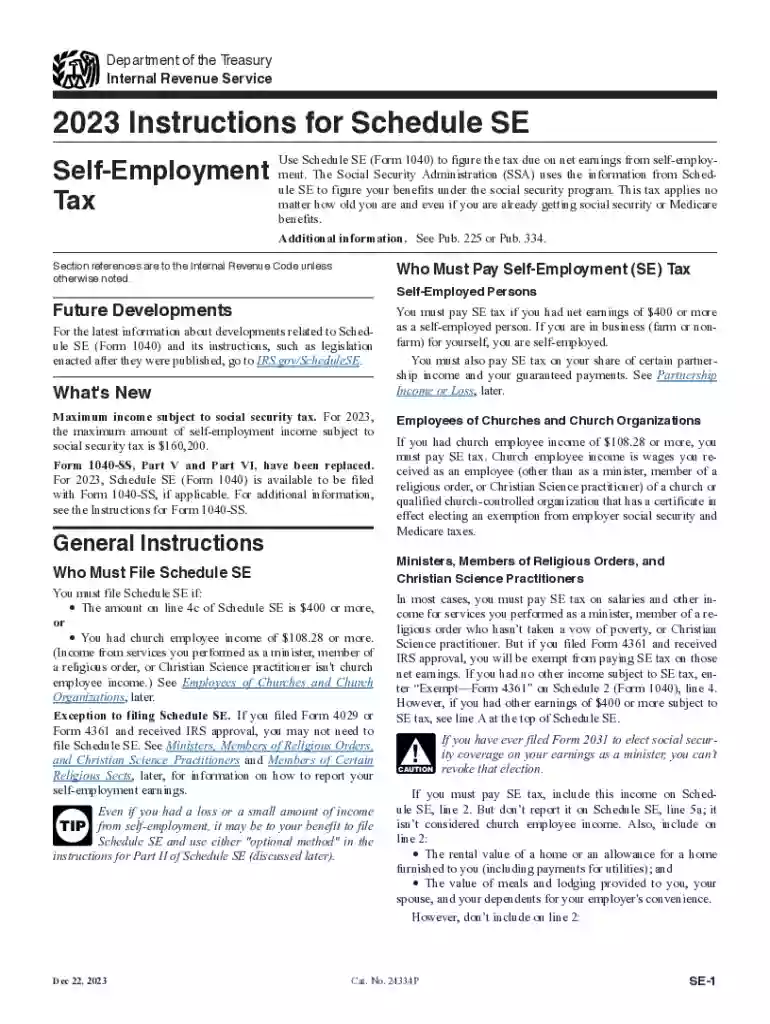
Schedule SE (Form 1040) is used by self-employed individuals to calculate their self-employment tax based on net earnings. It is essential for those who earn income through self-employment, including sole proprietors and independent contractors. This form helps determine the amount owed to the Social Security and Medicare programs, which are part of the self-employment tax. Unlike typical employees who have these taxes withheld from their paycheck, self-employed individuals are responsible for calculating and paying both the employer and employee portions themselves.
Obtaining Schedule SE is straightforward, as it is available directly from the IRS website. You can download the form as a PDF, which allows for easy access and printing. Alternatively, many tax preparation software packages, including TurboTax and QuickBooks, incorporate Schedule SE and guide users through its completion as part of the income tax filing process. For those who prefer physical forms, local IRS offices also provide copies upon request.
Schedule SE must be filed by the same deadline as your individual income tax return, typically April 15. If this date falls on a weekend or holiday, the due date is extended to the next business day. Extensions for filing are available through Form 4868, allowing more time to submit your return but not to pay any taxes due.
The IRS provides detailed instructions regarding who must file Schedule SE. Generally, anyone with self-employment earnings of $400 or more is required to complete the form. However, there are exceptions for certain church employees and individuals with very low or high earnings. IRS Publication 334 offers additional guidance specific to self-employed individuals, which can be a helpful resource in understanding any nuanced filing requirements.
Failing to file Schedule SE when required or underreporting self-employment income can lead to penalties from the IRS. These penalties may include fines, interest on unpaid tax amounts, and additional charges for late filing. To avoid these, ensure accurate and timely filing of Schedule SE alongside your regular tax return.
Both digital and paper filing options are available for Schedule SE. Filing electronically through the IRS's e-file system has several advantages, including faster processing and confirmation of receipt. Many users prefer digital filing for its convenience and lower error rates, often assisted by tax software. However, those with limited access to digital resources may still file a paper return by mailing in their completed forms.
We've got more versions of the nys tax forms form. Select the right nys tax forms version from the list and start editing it straight away!
| Versions | Form popularity | Fillable & printable |
|---|---|---|
| 2025 | 4.4 Satisfied (30 Votes) | |
| 2024 | 4.5 Satisfied (46 Votes) | |
| 2023 | 4.5 Satisfied (22 Votes) | |
| 2022 | 4.6 Satisfied (48 Votes) | |
| 2021 | 4.8 Satisfied (129 Votes) | |
| 2020 | 4.1 Satisfied (73 Votes) | |
| 2019 | 4.4 Satisfied (177 Votes) | |
| 2018 | 4.4 Satisfied (169 Votes) | |
| 2017 | 4.4 Satisfied (64 Votes) | |
| 2016 | 4.3 Satisfied (330 Votes) | |
| 2015 | 4 Satisfied (36 Votes) | |
| 2014 | 4 Satisfied (23 Votes) | |
| 2012 | 4 Satisfied (56 Votes) | |
| 2011 | 4.4 Satisfied (376 Votes) | |
| 2007 | 4.9 Satisfied (55 Votes) |
Managing your forms with DocHub this way is extremely easy once you have downloaded its extension for Google Chrome. Go to the Chrome Web Store and set up DocHub - Sign PDF from Gmail to obtain it. Give our tool access to your Google account, and then open an email containing form it 201 instructions as an attachment and point to the file with your cursor - the DocHub extension button will automatically appear there. Click on it to open your form in our editor. Make any required edits, fill out the blanks, and click Sign to create your legally-binding electronic signature.
You can easily edit fill out your se self employment on any iOS device. Open an internet browser of your choice, go to the DocHub website, authorize or create a new account, add your file for editing, and make your desired alterations. Our service is mobile-friendly, so utilizing its features on your phone will be a no-brainer, even on the first try.
At DocHub, your data security is our priority. We follow HIPAA, SOC2, GDPR, and other standards, so you can work on your documents with confidence.
Use Schedule SE (Form 1040) to figure the tax due on net earnings from self-employment. If you must pay SE tax, include this income on line 2 of either Short
If your self-employment income is subject to SE tax, complete Schedule SE and file it with your Form 1040-NR. SE tax, you must file Schedule SE.
You must figure your penalty and waiver amount and file Form 2210. You must figure the penalty using Schedule Al and file Form 2210.


