
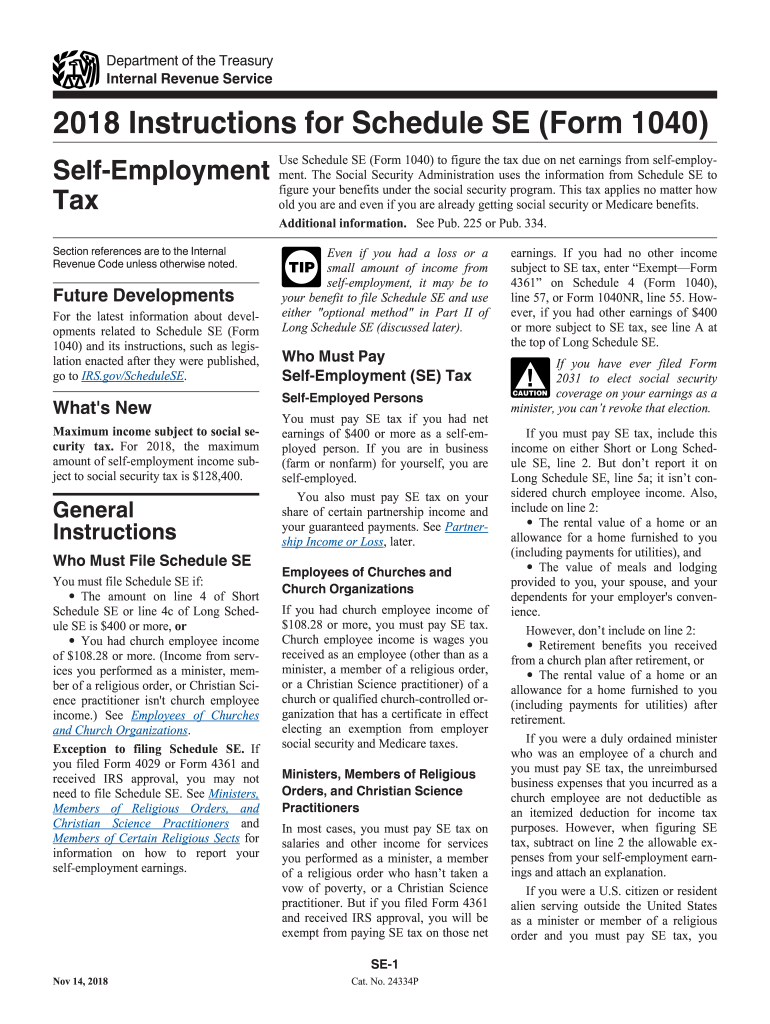







Definition and Purpose of the 2017 Schedule SE (Form 1040)
The 2017 Schedule SE (Form 1040) is a tax document used by self-employed individuals in the United States to calculate and report their self-employment tax. The form is essential for individuals who earn income through self-employment and ensures that both the Social Security and Medicare contributions are properly calculated based on the net earnings.
Key Components of the Form
- Income Reporting: The form captures net earnings from self-employment, which are subject to self-employment tax.
- Social Security Tax Calculation: It includes guidelines for calculating the portion of income subject to Social Security tax.
- Medicare Tax Component: It outlines the calculation for Medicare taxes.
- Deductions: Self-employed individuals can deduct half of the self-employment tax to determine the adjusted gross income (AGI) on Form 1040.
Steps to Complete the 2017 Schedule SE (Form 1040)
Filing the 2017 Schedule SE involves several steps to accurately calculate and report self-employment taxes. Follow the process below for a thorough completion:
- Determine Net Income: Calculate your net earnings by subtracting business expenses from gross income.
- Form Selection: Choose either the Short Schedule SE or Long Schedule SE based on your specific circumstances.
- Fill Out Schedule SE:
- Part I (Short Schedule SE): Use this if your net self-employment earnings are $400 or more and there are no tax-exempt provisions applicable to your situation.
- Part II (Long Schedule SE): For those with specific deductions, credits, or members of certain groups like clergy with income adjustment needs.
- Calculate Self-Employment Tax: Use the form to compute the Social Security and Medicare taxes on your self-employment income.
- Transfer Figures to Form 1040: Report the calculated self-employment tax on your Form 1040.
How to Obtain the 2017 Schedule SE (Form 1040)
Obtaining the 2017 Schedule SE is a straightforward process, accessible through multiple channels:
- Internal Revenue Service (IRS) Website: Download the form directly from the IRS's official website for free.
- Tax Preparation Software: Programs like TurboTax or QuickBooks typically include this form.
- Physical Copies: Visit local IRS offices or request a mailed copy by contacting the IRS.
Eligibility Criteria and Typical Users of the 2017 Schedule SE (Form 1040)
This form targets individuals with specific income sources and employment statuses:
- Self-Employed Individuals: Primarily designed for freelancers, independent contractors, and small business owners with self-employment income exceeding $400.
- Religious Employees: Includes specific clauses for church staff who are exempt from FICA taxes.
- Farmers and Fishermen: Specified provisions for these professions due to their unique income structures.


Important Terms Related to 2017 Schedule SE (Form 1040)
Understanding the terminology used in Schedule SE is crucial for accurate filing:
- Net Earnings: Total income from self-employment activities minus business expenses.
- Self-Employment Tax: A tax consisting of Social Security and Medicare taxes primarily for individuals not covered by employer-based programs.
- Deductions and Credits: Allowances that can reduce taxable income or taxes owed, impacting the net self-employment tax liability.
IRS Guidelines and Filing Deadlines for the 2017 Schedule SE
Adhering to IRS guidelines and important filing dates is crucial to avoid penalties:
- Deadline: Typically due on or before April 15 of the following year, coinciding with the federal tax return deadline.
- Extensions: Taxpayers can file for an automatic extension; however, self-employment taxes are still due by the original deadline.
- Amendments and Corrections: Use Form 1040X to amend any errors on a previously filed Schedule SE if discovered after submission.
Penalties for Non-Compliance with the 2017 Schedule SE (Form 1040)
Understanding the consequences of not complying with filing requirements is important for tax planning:
- Late Filing Penalties: A percentage of unpaid taxes accrued each month past the deadline, up to a maximum.
- Interest Charges: Accrued on any unpaid tax from the due date until the tax is paid in full.
- Negligence Penalties: If deemed negligent by IRS standards, further penalties may apply.
Digital vs. Paper Version of the 2017 Schedule SE (Form 1040)
Taxpayers have flexibility in the method of completing and submitting the form:
- Digital Submission: Utilize electronic filing via IRS-approved tax software for faster processing and confirmation.
- Paper Submission: Print and mail the form to the designated IRS location, as listed on the IRS website, ensuring timely delivery well ahead of the deadline to account for processing times.




