




01. Edit your form online
Type text, add images, blackout confidential details, add comments, highlights and more.

Type text, add images, blackout confidential details, add comments, highlights and more.

Draw your signature, type it, upload its image, or use your mobile device as a signature pad.

Send it via email, link, or fax. You can also download it, export it or print it out.
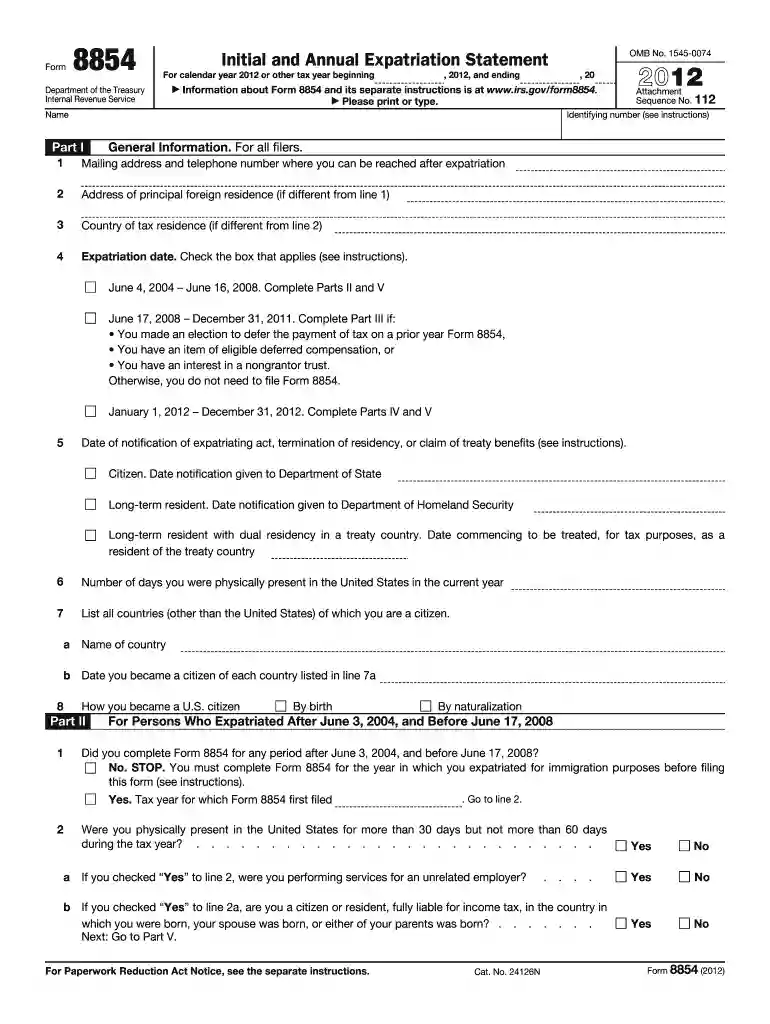
Form 8854, known as the Initial and Annual Expatriation Statement, serves as an official document for U.S. citizens and long-term residents who choose to expatriate. This form collects detailed information about the individual's expatriation process, including the expatriation date, tax residency status, and the individual's compliance with tax obligations. It plays a crucial role in managing taxes on income, assets, liabilities, and helps in deferring taxes on specific properties upon expatriation. The form ensures that all necessary tax liabilities are addressed when an individual decides to sever their official fiscal ties with the United States.
Proper utilization of Form 8854 can be essential for accurate reporting and compliance:


Form 8854 must be used in compliance with U.S. tax laws regarding expatriation. Filing accurately and timely ensures compliance; failure leads to penalties. Legal constraints prohibit falsification or omission of required information on this form.
The IRS provides specific instructions for completing Form 8854, including detailed guidance on each section, definitions of technical terms, and how to report expatriation accurately. Familiarity with these guidelines ensures proper filing and adherence to regulatory expectations.
Ensure compliance by cross-verifying information, adhering to deadlines, and using IRS resources for guidance.
We've got more versions of the 2012 form 8854 form. Select the right 2012 form 8854 version from the list and start editing it straight away!
| Versions | Form popularity | Fillable & printable |
|---|---|---|
| 2025 | 4.1 Satisfied (39 Votes) | |
| 2024 | 4.8 Satisfied (47 Votes) | |
| 2023 | 4.6 Satisfied (25 Votes) | |
| 2022 | 4.1 Satisfied (29 Votes) | |
| 2021 | 4.8 Satisfied (86 Votes) | |
| 2020 | 4.4 Satisfied (198 Votes) | |
| 2019 | 4.3 Satisfied (40 Votes) | |
| 2018 | 4.4 Satisfied (87 Votes) | |
| 2017 | 4 Satisfied (45 Votes) | |
| 2016 | 4.4 Satisfied (49 Votes) | |
| 2015 | 4.2 Satisfied (60 Votes) | |
| 2014 | 4 Satisfied (41 Votes) | |
| 2013 | 4 Satisfied (55 Votes) | |
| 2012 | 4.1 Satisfied (31 Votes) | |
| 2011 | 4 Satisfied (35 Votes) |
At DocHub, your data security is our priority. We follow HIPAA, SOC2, GDPR, and other standards, so you can work on your documents with confidence.


