




01. Edit your form online
Type text, add images, blackout confidential details, add comments, highlights and more.

Type text, add images, blackout confidential details, add comments, highlights and more.

Draw your signature, type it, upload its image, or use your mobile device as a signature pad.

Send it via email, link, or fax. You can also download it, export it or print it out.
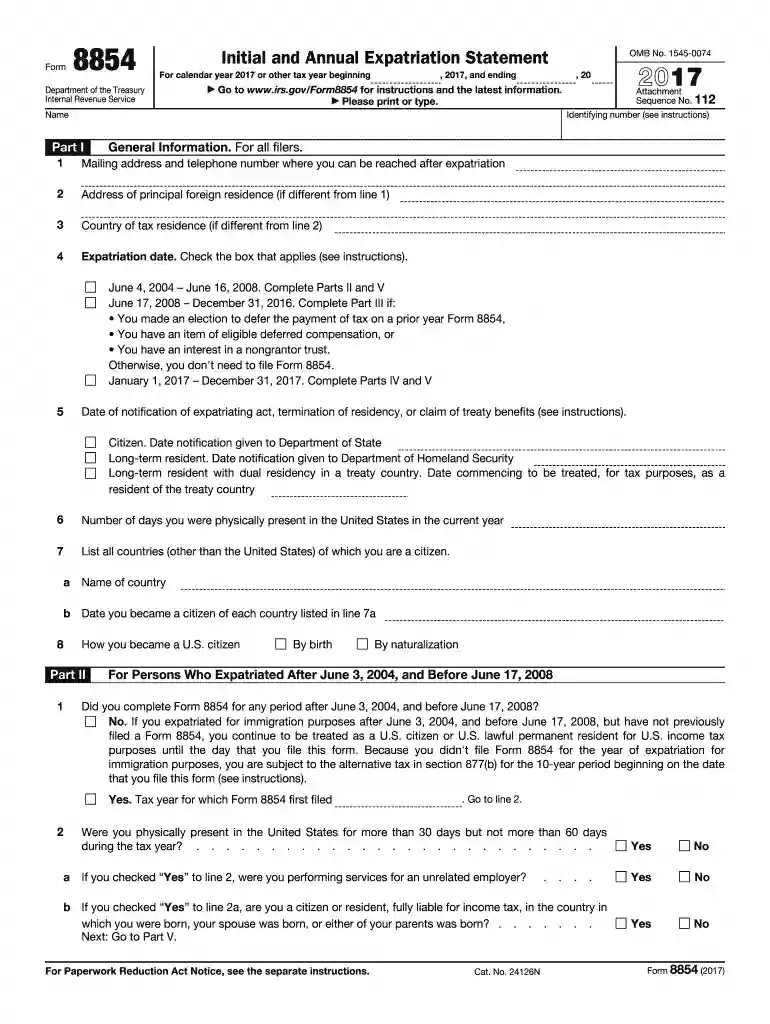
The IRS Form 8854, officially known as the Initial and Annual Expatriation Statement, is required for individuals who expatriated during the tax year 2017. This form plays a crucial role in reporting tax obligations related to expatriation. Filers must provide essential information such as their personal details, the date of expatriation, tax residency status, and financial data, including income and net worth. This data ensures compliance with U.S. tax regulations for those who renounce their citizenship or terminate long-term U.S. residency.
Utilizing Form 8854 requires understanding its sections and accurately completing each part. It involves:
Completing Form 8854 requires careful attention to each section:
Form 8854 is primarily used by:


Significant components of Form 8854 include:
The timing for filing Form 8854 is critical:
Failure to properly file Form 8854 can lead to:
Form 8854 is governed by specific IRS guidelines:
Knowing who needs to file is crucial:

Options for submitting Form 8854 include:
Each of these sections provides a thorough overview of the 2017 IRS Form 8854, ensuring filers understand the form's requirements and implications for those renouncing U.S. citizenship or terminating residency.
We've got more versions of the irs form 8854 2017 form. Select the right irs form 8854 2017 version from the list and start editing it straight away!
| Versions | Form popularity | Fillable & printable |
|---|---|---|
| 2025 | 4.1 Satisfied (39 Votes) | |
| 2024 | 4.8 Satisfied (47 Votes) | |
| 2023 | 4.6 Satisfied (25 Votes) | |
| 2022 | 4.1 Satisfied (29 Votes) | |
| 2021 | 4.8 Satisfied (86 Votes) | |
| 2020 | 4.4 Satisfied (198 Votes) | |
| 2019 | 4.3 Satisfied (40 Votes) | |
| 2018 | 4.4 Satisfied (87 Votes) | |
| 2017 | 4 Satisfied (45 Votes) | |
| 2016 | 4.4 Satisfied (49 Votes) | |
| 2015 | 4.2 Satisfied (60 Votes) | |
| 2014 | 4 Satisfied (41 Votes) | |
| 2013 | 4 Satisfied (55 Votes) | |
| 2012 | 4.1 Satisfied (31 Votes) | |
| 2011 | 4 Satisfied (35 Votes) |
At DocHub, your data security is our priority. We follow HIPAA, SOC2, GDPR, and other standards, so you can work on your documents with confidence.
Form 8854 (2017). Page 2. Form 8854 (2017). Page 2. Part III. For Persons Who Expatriated After June 16, 2008, and Before January 1, 2017. If you made anRead more
Form 8854, initial and annual expatriation information statement. Related to : Form 8854, initial and annual expatriation information statement. Related to


