




01. Edit your form 8854 online
Type text, add images, blackout confidential details, add comments, highlights and more.

Type text, add images, blackout confidential details, add comments, highlights and more.

Draw your signature, type it, upload its image, or use your mobile device as a signature pad.

Send 2021 form 8854 via email, link, or fax. You can also download it, export it or print it out.
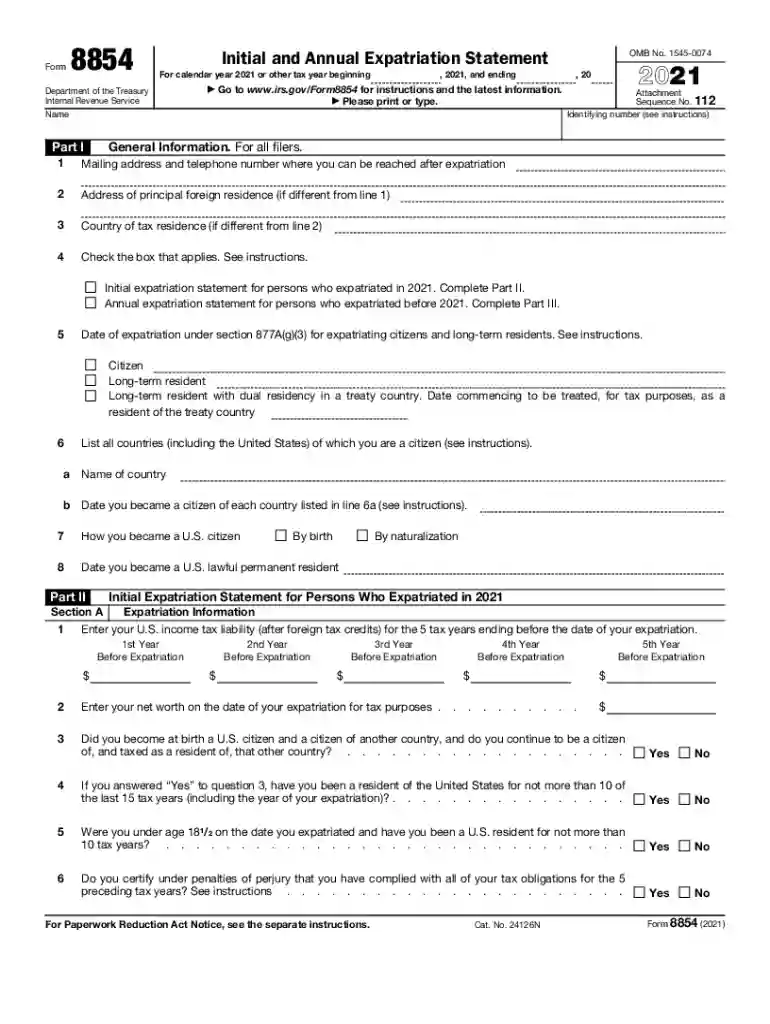
Form 8854, known as the Initial and Annual Expatriation Statement, is utilized by individuals who have expatriated from the United States. This form serves to document compliance with U.S. tax obligations for those who have renounced their citizenship or terminated their long-term residency. It requires detailed disclosure of personal information, tax liabilities, net worth, and assets at the time of expatriation. By submitting this form, individuals confirm they have met the necessary financial and legal criteria set forth by the U.S. Internal Revenue Service (IRS).
Form 8854 is essential for multiple stages of the expatriation process. Initially, it assists in evaluating whether an individual is a "covered expatriate" under U.S. tax law, based on specific thresholds for income tax compliance and net worth. It is used during the year of expatriation to report all qualifying events and ensure fulfillment of any remaining tax obligations. Annually, it must be submitted if the expatriation event is yet unresolved, making it a pivotal part of continued compliance for expatriates.
Securing Form 8854 is straightforward. The form is available for download directly from the IRS website. Additionally, it can be accessed through tax preparation software such as TurboTax or by working with a professional tax advisor. Ensure the most current version is used to reflect recent changes in tax law or procedural updates.
Completing Form 8854 involves several critical steps:
Gather Required Personal Information: Include personal details such as your name, address, and taxpayer identification number.
Identify Expatriation Status: Declare your expatriation date and provide evidence supporting your change in status.
Detail Financial Information: Disclose worldwide income, assets, liabilities, and net worth as of your expatriation date.
Calculate Tax Liabilities: Determine any applicable expatriation tax, considering your status as a covered expatriate.
Submit the Form: Ensure all sections are completed accurately before sending to the IRS by the specified deadline.
Filing deadlines vary depending on individual circumstances. Generally, Form 8854 is due by the tax return deadline for the year in which expatriation occurs, usually April 15. However, extensions may be granted under certain conditions, aligning with standard federal income tax filing extensions. Timely submission is crucial to avoid penalties or additional scrutiny from the IRS.
Form 8854 is composed of several critical elements:
Part I: Personal Information - Captures essential data to identify the expatriate.
Part II: Instructions for determining whether the expatriate is a covered expatriate.
Part III: Financial Data - Requires comprehensive accounts of assets, liabilities, and net worth.
Part IV: Expatriation Tax Calculation - Assesses the tax implications associated with expatriation.
Detailed attention is necessary in each part to ensure compliance and accuracy.
The IRS provides comprehensive guidelines to ensure accurate completion of Form 8854. These include instructions for defining expatriation events, calculating expatriation taxes, and understanding the implications as a covered expatriate. The IRS website is the primary source for detailed instructions, offering downloadable documentation and examples for clarity.
Failing to file Form 8854 or providing incorrect information can result in severe consequences. Non-compliance may attract penalties, including fines and accrued interest on unpaid taxes. The IRS mandates full disclosure and accuracy, ensuring all expatriation obligations are addressed. It's paramount to adhere strictly to guidelines and deadlines to mitigate any risk of punitive action.
These sections provide detailed guidance on how to understand, complete, and submit Form 8854, covering its uses and importance for expatriated individuals. They emphasize compliance and the potential penalties for failing to uphold IRS mandates.
We've got more versions of the form 8854 form. Select the right form 8854 version from the list and start editing it straight away!
| Versions | Form popularity | Fillable & printable |
|---|---|---|
| 2025 | 4.1 Satisfied (39 Votes) | |
| 2024 | 4.8 Satisfied (47 Votes) | |
| 2023 | 4.6 Satisfied (25 Votes) | |
| 2022 | 4.1 Satisfied (29 Votes) | |
| 2021 | 4.8 Satisfied (86 Votes) | |
| 2020 | 4.4 Satisfied (198 Votes) | |
| 2019 | 4.3 Satisfied (40 Votes) | |
| 2018 | 4.4 Satisfied (87 Votes) | |
| 2017 | 4 Satisfied (45 Votes) | |
| 2016 | 4.4 Satisfied (49 Votes) | |
| 2015 | 4.2 Satisfied (60 Votes) | |
| 2014 | 4 Satisfied (41 Votes) | |
| 2013 | 4 Satisfied (55 Votes) | |
| 2012 | 4.1 Satisfied (31 Votes) | |
| 2011 | 4 Satisfied (35 Votes) |
At DocHub, your data security is our priority. We follow HIPAA, SOC2, GDPR, and other standards, so you can work on your documents with confidence.
; Form 8854, initial and annual expatriation information statement. ; United States. Internal Revenue Service. ;. ; Washington, D.C. : Dept. of the TreasuryRead more
Apr 24, 2026 Expatriation tax provisions apply to U.S. citizens who have relinquished their citizenship and long-term residents who have ended theirRead more


