




01. Edit your form online
Type text, add images, blackout confidential details, add comments, highlights and more.

Type text, add images, blackout confidential details, add comments, highlights and more.

Draw your signature, type it, upload its image, or use your mobile device as a signature pad.

Send it via email, link, or fax. You can also download it, export it or print it out.
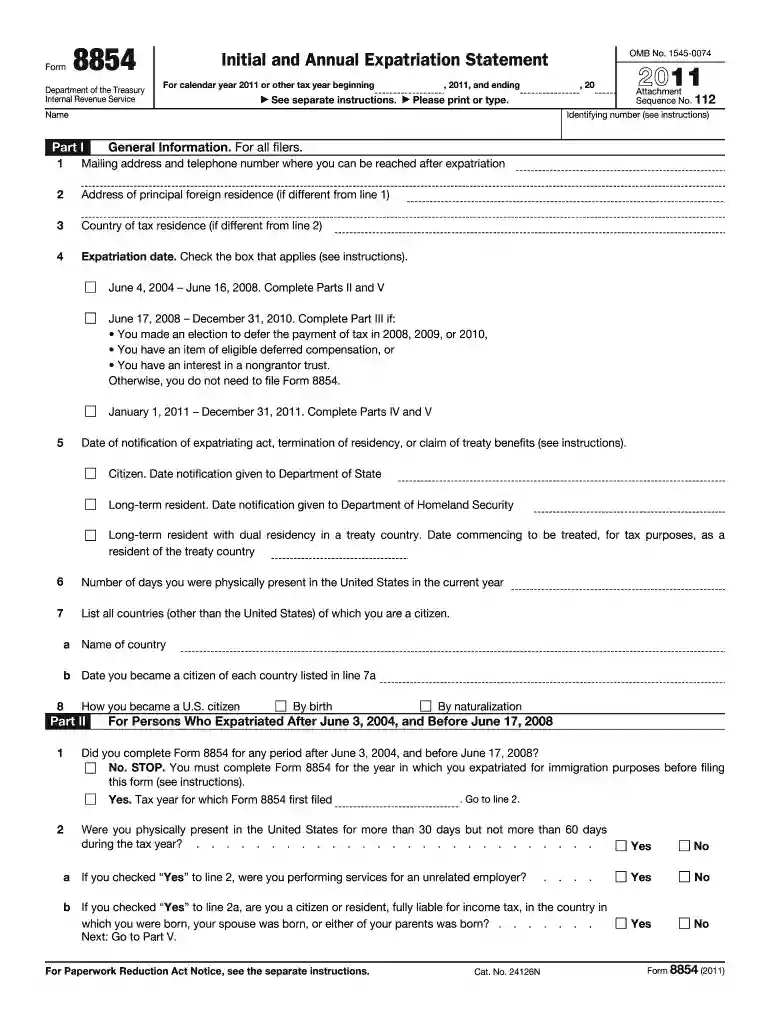
Form 8854, known as the Initial and Annual Expatriation Statement, is utilized by the IRS to collect pertinent information from individuals expatriating from the United States. This form requires expatriates to disclose their expatriation date, tax residency status, and detailed financial information, including tax liability and net worth. It is structured to ensure compliance with U.S. tax laws, serving as a critical document for individuals who no longer maintain U.S. citizenship or long-term residency.
Gather Required Information: Before you begin, collect details about your tax residency status, expatriation date, and financial information such as net worth and income.
General Information: Fill out Section I with your personal data, including your name, address, and taxpayer identification number.
Expatriation Details: In Section II, detail your expatriation date and explain the circumstances of your expatriation.
Financial Information: Complete Sections III and IV with your income statements and a detailed list of all assets and liabilities as of the expatriation date.
Review and Sign: Carefully review the form for accuracy before signing and dating it. Consult with a tax professional if necessary.
The deadline for filing Form 8854 depends on your specific circumstances. Generally, it should be submitted by the due date of your tax return for the year in which the expatriation occurred. This typically means the form is due by April 15th of the following year. If an extension is required, the form must be filed by the extended deadline.
The 8854 form for the year 2011 can be obtained directly from the IRS website, where it's available for download as a PDF. Additionally, the form can often be accessed through tax software programs like TurboTax and QuickBooks, which may provide guided assistance in filling it out.
Form 8854 is used primarily by U.S. citizens and long-term residents who have chosen to expatriate. This includes individuals renouncing their U.S. citizenship or terminating their long-term resident status. It's utilized by those whose expatriation might affect their U.S. tax obligations.


Complying with Form 8854 requirements is essential for avoiding potential tax penalties. The IRS mandates this form to ensure that expatriates continue to meet their tax obligations. Failure to file may lead to significant penalties, including an initial penalty and potential increased tax liability.
Each section requires precision and accuracy to fulfill IRS expectations. Erroneous information can result in penalties or delays, so thoroughness is crucial.
The IRS provides specific guidelines on completing Form 8854. These include instructions on calculating net worth and taxable income, listing assets and liabilities, and ensuring all expatriation details are accurately reflected. Consulting IRS documentation or a tax professional is advised for complex financial situations.
Consider a U.S. citizen who has decided to relocate permanently to another country. Upon renouncing their citizenship, they must submit Form 8854 to disclose their financial situation at the time of expatriation. Another example is a long-term resident opting to return to their country of origin, necessitating this form to finalize their change in tax status.
Failing to file Form 8854 or submitting incorrect information can lead to steep penalties and additional tax liabilities defined by the IRS. The penalty fee for non-compliance can be as substantial as $10,000, making it necessary to prioritize accuracy and timeliness in submission.
By following these detailed insights and procedural steps, individuals can ensure they meet all compliance and regulatory requirements associated with expatriation, thus avoiding unintended legal and financial consequences.
We've got more versions of the 8854 2011 form form. Select the right 8854 2011 form version from the list and start editing it straight away!
| Versions | Form popularity | Fillable & printable |
|---|---|---|
| 2025 | 4.1 Satisfied (39 Votes) | |
| 2024 | 4.8 Satisfied (47 Votes) | |
| 2023 | 4.6 Satisfied (25 Votes) | |
| 2022 | 4.1 Satisfied (29 Votes) | |
| 2021 | 4.8 Satisfied (86 Votes) | |
| 2020 | 4.4 Satisfied (198 Votes) | |
| 2019 | 4.3 Satisfied (40 Votes) | |
| 2018 | 4.4 Satisfied (87 Votes) | |
| 2017 | 4 Satisfied (45 Votes) | |
| 2016 | 4.4 Satisfied (49 Votes) | |
| 2015 | 4.2 Satisfied (60 Votes) | |
| 2014 | 4 Satisfied (41 Votes) | |
| 2013 | 4 Satisfied (55 Votes) | |
| 2012 | 4.1 Satisfied (31 Votes) | |
| 2011 | 4 Satisfied (35 Votes) |
At DocHub, your data security is our priority. We follow HIPAA, SOC2, GDPR, and other standards, so you can work on your documents with confidence.
1. Complete columns (a), (b), and (c) for all property on which you deferred tax on a prior-year Form 8854. Complete column (d) for anyRead more
Feb 26, 2020 Please follow the instructions below to complete the EGI form. Please email SOMSecurity@vcuhealth.org with any questions concerning this processRead more
Jan 1, 2016 This is Volvo Car Group. 2015 in brief. CEO comment. Our year. Our world. Challenges and opportunities. Strategy section.Read more


