
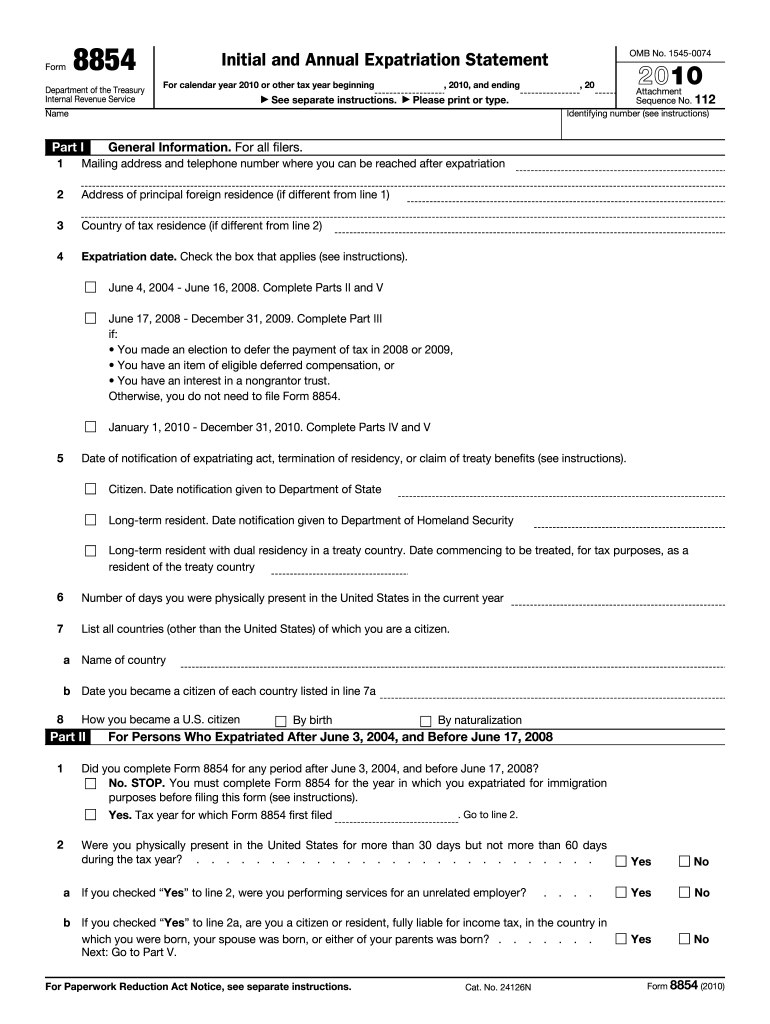







Definition and Meaning of Form 8854
Form 8854, known as the Initial and Annual Expatriation Statement, is a document required by the IRS for U.S. citizens and long-term residents who are expatriating. This form collects detailed information on an individual’s expatriation date, citizenship status, and financial details like income tax liabilities, net worth, deferred compensation, and trusts. The purpose of this form is to ensure compliance with U.S. tax obligations after an individual has chosen to expatriate.
How to Obtain Form 8854
Individuals can obtain Form 8854 through the IRS website, where it can be downloaded in PDF format. It is crucial to access the correct version for the year you are filing; for instance, the 2010 version can be specifically located through the IRS's form index. For those who require a paper copy, contacting the IRS directly for postal mail delivery is another option. Beyond these methods, tax software like TurboTax may offer a digital version of Form 8854 as part of their package for easy filing.
Steps to Complete Form 8854
- Personal Information: Start by providing your full name, social security number, and expatriation date in Part I.
- Net Worth Assessment: In Part IV, calculate your net worth, including all worldwide assets. This section requires a detailed account of all properties, investments, and personal belongings.
- Certification Requirement: Verify compliance with U.S. tax obligations for the five years preceding the expatriation year under Part V.
- Income Reporting: Under Part VI, report any income and liabilities that remain relevant after expatriation to ensure tax compliance.
- Signature and Date: Finally, ensure the form is signed and dated before submission to confirm the information is accurate and complete.
Key Elements of Form 8854
- Expatriation Date: The exact date an individual ceases to be a U.S. citizen or long-term resident.
- Annual Certification: A statement of compliance with U.S. tax obligations for the five years prior to expatriation.
- Net Worth: Total market value of an individual's assets minus any liabilities at the time of expatriation.
- Financial Details: Includes deferred compensation, trust interests, and other pertinent financial components affecting taxation.
Why Should You Use Form 8854
Completing Form 8854 is a legal requirement for expatriates to report their tax responsibilities and finalize their U.S. tax obligations. This includes determining if an individual falls under the category of a covered expatriate, which can result in tax consequences such as an exit tax. Understanding and accurately completing this form avoids potential penalties and ensures compliance with IRS rules, preserving an individual's legal status post-expatriation.
Examples of Using Form 8854
- Retiring Abroad: A U.S. citizen retiring in another country leverages Form 8854 to report their expatriation status, providing details of their retirement accounts and investments to the IRS.
- Dual Citizenship: An individual renouncing U.S. citizenship for dual nationality in another country uses this form to manage tax reporting and ensure they meet all IRS obligations.
Filing Deadlines for Form 8854
Form 8854 should be filed by the applicable due date of the taxpayer’s income tax return, including extensions. Typically, this is April 15th of the year following expatriation. Extensions can be sought for filing U.S. income tax returns, which also extends the deadline for Form 8854.
IRS Guidelines for Form 8854
The IRS provides comprehensive instructions including line-by-line guidance, examples of calculations for net worth, and clarification of terms such as “covered expatriate.” These guidelines are essential for accurately completing the form and avoiding common errors. Compliance with these guidelines ensures accurate representation of an individual’s financial situation to meet federal tax compliance standards.




