




01. Edit your 8854 instructions online
Type text, add images, blackout confidential details, add comments, highlights and more.

Type text, add images, blackout confidential details, add comments, highlights and more.

Draw your signature, type it, upload its image, or use your mobile device as a signature pad.

Send form 8854 via email, link, or fax. You can also download it, export it or print it out.
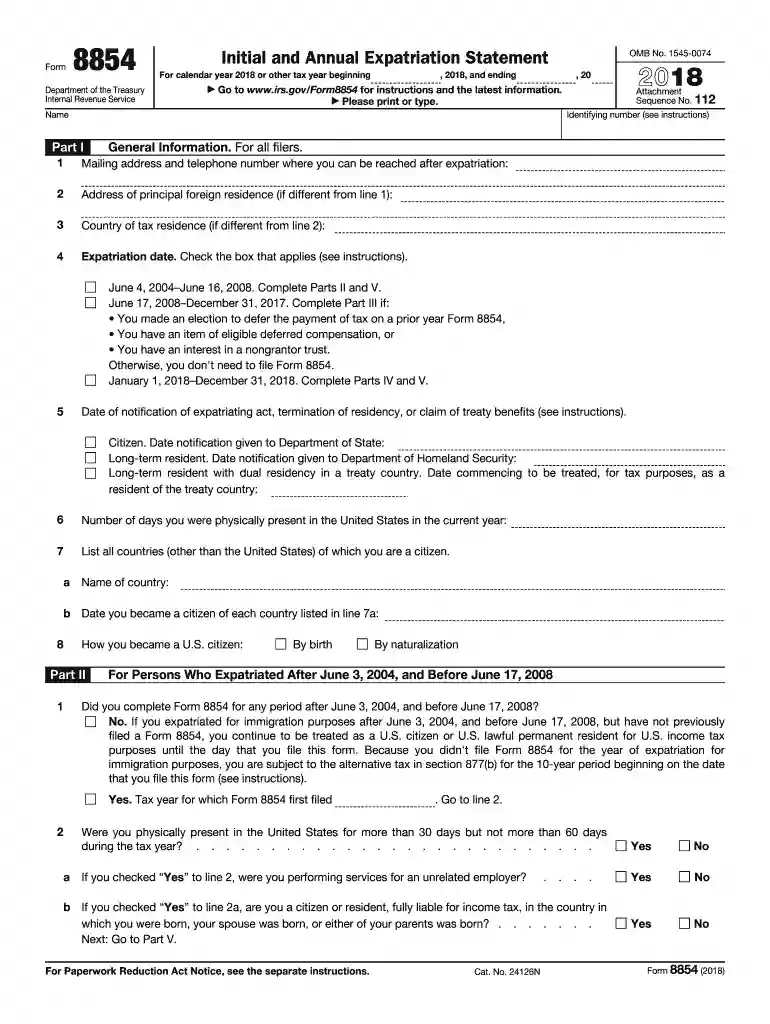
Form 8854, also known as the Initial and Annual Expatriation Statement, is utilized by individuals who have expatriated, or ceased to be U.S. citizens or long-term residents. This form is crucial for reporting tax obligations associated with expatriation. Filers must provide personal information and financial details such as income and net worth, enabling the IRS to assess tax liabilities. It helps ensure compliance with U.S. tax laws even after an individual's expatriation.
When completing Form 8854, the instructions serve as a comprehensive guide to help you accurately fill out each section. The instructions detail the eligibility criteria, definitions of important terms, and the sequential steps necessary to complete the form. Following the instructions closely is vital, as they emphasize specific requirements and provide clarity on complex tax matters related to expatriation.
Collect Personal Information: Gather essential personal details, including your name, Social Security Number, and expatriation date.
Financial Reporting: Fill in information regarding your income, assets, and net worth. This includes declaring any taxable assets at the time of expatriation.
Determine Expatriation Date: Clearly state your expatriation date, as this affects your tax obligations.
Complete Sections Based on Expatriation Category: Follow differing requirements depending on whether you are filing as a covered expatriate or not.
Review Filing Deadlines: Ensure submission aligns with the IRS deadlines to avoid penalties.
Definitions: Understand important terms such as “covered expatriate,” “mark-to-market tax,” and “dual-status alien.”
Filing Deadlines: Know specific dates by which the form must be submitted, usually coinciding with your annual tax return deadlines.
Reporting Requirements: Detailed information on what must be reported, including income sourced both from the U.S. and globally.
Penalties for Non-Compliance: Outlines penalties for failing to file or inaccuracies in reporting.
The instructions are primarily used by individuals who choose to renounce their U.S. citizenship or relinquish their long-term U.S. resident status. This includes citizens leaving the U.S. for permanent residence abroad, long-term green cardholders surrendering their status, and those seeking to ensure compliance with U.S. expatriation tax laws.


Expatriation Date: The date you officially cease to be a U.S. citizen or resident for tax purposes.
Covered Expatriate: An individual meeting certain thresholds of net worth or tax liability, subject to specific taxes.
Mark-to-Market Tax: A tax on unrealized gains for individuals deemed as covered expatriates.
A retiree moving to another country may need to complete Form 8854 to report final U.S. tax obligations. Another scenario might involve a former green card holder who decides to permanently reside outside the U.S., necessitating a clear understanding of expatriation tax requirements to avoid penalties.
The IRS provides guidelines integral to the completion of Form 8854. These include detailed criteria on tax obligations upon expatriation, determination of expatriation status, and specific instructions for calculating any applicable taxes owed. The IRS expects full compliance with these guidelines to ensure accurate and complete reporting.
The form should be filed by the due date of your federal tax return, including extensions. Typically, the deadline aligns with the regular April 15 tax filing date or October 15 if an extension is granted. Timeliness is critical to avoid interest and penalties.
We've got more versions of the 8854 instructions form. Select the right 8854 instructions version from the list and start editing it straight away!
| Versions | Form popularity | Fillable & printable |
|---|---|---|
| 2025 | 4.1 Satisfied (39 Votes) | |
| 2024 | 4.8 Satisfied (47 Votes) | |
| 2023 | 4.6 Satisfied (25 Votes) | |
| 2022 | 4.1 Satisfied (29 Votes) | |
| 2021 | 4.8 Satisfied (86 Votes) | |
| 2020 | 4.4 Satisfied (198 Votes) | |
| 2019 | 4.3 Satisfied (40 Votes) | |
| 2018 | 4.4 Satisfied (87 Votes) | |
| 2017 | 4 Satisfied (45 Votes) | |
| 2016 | 4.4 Satisfied (49 Votes) | |
| 2015 | 4.2 Satisfied (60 Votes) | |
| 2014 | 4 Satisfied (41 Votes) | |
| 2013 | 4 Satisfied (55 Votes) | |
| 2012 | 4.1 Satisfied (31 Votes) | |
| 2011 | 4 Satisfied (35 Votes) |
At DocHub, your data security is our priority. We follow HIPAA, SOC2, GDPR, and other standards, so you can work on your documents with confidence.
Dec 8, 2025 Form 8854 is used by expatriates to DocHub compliance with tax obligations in the 5 years before expatriation and to comply with their initialRead more
Form 8854, initial and annual expatriation information statement Some forms and instructions also available in: United States. InternalRead more


