




01. Edit your form 709 online
Type text, add images, blackout confidential details, add comments, highlights and more.

Type text, add images, blackout confidential details, add comments, highlights and more.

Draw your signature, type it, upload its image, or use your mobile device as a signature pad.

Send from 709 via email, link, or fax. You can also download it, export it or print it out.
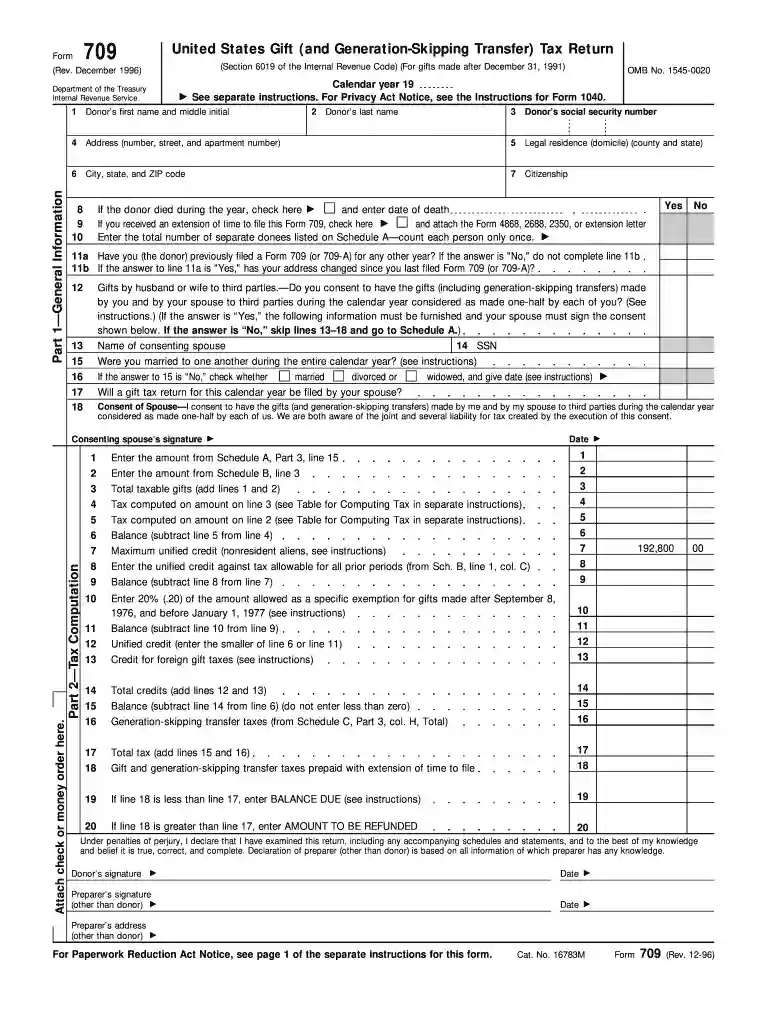
1996 Form 709 is crucial for documenting the giving of gifts and handling Generation-Skipping Transfer (GST) taxes in the United States. This form is officially known as the United States Gift (and Generation-Skipping Transfer) Tax Return. Individuals who have made significant gifts after December 31, 1991, typically need to fill out this form for proper reporting to the IRS. It covers specific sections such as the donor's information, details of gifts given, and tax computations related to taxable gifts.
To effectively use the 1996 Form 709, it is necessary to gather detailed information regarding any gifts that have been made throughout the year. The form requires documentation about the recipients (donees), the value of the gifted assets, and applicable deductions or credits. Accurately filling out each section ensures compliance with IRS guidelines and helps in tax computations for any applicable gift or GST taxes.
The 1996 Form 709 can be accessed through various means such as direct download from the IRS website, requesting a copy via mail, or obtaining it physically from an IRS office. Securing this form through reliable methods ensures you have the correct version that aligns with legal regulations for the specific year.
The deadline to file the 1996 Form 709 aligns with the annual tax return due date, which typically falls on April 15th of the following year. Filing extensions are available upon request, although they require adherence to specified procedures and limits. Timely submission of this form helps to avert potential penalties or complications.
Several critical components make up the 1996 Form 709, each demanding attention for accurate completion:
The legal framework surrounding the 1996 Form 709 involves strictly adhering to federal tax regulations regarding gift reporting and payment of applicable taxes. Utilization of the form must comply with IRS standards to prevent any legal infringement or penalties. Proper use guarantees the taxpayer meets all federal guidelines and avoids missteps that could lead to audits or legal consequences.
Adhering to IRS guidelines is crucial for the successful completion and submission of Form 709. These guidelines dictate how to calculate exclusions, apply the unified credit, and document gifts accurately to ensure compliance. The IRS provides comprehensive instructions for filling out the form, thereby reducing potential errors and facilitating accurate tax reporting.
Failure to file Form 709 when required can lead to substantial penalties, including fines and interest on owed taxes. Misreporting or underreporting the amounts can result in legal scrutiny and additional charges. Maintaining adherence to submission guidelines helps in mitigating risks of legal issues or financial repercussions from the IRS.
We've got more versions of the form 709 form. Select the right form 709 version from the list and start editing it straight away!
| Versions | Form popularity | Fillable & printable |
|---|---|---|
| 2025 | 4.3 Satisfied (24 Votes) | |
| 2024 | 4.2 Satisfied (58 Votes) | |
| 2023 | 4.4 Satisfied (50 Votes) | |
| 2022 | 4.9 Satisfied (46 Votes) | |
| 2021 | 4.9 Satisfied (24 Votes) | |
| 2020 | 4.3 Satisfied (180 Votes) | |
| 2019 | 4.3 Satisfied (183 Votes) | |
| 2018 | 4.3 Satisfied (183 Votes) | |
| 2017 | 4.2 Satisfied (54 Votes) | |
| 2016 | 4.4 Satisfied (60 Votes) | |
| 2015 | 4 Satisfied (25 Votes) | |
| 2014 | 4 Satisfied (38 Votes) | |
| 2013 | 4.3 Satisfied (55 Votes) | |
| 2012 | 4.1 Satisfied (59 Votes) | |
| 2011 | 4 Satisfied (41 Votes) |
At DocHub, your data security is our priority. We follow HIPAA, SOC2, GDPR, and other standards, so you can work on your documents with confidence.
A Form 709 is timely filed if it is filed on or before the date required for reporting the transfer if it were a taxable gift (i.e., the date prescribed byRead more
This form of Combined reporting was approved by the ICC Accounting and 709, 708. - Accrued Accounts Receivables. 158,224. 179,591. 8. 9.Read more
Aug 7, 2025 Title Application for Automatic Extension of Time To File Form 709 or Form 709-NA and/or Payment of Gift/Generation-Skipping Transfer TaxRead more


