01. Edit your form online
Type text, add images, blackout confidential details, add comments, highlights and more.

Type text, add images, blackout confidential details, add comments, highlights and more.

Draw your signature, type it, upload its image, or use your mobile device as a signature pad.

Send it via email, link, or fax. You can also download it, export it or print it out.
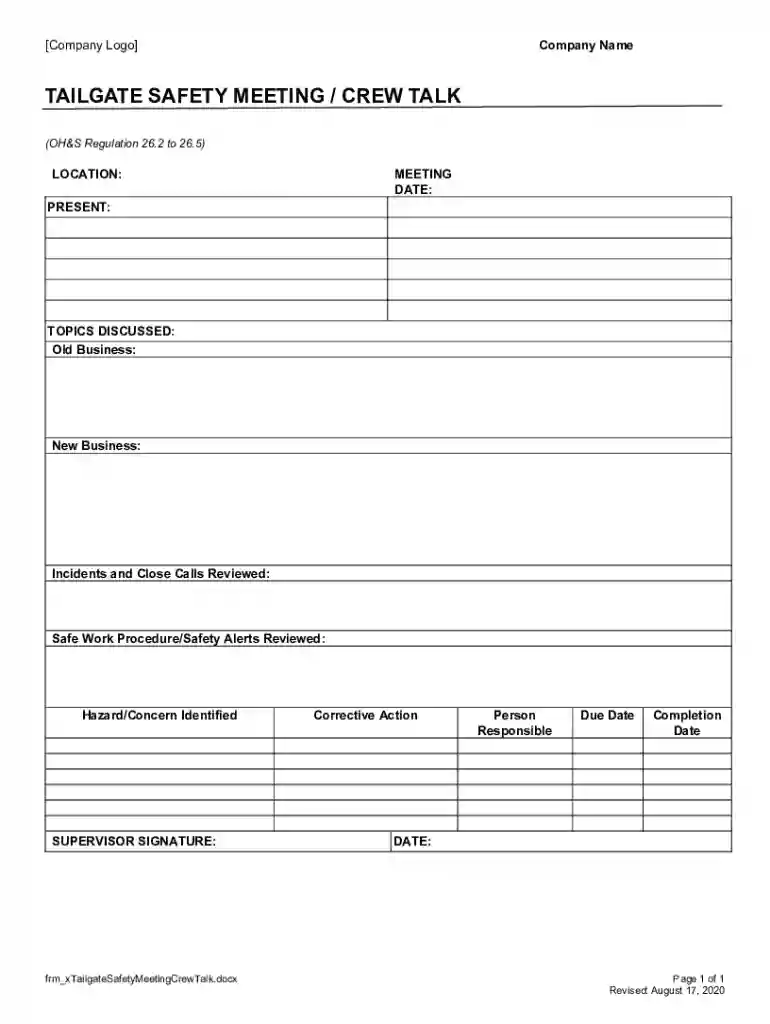
The "Tailgate Meeting Form Tailgate Safety Meeting Crew Talk" is a structured tool utilized in occupational health and safety settings, primarily for documenting safety discussions that occur in the field. These meetings, often referred to as tailgate meetings, are informal safety talks conducted before the commencement of a work shift to address safety protocols, identify potential hazards, and communicate relevant policies or updates. The form serves as a record-keeping device to ensure compliance with safety regulations, providing a systematic approach for capturing key discussion points and actions agreed upon during these meetings.
Using the Tailgate Meeting Form effectively involves several steps to ensure comprehensive documentation and enhanced crew safety. Here is a simplified guide:
Preparation Before Meeting: Prior to conducting the meeting, review any safety incidents from previous meetings, updates in safety protocols, and company-specific safety guidelines.
Initiating the Session: Gather the crew and explain the purpose of the tailgate meeting. Outline the agenda and encourage participation from all members.
Documenting Discussions: Utilize the form to record the date, location, names of attendees, and key topics discussed.
Identifying Hazards: Note specific hazards relevant to the day's tasks. Discuss past incidents and preventive measures, ensuring these are clearly recorded in the form.
Setting Corrective Actions: Identify any corrective actions needed, assign responsibilities to specific crew members, and set deadlines for each task. Document these details on the form.
Review & Sign-off: Conclude the meeting by reviewing the documented items with the team, ensuring agreement and understanding. Secure signatures from all attendees to validate the meeting's conclusions.
Completing the Tailgate Meeting Form requires a detailed approach to ensure every aspect of the safety meeting is accurately captured. Follow this step-by-step guide:
Header Information:
Agenda Overview:
Discussion Points:
Hazard Identification:
Corrective Measures:
Validation:
Understanding the key elements of the Tailgate Meeting Form is crucial for its effective use. The form typically includes:
Attendee Details: Names and roles of those attending the meeting are crucial for accountability.
Meeting Agenda: A pre-defined list of topics ensures focused and productive discussions.
Hazard Identification Section: A dedicated space for noting down hazards associated with the tasks to be performed.
Corrective Actions: Clearly defined actions with the assignment of responsibilities to address identified issues.
Sign-Off Area: Space for signatures to validate attendance and agreement on the discussed safety measures.
The Tailgate Meeting Form plays a significant role in legal compliance within workplace safety regulations. Here are some considerations:
Regulatory Compliance: The form is often used to demonstrate adherence to OSHA (Occupational Safety and Health Administration) standards, showing that safety meetings are routinely conducted and documented.
Incident Documentation: In case of occupational accidents, completed forms serve as evidence that due diligence was observed through regular safety discussions.
Employer Protection: Ensures that an organization has records of safety protocols being communicated, potentially mitigating liability in the event of safety violations.
In practical settings, the Tailgate Meeting Form can be used in various scenarios:
Construction Sites: To discuss daily tasks and pinpoint machinery-related hazards, ensuring workers understand new safety updates.
Manufacturing Facilities: For assembly line teams to review procedural changes and record discussions about equipment safety.
Transportation and Logistics: To address driving safety rules, discuss route changes, and document understanding among vehicle operators.
Utility Services: To prepare teams for maintenance jobs, highlighting electrical or water safety hazards specific to the day’s operations.
While the Tailgate Meeting Form is a standard in many industries for daily safety check-ins, there might be variations or alternative means for similar purposes:
Digital Forms: Many companies are transitioning to digital versions for easier access and streamlined record-keeping.
Safety Apps: Applications designed for safety management can function as alternatives, offering features like automated alerts and digital signatures.
Custom Templates: Organizations may create tailored forms specific to their operational needs which can be utilized alongside or in place of standard forms.
Certain business types find immense value in the regular use of the Tailgate Meeting Form:
Construction Firms: With high-risk environments, these firms leverage the form to ensure crew safety and compliance with industry regulations.
Manufacturing Companies: Use the form to maintain regular safety briefings as a proactive strategy to prevent industrial accidents.
Logistics Operators: Regularly hold safety talks using the form to address the ever-changing logistics operations and transit safety protocols.
Public Utilities: Benefit from structured safety discussions given the potential for public and worker exposure to risks.
We've got more versions of the Tailgate Meeting Form Tailgate Safety Meeting Crew Talk form. Select the right Tailgate Meeting Form Tailgate Safety Meeting Crew Talk version from the list and start editing it straight away!
| Versions | Form popularity | Fillable & printable |
|---|---|---|
| 2020 | 4.5 Satisfied (23 Votes) | |
| 2020 | 4.9 Satisfied (51 Votes) | |
| 2016 | 4.1 Satisfied (52 Votes) | |
| 2014 | 4 Satisfied (61 Votes) | |
| 2014 | 4.8 Satisfied (60 Votes) | |
| 2014 | 4.4 Satisfied (37 Votes) | |
| 2013 | 4.3 Satisfied (24 Votes) | |
| 2013 | 4.5 Satisfied (52 Votes) | |
| 2011 | 4 Satisfied (44 Votes) | |
| 2004 | 4.5 Satisfied (39 Votes) | |
| 2003 | 4.8 Satisfied (127 Votes) | |
| 2000 | 4.8 Satisfied (101 Votes) |
At DocHub, your data security is our priority. We follow HIPAA, SOC2, GDPR, and other standards, so you can work on your documents with confidence.