




01. Edit your form online
Type text, add images, blackout confidential details, add comments, highlights and more.

Type text, add images, blackout confidential details, add comments, highlights and more.

Draw your signature, type it, upload its image, or use your mobile device as a signature pad.

Send it via email, link, or fax. You can also download it, export it or print it out.
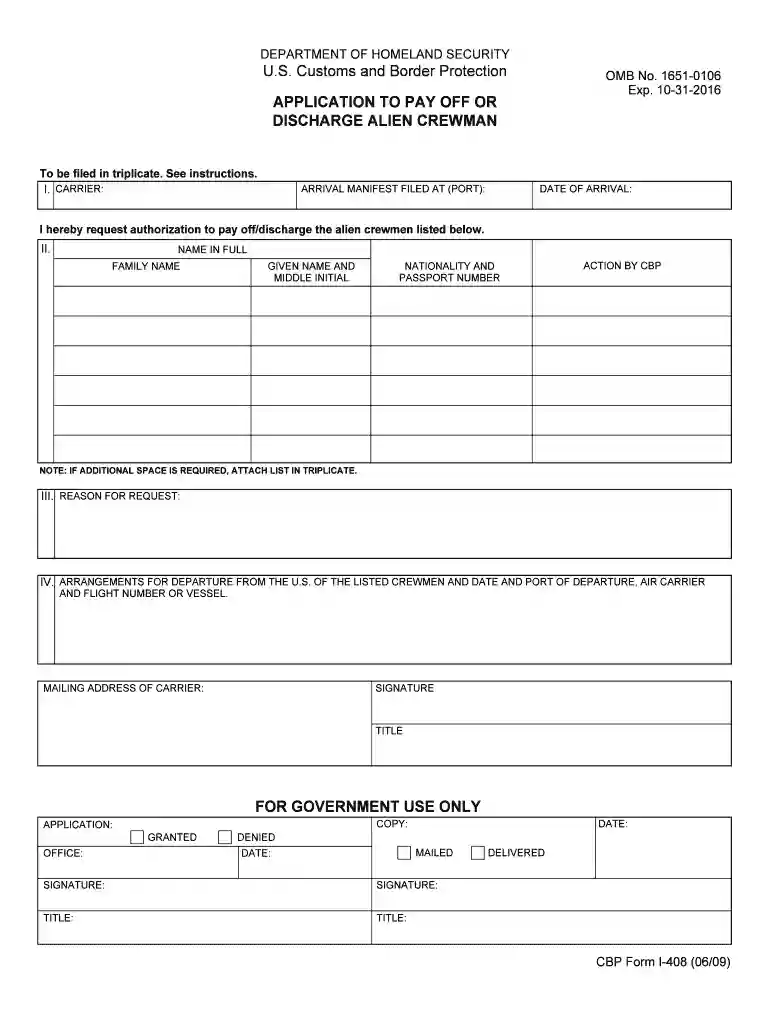
The "Agency Clearance Officer, U.S. Customs and Border Protection" form is an essential documentation tool used primarily by carriers to request authorization for specific operational needs. Typically, this involves the clearance of alien crewmen upon arriving in the United States, ensuring compliance with immigration laws and regulations. U.S. Customs and Border Protection (CBP) mandates this form, underscoring its significance in maintaining security and legal integrity at U.S. borders. The form assists in gathering vital information about crewmen and detailing the reasons behind such requests, making it indispensable for any carrier operations involving international personnel.
Acquiring the "Agency Clearance Officer, U.S. Customs and Border Protection" form can be straightforward. Interested parties generally access the form through official CBP channels or government websites. Alternatively, it may be sourced directly from CBP offices when dealing with physical submissions. It is advisable to verify the most recent version of the form to account for any updates or changes in the requirements. Electronic versions may also be available, providing a simple and convenient way to obtain and complete the form digitally.
Completing the form requires adherence to specific guidelines to ensure accuracy and compliance:
The form comprises several fundamental sections that carriers need to address:
Compliance with U.S. immigration laws is paramount. Using the form legally entails ensuring all information provided is truthful and complete. Non-compliance can result in legal actions, fines, or penalties. It is critical for carriers to understand the legal ramifications and maintain transparency throughout the submission process. Legal advice can be beneficial in navigating complex aspects and adhering to statutory requirements.
Failure to comply with CBP regulations as outlined in the form can attract significant penalties. These may range from monetary fines to legal actions, emphasizing the importance of adherence to procedural accuracy. Carriers are liable for any misrepresentations or omissions, and rectifying such errors can lead to delays and additional scrutiny. It is advisable to consult legal counsel if uncertainties arise during the form submission process.
Primarily, carriers operating at international ports of entry use this form to manage the discharge of alien crewmen. It is heavily utilized by maritime operators, commercial airlines, and other transport entities responsible for personnel who do not hold U.S. citizenship. The form's function extends to logistics teams, compliance officers, and legal consultants within these organizations, all working to ensure adherence to U.S. legal frameworks.


Familiarity with terminology specific to CBP operations can aid in completing the form. Key terms include:
Organizations often integrate various software tools to streamline form handling. While direct compatibility with quick tax or accounting solutions, like TurboTax or QuickBooks, is not required for this form, software that supports PDF editing and document management can enhance efficiency in preparing and submitting the form. DocHub, for instance, can facilitate seamless modification, signing, and sharing of necessary documentation, adding value to the entire workflow process.
We've got more versions of the Agency Clearance Officer, U S Customs and Border Protection form. Select the right Agency Clearance Officer, U S Customs and Border Protection version from the list and start editing it straight away!
At DocHub, your data security is our priority. We follow HIPAA, SOC2, GDPR, and other standards, so you can work on your documents with confidence.
There shall be in U.S. Customs and Border Protection a Deputy Commissioner who shall assist the Commissioner in the management of U.S. Customs and Border
The fee must be paid by the importer by adding it to any nor- mal duty, tax or fee payable at the time of formal entry processing. If no other duty, tax, or fee
CBP Officers are responsible for Americas border security at ports of entry, safeguarding our country and communities from terrorism, illegal activity,


