




01. Edit your nyc doe 408 form online
Type text, add images, blackout confidential details, add comments, highlights and more.

Type text, add images, blackout confidential details, add comments, highlights and more.

Draw your signature, type it, upload its image, or use your mobile device as a signature pad.

Send chapter 408 nyc doe via email, link, or fax. You can also download it, export it or print it out.
The 408 form, also known as the Chapter 408 form, serves as a key document within the New York City Department of Education (NYC DOE) framework, particularly in the context of special education services. This application form is essential for families seeking special educational support and accommodations for their children. Specifically, it is linked to the rules and procedures established under Chapter 408, which governs the provisions for children with disabilities in New York City.
Understanding the implications of the 408 form is vital for parents and guardians. It details the types of services available, the assessment processes involved, and the rights of students under local and federal law. The completion of this form initiates the process of obtaining appropriate educational accommodations tailored to a child's unique needs, ensuring compliance with the Individuals with Disabilities Education Act (IDEA).
Key components typically addressed in the 408 form include:
Completing the 408 form requires careful attention to detail to ensure that all information is accurately captured. Here are the essential steps for filling out the form effectively:
Gather Necessary Documentation: Collect all relevant information, including the child's educational records, assessment reports, and any documentation related to prior services received.
Fill Out Personal Information: Enter the child's full name, date of birth, and school information precisely as it appears on official documents.
Describe the Student’s Needs: Clearly outline the specific challenges the child faces, referencing any evaluations that support these claims.
Include Family Information: Provide the necessary contact details for the foremost guardian or parent, ensuring that this section is up to date and completed accurately.
Review the Form Thoroughly: Before submission, carefully review all entries for accuracy and completeness. Ensure that all required fields are filled.
Submit the Form: Choose the appropriate submission method (online or paper) as specified by the NYC DOE guidelines, ensuring it is sent to the correct department to avoid processing delays.
Understanding key terminology associated with the 408 form can aid families in navigating the special education process. Here are essential terms related to this form:
The 408 form is legally recognized within the framework of special education legislation. It functions under the purview of both state and federal laws aimed at protecting the educational rights of children with disabilities. Under these laws, schools are mandated to provide necessary accommodations and services to ensure access to quality education.
Legal implications of submitting the 408 form include:
Failure to comply with legal obligations, including submitting the 408 form correctly, can lead to gaps in services, which may adversely affect a child's education journey.
A variety of scenarios illustrate the utility of the 408 form in aiding families in accessing special education services. Here are practical examples:
Scenario One: A parent notices that their child struggles significantly with reading and writing compared to their peers. The parent completes the 408 form, detailing the challenges and requesting an educational evaluation. Based on the evaluations conducted, the child is deemed eligible for special accommodations in literacy programs.
Scenario Two: A family with a child who has ADHD completes the 408 form to request additional support, such as behavioral interventions and classroom modifications. The submission of this form initiates the process to develop an IEP tailored to the child’s needs, ensuring they receive appropriate assistance.
Scenario Three: Parents of a child with autism utilize the 408 form to secure related services, such as speech therapy and social skills training, integrated into their child’s educational setting. This enables the child to access learning in a supportive and effective environment.
Through these examples, the 408 form demonstrates its critical role in facilitating necessary educational adjustments and support for children with special needs.
We've got more versions of the nyc doe 408 form form. Select the right nyc doe 408 form version from the list and start editing it straight away!
At DocHub, your data security is our priority. We follow HIPAA, SOC2, GDPR, and other standards, so you can work on your documents with confidence.
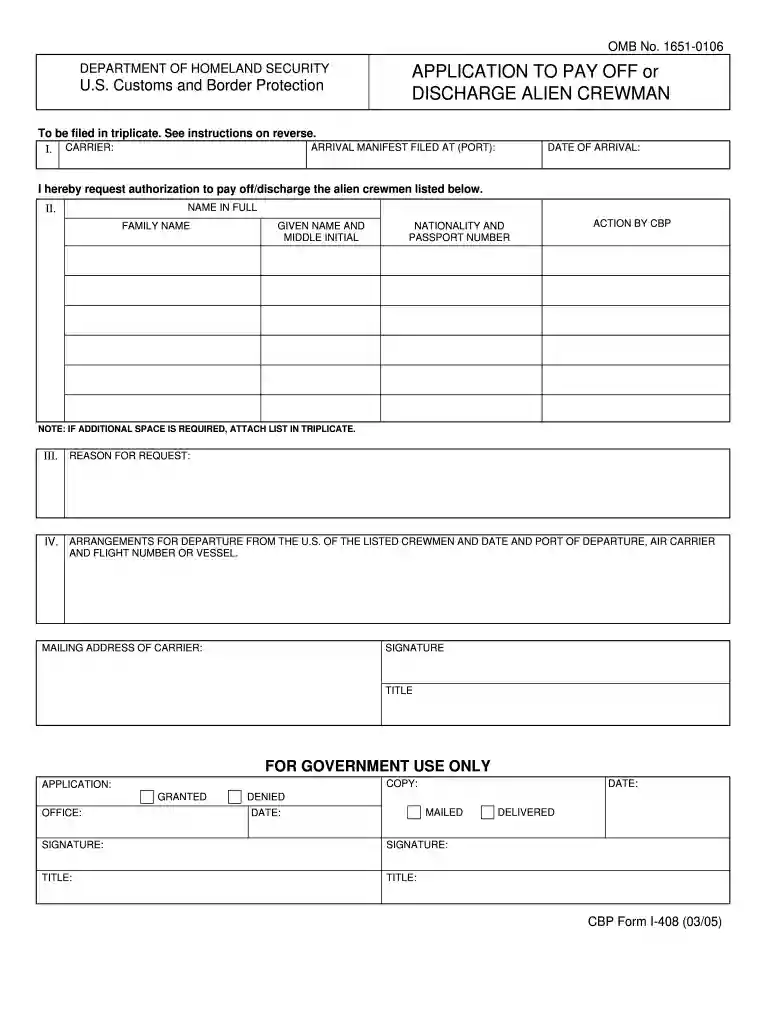
Jul 25, 2025 To be filed in triplicate (see instructions). CARRIER: CBP Form I-408 (3/22). ACTION BY CBP. I. NATIONALITY AND. PASSPORT NUMBER. ARRIVALRead more
26 U.S. Code 408 - Individual retirement accounts ; (1) Exemption from tax ; (3) Effect of borrowing on annuity contract ; (4) Effect of pledging account asRead more


