







Understanding the 1120 Tax Forms
The 1120 tax forms, officially known as the U.S. Corporation Income Tax Return, play a crucial role in the corporate tax filing process. These forms are used by corporations to report their income, gains, losses, deductions, and credits. The primary purpose is to calculate the federal income tax a corporation owes to the IRS for the tax year.
Who Typically Uses the 1120 Tax Forms
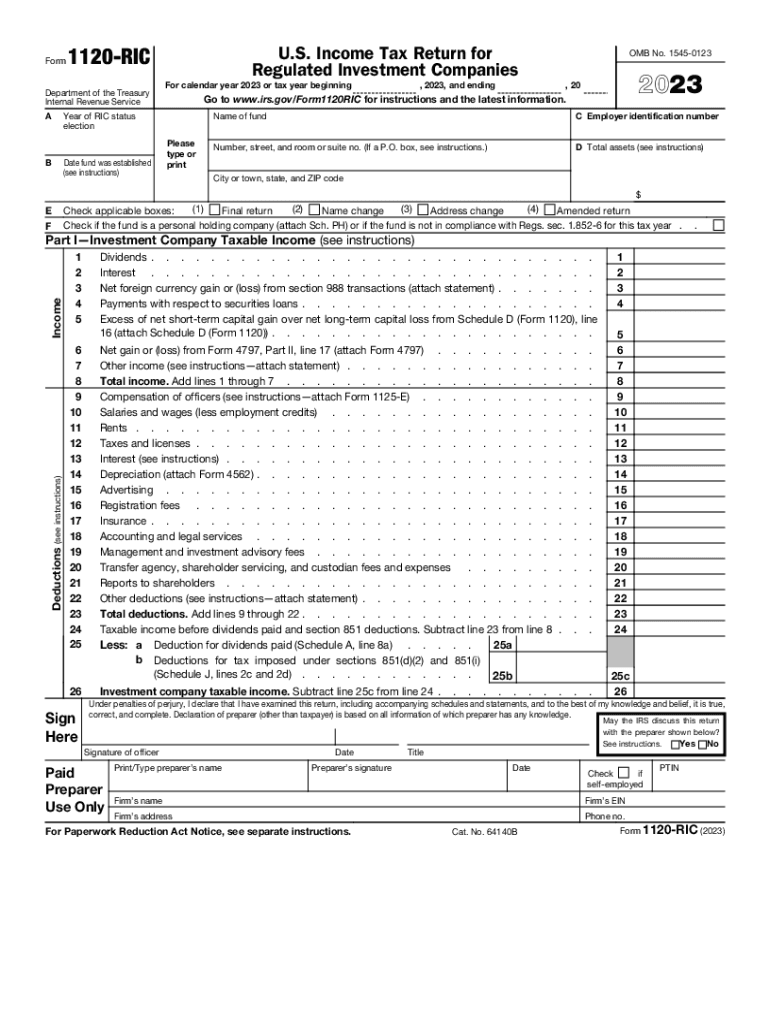
The 1120 forms are primarily used by U.S.-based corporations, including domestic and foreign corporations operating in the United States. Typical users include C corporations, which are entities that are taxed separately from their owners. They file this form to report their annual income and to determine the taxes due. Form 1120-RIC, in particular, is used by regulated investment companies to report their financial data.


Key Elements of the 1120 Tax Forms
The 1120 tax forms comprise various sections that require detailed information about a corporation's financial status. Key elements include:
- Income: Corporations must report their gross receipts or sales, as well as other incomes such as dividends and interest.
- Deductions: Includes ordinary and necessary business expenses like employee salaries, rent, and interest payments.
- Tax Computation and Payment: Corporations need to calculate the tax owed after accounting for deductions and credits.
- Other Information: This includes schedules detailing items like the balance sheet and shareholder identity.
Steps to Complete the 1120 Tax Forms
Completing the 1120 form involves a series of steps that require careful attention to detail:
-
Gather Required Documents: Collect relevant financial records, including income statements, balance sheets, and records of expenses.
-
Complete Income Section: Report gross revenue and income generated from other sources.
-
Document Deductions: List and specify all allowable business expenses.
-
Calculate Taxes: Use the provided formulas and schedules to compute federal taxes owed.
-
Review for Accuracy: Double-check all entries for accuracy and ensure compliance with IRS requirements.
-
Submit Form: File the completed form with the IRS by the specified deadline to avoid penalties.
Filing Deadlines / Important Dates
Corporations need to be aware of critical deadlines related to the 1120 tax forms:
-
Regular Deadline: The form is typically due by the 15th day of the fourth month after the end of the corporation's fiscal year. For calendar-year corporations, this is usually April 15.
-
Extensions: Corporations can file for a six-month extension, which moves the deadline to October 15 for calendar-year entities.
Timely filing is crucial to avoid penalties and interest charges on overdue taxes.
Legal Use of the 1120 Tax Forms
All corporations must adhere to federal regulations when completing and submitting the 1120 tax forms. Compliance ensures that all income, deductions, and credits are accurately reported. Failure to comply can result in legal penalties and interest charges. The IRS requires that the information submitted is honest and reflective of the corporation’s financial activities.
Penalties for Non-Compliance
Non-compliance with form 1120 filing requirements can result in significant penalties:
- Late Filing Penalty: Generally, 5% of the unpaid taxes for each month the return is late, up to 25%.
- Underpayment Penalty: Additional charges apply if taxes owed are not paid by the due date.
Corporations must ensure full compliance to avoid these financial penalties.
Software Compatibility
Various software systems can assist with preparing the 1120 tax forms, ensuring accuracy and efficiency. Popular software options include:
- TurboTax: Offers step-by-step guidance for preparing corporate tax returns.
- QuickBooks: Integrates accounting information to streamline form completion.
- H&R Block: Provides tools to verify and file corporate returns online.
Using compatible software can decrease preparation time and reduce the risk of errors.
Business Entity Types
The 1120 forms are specifically designed for certain business entities, primarily C corporations. These entities are distinct in that they are taxed separately from their owners, as opposed to partnerships and S corporations that pass income directly to their shareholders. Understanding which entity types require filing an 1120 form is vital for compliance and organizational tax planning.
Important Terms Related to 1120 Tax Forms
- Gross Receipts or Sales: The total amount received from all sources before any deductions.
- Deductions: Business expenses that can be subtracted from gross income to determine taxable income.
- Credits: Direct reductions in tax liability that can result from specific corporate activities and expenses.
- Net Income: Total revenue after all deductions and expenses, serving as a basis for tax computation.


