




01. Edit your form online
Type text, add images, blackout confidential details, add comments, highlights and more.

Type text, add images, blackout confidential details, add comments, highlights and more.

Draw your signature, type it, upload its image, or use your mobile device as a signature pad.

Send it via email, link, or fax. You can also download it, export it or print it out.
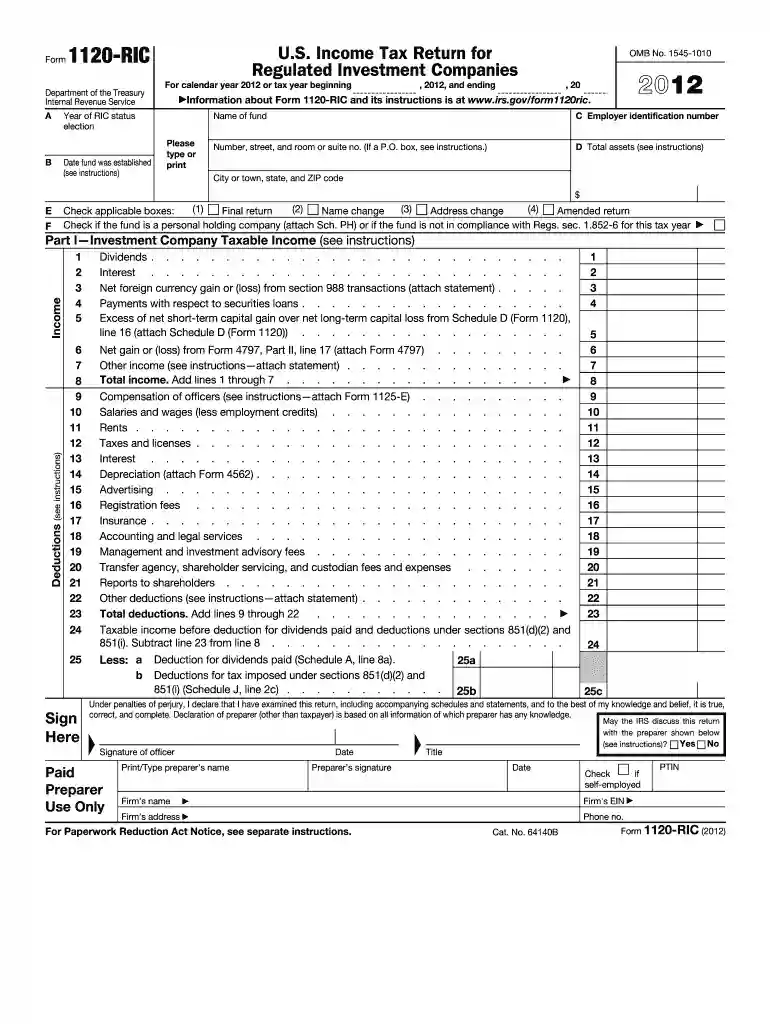
The 2012 Form 1120-RIC is a U.S. Income Tax Return specifically designed for Regulated Investment Companies (RICs). It's a critical form used by funds that qualify as RICs to report their earnings, taxes owed, and deductions. These funds often include mutual funds and certain exchange-traded funds (ETFs) that distribute income to shareholders. The form captures crucial details about investment income, compliance with the Internal Revenue Code (IRC) specifically applicable to investment companies, and statutory income distribution requirements.
This form is primarily used by Regulated Investment Companies, which are typically mutual funds and ETFs operating under the terms outlined in Subchapter M of the IRC. These companies must meet specific requirements, such as distributing a substantial portion of their income to shareholders, to qualify for favorable tax treatment. The IRS grants RIC status to companies whose business involves investment in securities and who comply with specific asset diversification and income distribution laws.


Make sure to align the filing of the 2012 Form 1120-RIC with the tax year-end of the RIC, typically by March 15th following the close of the tax year. Extensions can be sought if required, often granting an additional six months.
Failure to file on time or inaccurately reporting tax obligations can result in severe penalties from the IRS. These might include monetary fines and potential loss of RIC status, which would alter the tax treatment of the investment company drastically.
Forms can be submitted electronically or via mail. Each method has specific instructions available for ensuring the secure and verified submission of the form. Given the importance of timely filing, electronic submission is recommended for faster processing and immediate confirmation.
To be eligible to use Form 1120-RIC, companies must:
Ensuring compliance with these criteria is fundamental to optimizing tax advantages and maintaining lawful operational status.

We've got more versions of the 2012 form 1120 ric form. Select the right 2012 form 1120 ric version from the list and start editing it straight away!
| Versions | Form popularity | Fillable & printable |
|---|---|---|
| 2025 | 4.7 Satisfied (47 Votes) | |
| 2024 | 4.4 Satisfied (30 Votes) | |
| 2023 | 4.4 Satisfied (53 Votes) | |
| 2022 | 4.6 Satisfied (34 Votes) | |
| 2021 | 4.9 Satisfied (31 Votes) | |
| 2020 | 4.3 Satisfied (53 Votes) | |
| 2019 | 4.2 Satisfied (94 Votes) | |
| 2018 | 4.4 Satisfied (118 Votes) | |
| 2017 | 3.9 Satisfied (48 Votes) | |
| 2016 | 4.4 Satisfied (467 Votes) | |
| 2015 | 4.2 Satisfied (68 Votes) | |
| 2014 | 4 Satisfied (45 Votes) | |
| 2013 | 4 Satisfied (56 Votes) | |
| 2012 | 4 Satisfied (22 Votes) | |
| 2011 | 4.3 Satisfied (65 Votes) |
At DocHub, your data security is our priority. We follow HIPAA, SOC2, GDPR, and other standards, so you can work on your documents with confidence.
Dec 31, 2025 For tax years beginning in. 2012, RICs must now report the tax(es) imposed for relief from failure to meet the asset test and/or the grossRead more
Jan 26, 2017 LIST OF FIGURES. Figure 1. Sewer Location Map Near Chemtura Site. Figure 2. Site Map TCE Groundwater Isoconcentration Map. Figure 3.Read more
Effective May 21, 2012, to ensure fair and equitable treatment for all taxpayers, Form 1120-RIC, U.S. Income Tax Return for Regulated Investment Companies.Read more


