




01. Edit your registered investment company online
Type text, add images, blackout confidential details, add comments, highlights and more.

Type text, add images, blackout confidential details, add comments, highlights and more.

Draw your signature, type it, upload its image, or use your mobile device as a signature pad.

Send form 1120 ric via email, link, or fax. You can also download it, export it or print it out.
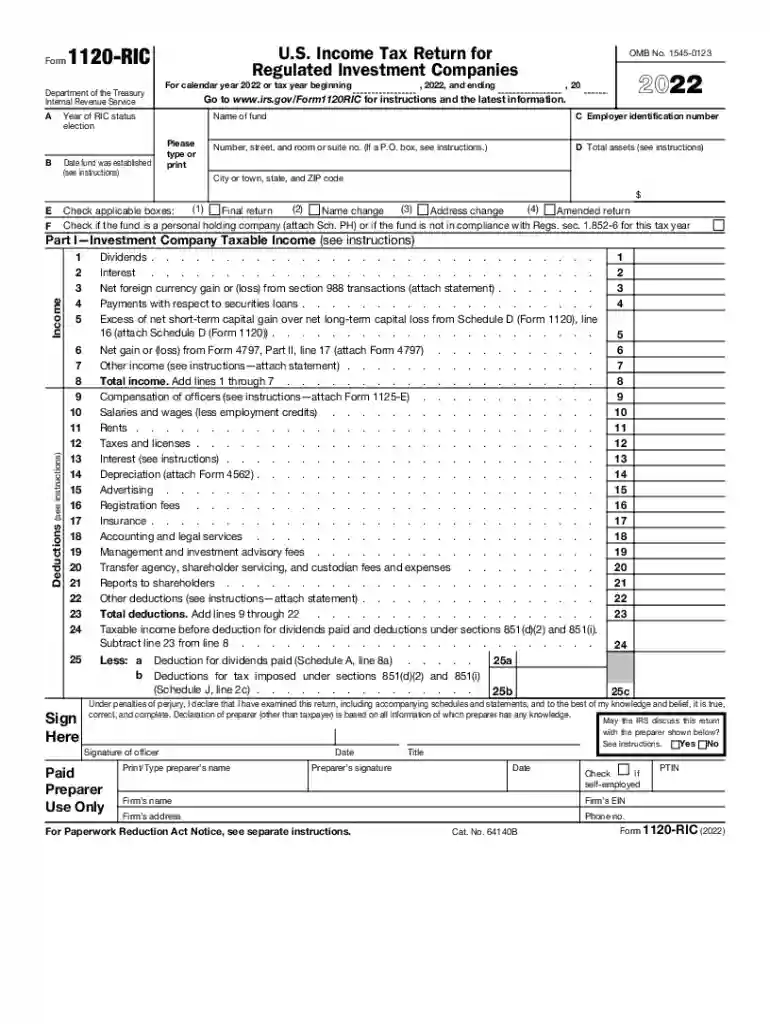
Federal Form 1120-RIC, also known as the U.S. Income Tax Return Form for Regulated Investment Companies, is utilized by investment entities to report their income, deductions, and tax obligations. It specifically serves companies qualifying as regulated investment companies (RICs) under the Internal Revenue Code. The form ensures that these companies conform to federal tax requirements, providing a structured approach to tax compliance for entities distributing dividends and managing investments.
Regulated investment companies use this form to demonstrate their adherence to regulations governing the distribution of taxable income and engage with certain deductions available under law. These entities primarily include mutual funds, which play a significant role in the financial industry by pooling resources from multiple investors to invest in stocks, bonds, and other securities.
Gather Necessary Documentation: Start by collecting statements and records related to the fund's income, deductions, distributions, and financial transactions. Documents may include the balance sheet, income statements, and records of dividends paid to investors.
Filling Out Basic Information: Enter the legal name of the company, its address, the employer identification number (EIN), and the fiscal year details at the beginning of the form.
Report Income: Complete the sections that outline total income, specifically interest, dividends, and any other applicable sources.
Itemize Deductions: List deductible expenses that the company incurs during its operations, including management fees and administration expenses.
Calculate Tax Obligations: Using the provided schedules, calculate the company’s tax liabilities, including corporate tax obligations and special taxes related to investment income.
Complete Remaining Schedules: Address the appropriate schedules that detail financial information regarding dividends paid and other distributions.
Review and Sign the Form: Ensure all information is accurate, sign the form, and gather the relevant documentation for submission.
Submit the Form: The IRS accepts both paper and electronic submissions. Ensure you meet the filing deadlines to avoid penalties.
Regulated investment companies such as mutual funds and ETFs primarily utilize Federal Form 1120-RIC. These entities have special tax designations that require them to distribute most of their income back to shareholders in the form of dividends. This form allows them to report on their income and ensure compliance with federal tax laws.
Entities structured as RICs under the IRS guidelines benefit from special tax treatment, reducing the risk of double taxation which often affects regular corporations. By using Form 1120-RIC, these companies can allocate taxable income to shareholders while complying with specific distribution standards.
Ensuring access to complete and precise documentation simplifies the tax filing process and ensures accuracy in financial reporting.
RICs must file Form 1120-RIC by the 15th day of the fourth month after the end of their tax year. For example, if the tax year ends on December 31, the form is due on April 15 of the following year.
Deadlines are critical, and timely filing is necessary to avoid late penalties. Consult the IRS or a tax professional to determine applicable extensions or special considerations for unique financial circumstances.
Failure to file Form 1120-RIC accurately and by the due date can result in significant penalties:
Engaging a qualified tax advisor helps ensure compliance and mitigates risks associated with inaccurate or late filing.
Such real-world scenarios highlight the form's role in facilitating transparency and compliance for investment companies distributing dividends to shareholders effectively.
We've got more versions of the registered investment company form. Select the right registered investment company version from the list and start editing it straight away!
| Versions | Form popularity | Fillable & printable |
|---|---|---|
| 2025 | 4.7 Satisfied (47 Votes) | |
| 2024 | 4.4 Satisfied (30 Votes) | |
| 2023 | 4.4 Satisfied (53 Votes) | |
| 2022 | 4.6 Satisfied (34 Votes) | |
| 2021 | 4.9 Satisfied (31 Votes) | |
| 2020 | 4.3 Satisfied (53 Votes) | |
| 2019 | 4.2 Satisfied (94 Votes) | |
| 2018 | 4.4 Satisfied (118 Votes) | |
| 2017 | 3.9 Satisfied (48 Votes) | |
| 2016 | 4.4 Satisfied (467 Votes) | |
| 2015 | 4.2 Satisfied (68 Votes) | |
| 2014 | 4 Satisfied (45 Votes) | |
| 2013 | 4 Satisfied (56 Votes) | |
| 2012 | 4 Satisfied (22 Votes) | |
| 2011 | 4.3 Satisfied (65 Votes) |
At DocHub, your data security is our priority. We follow HIPAA, SOC2, GDPR, and other standards, so you can work on your documents with confidence.
Instructions for Form Form 1120-RIC, U.S. income tax return for regulated investment companies Reproducible copies of federal tax forms and instructions.Read more
Mar 30, 2026 Form 1120-RIC is used to report an annual return of tax payable on or before the 15th day of the 3rd month following the close of companys


