




01. Edit your form online
Type text, add images, blackout confidential details, add comments, highlights and more.

Type text, add images, blackout confidential details, add comments, highlights and more.

Draw your signature, type it, upload its image, or use your mobile device as a signature pad.

Send it via email, link, or fax. You can also download it, export it or print it out.
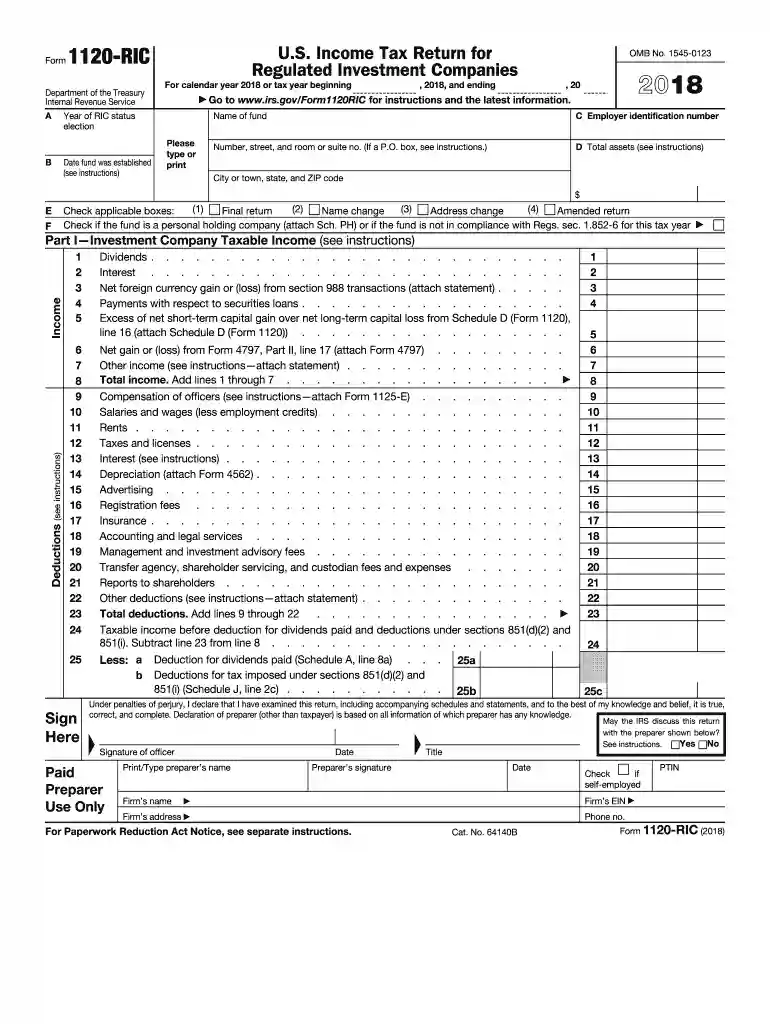
The "RIC 2015" pertains to Form 1120-RIC, used by Regulated Investment Companies (RICs) to report their income, deductions, and taxable earnings for the tax year in question. This form is crucial for entities such as mutual funds, which must declare their financial activity and compliance with regulations set forth by the Internal Revenue Service (IRS). The form establishes the framework within which these companies report figures like net investment income, capital gains, and the dividends paid to shareholders, adhering closely to the provisions within the IRS code.
Gather Required Documents: Ensure you have all necessary financial statements, previous tax returns, and dividend records to accurately report on the form.
Calculate Income and Deductions: Start with reporting gross revenue before moving on to specific deductions, including operational costs and dividends paid.
Complete Tax Schedules: Fill out associated schedules that detail capital gains, losses, and any applicable tax credits or adjustments.
Verify Accuracy: It’s crucial to double-check all figures and calculations to ensure compliance and avoid penalties for erroneous submissions.
Submit the Form: Depending on operational preferences, you can either submit the form electronically or via mail to the IRS before the filing deadline.
Regulated Investment Companies, notably mutual funds and certain investment trusts, are the primary users of the RIC 2015. These entities must report financial activities that affect their shareholders, which include distributing dividends, capital gain distributions, and any other taxable events. The necessity to file this form arises from the specific tax treatment provided to RICs, which allows them to avoid double taxation under certain conditions.


The IRS provides explicit guidelines that Regulated Investment Companies need to follow while filling out the 2015 form. These guidelines cover the classification of income, allowable deductions, and specific IRS codes that apply to the calculations on the form. Following these guidelines is crucial for compliance and to prevent potential audits or penalties due to misreporting or omissions.
The typical due date for filing the RIC 2015 corresponds with the 15th day of the third month after the end of the company’s tax year, usually March 15. Extensions are available upon filing Form 7004, which can grant an additional six-month period. Keeping track of these deadlines is crucial for maintaining good standing with the IRS and avoiding late filing penalties.
Consider a mutual fund managing a diversified portfolio. By completing the RIC 2015, the fund can accurately report its earnings, deductions, and dividends paid to shareholders. This not only ensures compliance with tax laws but also optimizes tax obligations by leveraging allowable deductions. For instance, if a fund distributes most of its revenue through dividends, it significantly reduces its taxable income.
Failing to file the RIC 2015 or inaccurate submissions can result in substantial penalties from the IRS. These include fines assessed on a monthly basis for late submissions and additional penalties for underreporting income. Misinterpretation or disregard of filing requirements can lead to audits or investigations, ultimately impacting the credibility and financial standing of the company.
We've got more versions of the ric 2015 form. Select the right ric 2015 version from the list and start editing it straight away!
| Versions | Form popularity | Fillable & printable |
|---|---|---|
| 2025 | 4.7 Satisfied (47 Votes) | |
| 2024 | 4.4 Satisfied (30 Votes) | |
| 2023 | 4.4 Satisfied (53 Votes) | |
| 2022 | 4.6 Satisfied (34 Votes) | |
| 2021 | 4.9 Satisfied (31 Votes) | |
| 2020 | 4.3 Satisfied (53 Votes) | |
| 2019 | 4.2 Satisfied (94 Votes) | |
| 2018 | 4.4 Satisfied (118 Votes) | |
| 2017 | 3.9 Satisfied (48 Votes) | |
| 2016 | 4.4 Satisfied (467 Votes) | |
| 2015 | 4.2 Satisfied (68 Votes) | |
| 2014 | 4 Satisfied (45 Votes) | |
| 2013 | 4 Satisfied (56 Votes) | |
| 2012 | 4 Satisfied (22 Votes) | |
| 2011 | 4.3 Satisfied (65 Votes) |
At DocHub, your data security is our priority. We follow HIPAA, SOC2, GDPR, and other standards, so you can work on your documents with confidence.
Oct 14, 2015 Sen. Reed, who helped pass the Higher Education Opportunity Act, says new RIC program will help students with intellectual disabilities haveRead more
Bannister Gallery 2015-16 Exhibitions. Amy Montali: Selections from Volume IV. September 3October 2, 2015. Amy Montali, RIC associate professor of artRead more


