




01. Edit your form online
Type text, add images, blackout confidential details, add comments, highlights and more.

Type text, add images, blackout confidential details, add comments, highlights and more.

Draw your signature, type it, upload its image, or use your mobile device as a signature pad.

Send it via email, link, or fax. You can also download it, export it or print it out.
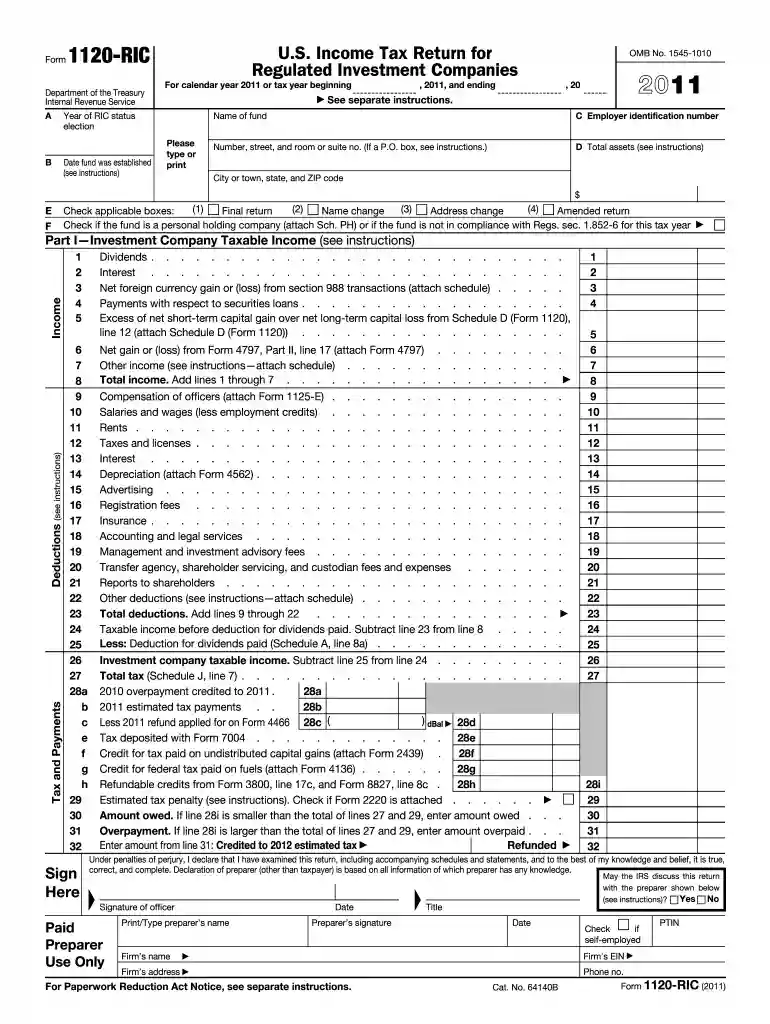
Form 1120-RIC is the U.S. Income Tax Return for Regulated Investment Companies (RIC) for the tax year 2011. This form is used by mutual funds and similar investment entities to report income, deductions, and tax liabilities to the Internal Revenue Service (IRS). RICs are required to distribute their income to shareholders and pay taxes on undistributed amounts, making this form essential for compliance with federal tax regulations.
To effectively use Form 1120-RIC, preparers must first gather comprehensive financial records of the investment company. These records should include income statements, dividend records, and details of expenses. The form consists of various sections where preparers must input figures corresponding to income, deductions, and taxes. Ensure all data is accurate to prevent discrepancies and potential penalties.
Completing Form 2-RIC involves a systematic process to ensure adherence to tax regulations. Precise and accurate completion is critical to avoid auditing or penalties from the IRS.
Form 1120-RIC is predominantly used by mutual funds and regulated investment companies. These entities are required to report their annual financial activities to the IRS. Investment firms must comply with strict distribution rules, and filing this form is pivotal for regulatory compliance.
Understanding key terms is critical when handling Form 1120-RIC to ensure the form is completed accurately.
Filing deadlines for the Form 1120-RIC must be strictly adhered to, as late submissions can lead to penalties and interest charges.
IRS guidelines provide comprehensive instructions on completing and filing Form 1120-RIC. These resources help ensure that preparers fully comply with tax laws and regulations.
Failure to file or accurately complete Form 1120-RIC can result in significant penalties and added interest. It's imperative for RICs to comply with all filing requirements.
Ensuring the accurate completion and timely filing of Form 1120-RIC is crucial for regulated investment companies to remain in good standing with the IRS.
We've got more versions of the form 2011 1120 ric form. Select the right form 2011 1120 ric version from the list and start editing it straight away!
| Versions | Form popularity | Fillable & printable |
|---|---|---|
| 2025 | 4.7 Satisfied (47 Votes) | |
| 2024 | 4.4 Satisfied (30 Votes) | |
| 2023 | 4.4 Satisfied (53 Votes) | |
| 2022 | 4.6 Satisfied (34 Votes) | |
| 2021 | 4.9 Satisfied (31 Votes) | |
| 2020 | 4.3 Satisfied (53 Votes) | |
| 2019 | 4.2 Satisfied (94 Votes) | |
| 2018 | 4.4 Satisfied (118 Votes) | |
| 2017 | 3.9 Satisfied (48 Votes) | |
| 2016 | 4.4 Satisfied (467 Votes) | |
| 2015 | 4.2 Satisfied (68 Votes) | |
| 2014 | 4 Satisfied (45 Votes) | |
| 2013 | 4 Satisfied (56 Votes) | |
| 2012 | 4 Satisfied (22 Votes) | |
| 2011 | 4.3 Satisfied (65 Votes) |
At DocHub, your data security is our priority. We follow HIPAA, SOC2, GDPR, and other standards, so you can work on your documents with confidence.
Utah statutes include taxable income from federal form 1120-REIT before the net operating loss deduction and the deduction for dividends paid. A Utah deductionRead more
Schedule A. Deduction for Dividends Paid (Do not include exempt-interest dividends or capital gain dividends reported on Form 2438, line 9b; see instructions.).Read more


