




01. Edit your 1120 ric online
Type text, add images, blackout confidential details, add comments, highlights and more.

Type text, add images, blackout confidential details, add comments, highlights and more.

Draw your signature, type it, upload its image, or use your mobile device as a signature pad.

Send 1120 ric instructions via email, link, or fax. You can also download it, export it or print it out.
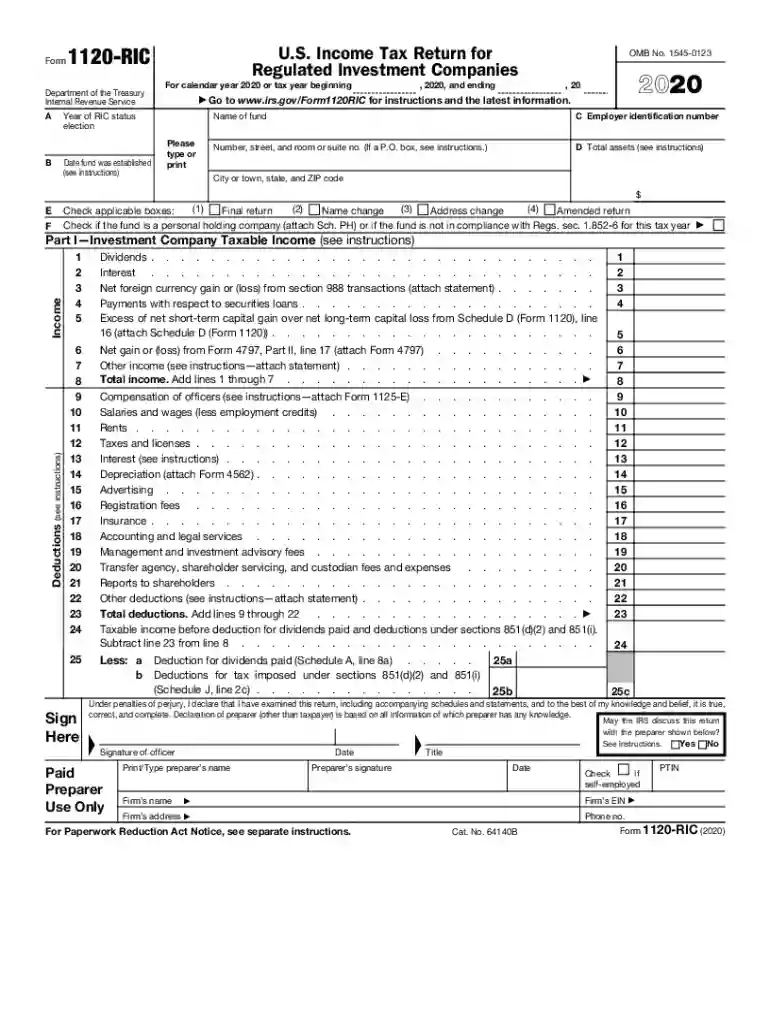
Form 1120-RIC is the U.S. Income Tax Return for Regulated Investment Companies. Its primary purpose is to report the taxable income, deductions, and taxes owed by these entities. Understanding this form is crucial for businesses that need to adhere to the specific compliance and reporting obligations it mandates. It ensures all income sources, such as dividends and interest, are accurately accounted for, along with deductions and capital gains.
Successfully completing the 1120-RIC requires accuracy and attention to detail. The process involves:
Form 1120-RIC can be obtained directly from the Internal Revenue Service (IRS) website. It is also available through tax preparation software and tax professionals well-versed in regulated investment company filings. Acquiring an updated version of the form is essential, particularly since tax regulations and form requirements can change.
The IRS provides specific guidelines and instructions for using Form 1120-RIC, detailing how regulated investment companies should calculate and report their taxes. These guidelines emphasize the importance of reporting accurate financial figures and adhering to defined deadlines and filing instructions to avoid any compliance issues.
Form 1120-RIC is used to ensure that regulated investment companies comply with tax laws regarding the disclosure and payment of taxes on their earned income. It is legally binding, meaning companies must provide truthful and complete information or face potential legal repercussions.
Primarily, mutual funds and exchange-traded funds (ETFs) fall under the category of regulated investment companies. These entities benefit from utilizing Form 1120-RIC as it allows them to report their operational income and corresponding taxes officially.
Form 1120-RIC can be filed using various tax preparation software that supports business tax forms. Popular options include TurboTax and QuickBooks, which provide user-friendly platforms to streamline the filing process and ensure accuracy.
Failing to file Form 1120-RIC correctly or on time can result in significant penalties, including fines and interest on unpaid taxes. It is vital for regulated investment companies to adhere to filing deadlines and ensure all required information is accurately reported to avoid these consequences.
The U.S. Internal Revenue Service is responsible for issuing Form 1120-RIC, which must be utilized by regulated investment companies nationwide. It is the official document used to report their annual income and tax obligations.
We've got more versions of the 1120 ric form. Select the right 1120 ric version from the list and start editing it straight away!
| Versions | Form popularity | Fillable & printable |
|---|---|---|
| 2025 | 4.7 Satisfied (47 Votes) | |
| 2024 | 4.4 Satisfied (30 Votes) | |
| 2023 | 4.4 Satisfied (53 Votes) | |
| 2022 | 4.6 Satisfied (34 Votes) | |
| 2021 | 4.9 Satisfied (31 Votes) | |
| 2020 | 4.3 Satisfied (53 Votes) | |
| 2019 | 4.2 Satisfied (94 Votes) | |
| 2018 | 4.4 Satisfied (118 Votes) | |
| 2017 | 3.9 Satisfied (48 Votes) | |
| 2016 | 4.4 Satisfied (467 Votes) | |
| 2015 | 4.2 Satisfied (68 Votes) | |
| 2014 | 4 Satisfied (45 Votes) | |
| 2013 | 4 Satisfied (56 Votes) | |
| 2012 | 4 Satisfied (22 Votes) | |
| 2011 | 4.3 Satisfied (65 Votes) |
At DocHub, your data security is our priority. We follow HIPAA, SOC2, GDPR, and other standards, so you can work on your documents with confidence.
Form Form 1120-RIC, U.S. income tax return for regulated investment companies. Form Form 1120-RIC, U.S. income tax return for regulated investment companies.Read more
Form 1120-RIC is used to report an annual return of tax payable on or before the 15th day of the 3rd month following the close of companys taxable year.
Utah statutes include taxable income from federal form 1120-REIT before the net operating loss deduction and the deduction for dividends paid. A Utah deductionRead more


