




01. Edit your 1996 540 online
Type text, add images, blackout confidential details, add comments, highlights and more.

Type text, add images, blackout confidential details, add comments, highlights and more.

Draw your signature, type it, upload its image, or use your mobile device as a signature pad.

Send 1996 form via email, link, or fax. You can also download it, export it or print it out.
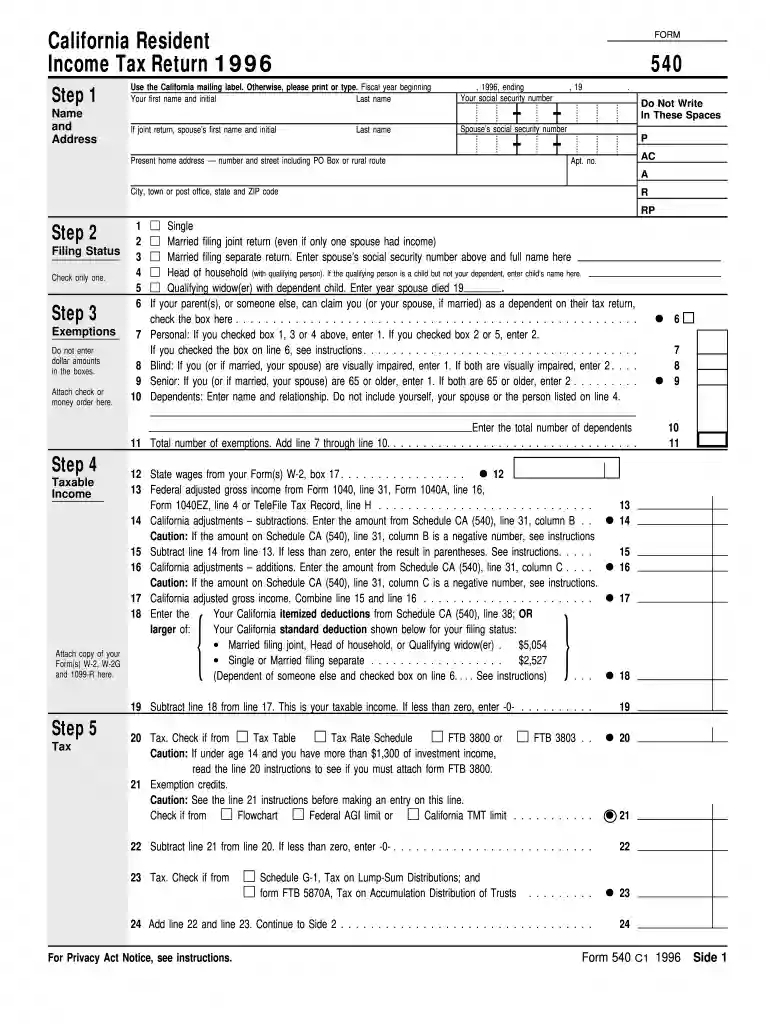
The California Form 540 for 1996 is a state tax document used by residents of California to report their income and calculate their income tax liability for that tax year. This form is essential for ensuring compliance with state tax obligations and helps determine the amount owed or the potential refund. The document requires taxpayers to provide personal information, report income, calculate deductions, and apply for any relevant tax credits.
To obtain a copy of the 1996 CA Form 540, individuals can access archived records from the California Franchise Tax Board (FTB) website or request a physical copy from the FTB through mail. Libraries and certain public institutions may also retain historical copies. It's important to ensure that you're using the correct year version, as tax laws and instructions may differ significantly from year to year.
California has specific tax regulations that may differ from federal rules. While completing the Form 540, it's crucial to be aware of California's unique deductions, credit offerings, and income brackets. The state offers certain tax credits that are not available federally, such as credits related to energy efficiency or specific state employment incentives. Compliance with these state-specific rules is necessary to avoid complications or additional tax liabilities.
Failing to file the 1996 CA Form 540 or submitting inaccurate information can result in penalties. The California FTB imposes fees for late filing, underpayment, or omission of important details. The penalties can be significant and may also include interest on unpaid taxes. Taxpayers are advised to review their filings carefully or consult a tax professional if uncertain.
In 1996, tax forms were predominantly filed in paper form, but with the advent of technology, it became possible to submit digitally. Using digital forms reduces the risk of errors and streamlines the submission process. However, taxpayers should ensure that any digital version conforms to the original 1996 paper form's structure and content to ensure accuracy and compliance.
We've got more versions of the 1996 540 form. Select the right 1996 540 version from the list and start editing it straight away!
| Versions | Form popularity | Fillable & printable |
|---|---|---|
| 2025 | 4.9 Satisfied (32 Votes) | |
| 2024 | 4.5 Satisfied (41 Votes) | |
| 2023 | 4.8 Satisfied (57 Votes) | |
| 2022 | 4.4 Satisfied (58 Votes) | |
| 2021 | 4.8 Satisfied (196 Votes) | |
| 2020 | 4.4 Satisfied (68 Votes) | |
| 2019 | 4.3 Satisfied (176 Votes) | |
| 2018 | 4.3 Satisfied (120 Votes) | |
| 2017 | 4.3 Satisfied (127 Votes) | |
| 2016 | 4.4 Satisfied (234 Votes) | |
| 2015 | 4.3 Satisfied (243 Votes) | |
| 2014 | 4 Satisfied (31 Votes) | |
| 2013 | 4 Satisfied (47 Votes) | |
| 2012 | 4.3 Satisfied (54 Votes) | |
| 2011 | 4 Satisfied (35 Votes) |
At DocHub, your data security is our priority. We follow HIPAA, SOC2, GDPR, and other standards, so you can work on your documents with confidence.
96 Individual Shared Responsibility Penalty Balance. If line 92 is more than line 93, subtract line 93 from line 92. . . . . . . . . . . . .Read more
Jun 5, 1997 The policies and procedures set forth here are intended as guidance to Agency and other government employees.Read more
California State University, Long Beach. Policy Statement. 96-05 Successful completion of 540 including fingerprints, Certificate of Clearance and Character


