




01. Edit your when is schedule d not required online
Type text, add images, blackout confidential details, add comments, highlights and more.

Type text, add images, blackout confidential details, add comments, highlights and more.

Draw your signature, type it, upload its image, or use your mobile device as a signature pad.

Send it via email, link, or fax. You can also download it, export it or print it out.
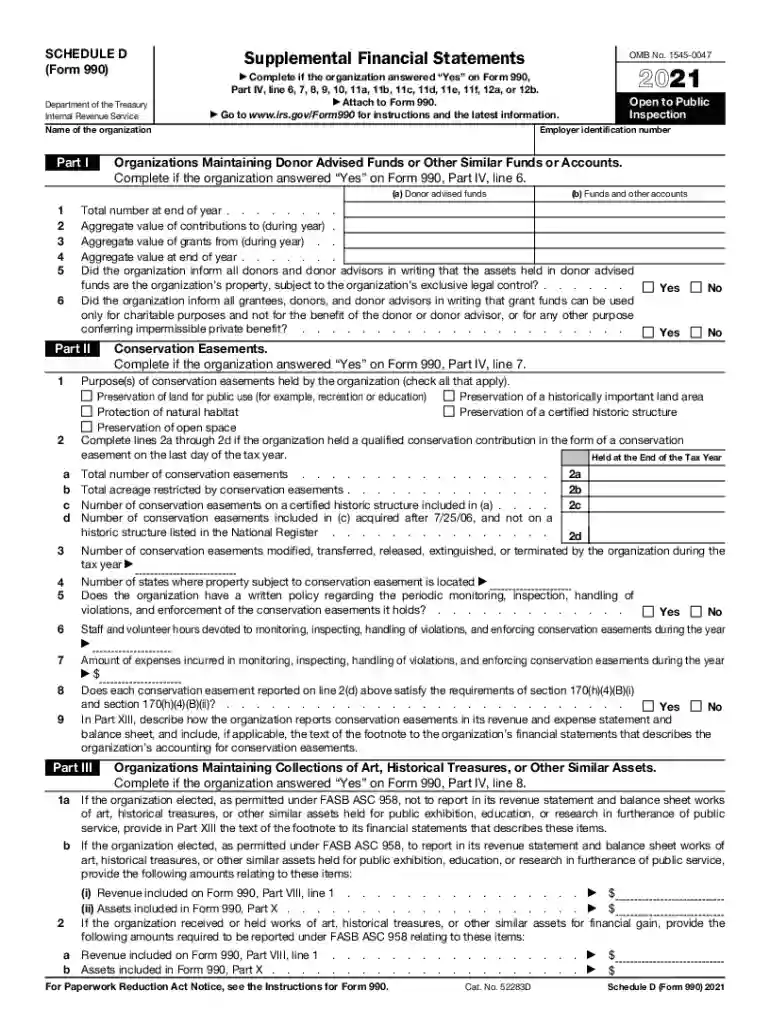
Schedule D is a supplemental financial form mandated by the IRS for certain organizations that maintain distinct types of financial interests. This includes entities engaged with donor-advised funds, conservation easements, collections of art or historical treasures, and various other financial assets. Its primary purpose is to deliver detailed financial data to assure compliance with U.S. tax laws and to foster transparency in financial reporting.
An art museum using Schedule D must disclose information about its art collections' financial value, ensuring full compliance with IRS regulations.
Schedule D is predominantly used by tax-exempt organizations such as non-profits, art museums, educational foundations, and environmental conservation groups. These entities must provide meticulous financial details to the IRS if they manage specific financial interests.


A community foundation administering several donor-advised funds would file Schedule D annually to display how these funds are allocated and managed.
Schedule D can be downloaded directly from the IRS website, ensuring users have access to the most recent version. It is available alongside Form 990, which it supplements.
Completing Schedule D involves accurate data compilation and entering precise information about the organization's finances related to specific financial interests.
Schedule D requires a detailed breakdown of financial elements that contribute to an organization’s transparency and compliance with IRS requirements.
An endowment fund at a university would require detailed reporting through Schedule D to clarify how funds are invested and spent, providing stakeholders with clear insights into financial practices.
Ensuring the accurate and truthful completion of Schedule D is legally imperative for organizations subject to IRS scrutiny. Incorrect or withheld information can lead to legal repercussions.
Organizations that fail to meet these requirements can be subjected to audits and potential penalties, emphasizing the importance of legal compliance.
The IRS provides comprehensive guidelines on who must file Schedule D, supplemented with instructions to ensure accurate completion.
Adhering to IRS guidelines not only ensures compliance but also enhances an organization's credibility with donors and regulatory bodies.
Failure to correctly file Schedule D may result in significant penalties from the IRS, potentially including monetary fines or revocation of tax-exempt status.
Maintaining up-to-date financial records and ensuring accurate and timely filings of Schedule D can mitigate the risk of incurring penalties.
We've got more versions of the when is schedule d not required form. Select the right when is schedule d not required version from the list and start editing it straight away!
| Versions | Form popularity | Fillable & printable |
|---|---|---|
| 2024 | 4.5 Satisfied (39 Votes) | |
| 2023 | 4.3 Satisfied (40 Votes) | |
| 2022 | 4.9 Satisfied (48 Votes) | |
| 2021 | 4.8 Satisfied (171 Votes) | |
| 2020 | 4.4 Satisfied (138 Votes) | |
| 2019 | 4.3 Satisfied (93 Votes) | |
| 2018 | 4.2 Satisfied (79 Votes) | |
| 2017 | 4.2 Satisfied (114 Votes) | |
| 2016 | 4.2 Satisfied (72 Votes) | |
| 2015 | 4 Satisfied (43 Votes) | |
| 2014 | 4 Satisfied (32 Votes) | |
| 2013 | 4 Satisfied (59 Votes) | |
| 2012 | 4 Satisfied (50 Votes) | |
| 2011 | 4 Satisfied (28 Votes) | |
| 2010 | 4 Satisfied (58 Votes) |
At DocHub, your data security is our priority. We follow HIPAA, SOC2, GDPR, and other standards, so you can work on your documents with confidence.
(D) Schedule D The term Schedule D means a form or information filed by a taxpayer to report sales, exchanges or some involuntary conversions of capitalRead more
Mar 30, 2026 Use Schedule D (Form 1040) to report the following: The sale or exchange of a capital asset not reported on another form or schedule.Read more
(d) Official follow-up prescriptions from prescribers for schedule III, IV and V controlled substances shall be attached to the corresponding oral orders, andRead more


