




01. Edit your form online
Type text, add images, blackout confidential details, add comments, highlights and more.

Type text, add images, blackout confidential details, add comments, highlights and more.

Draw your signature, type it, upload its image, or use your mobile device as a signature pad.

Send it via email, link, or fax. You can also download it, export it or print it out.
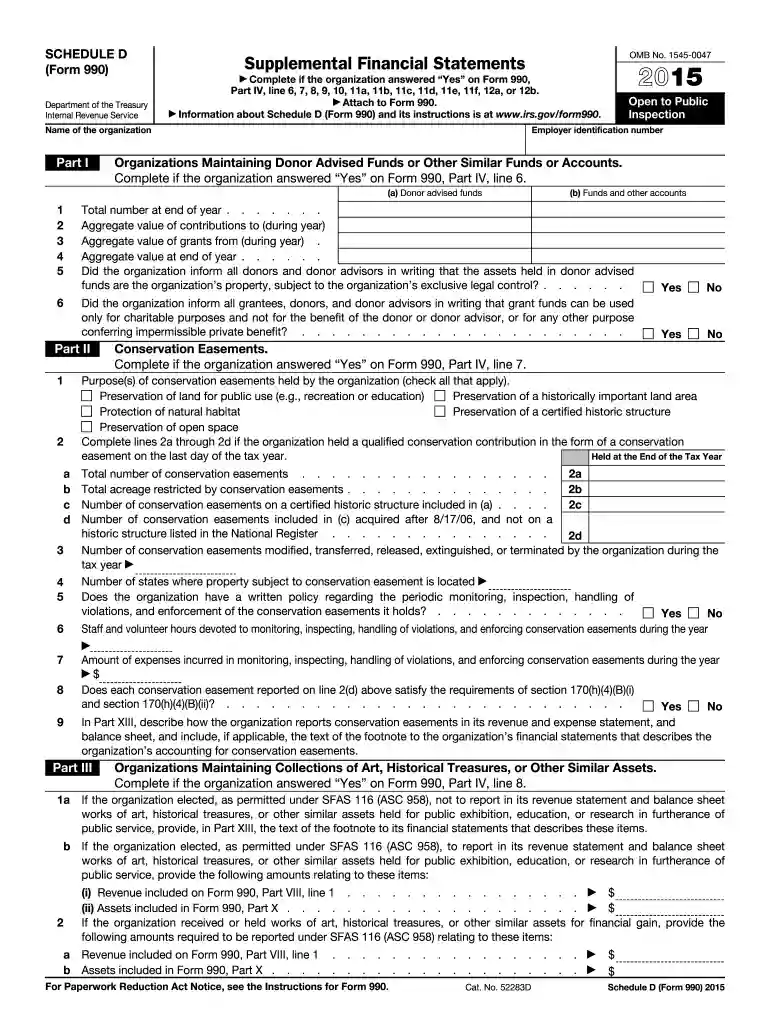
Schedule D (Form 990) is a supplemental financial statement required by the IRS for tax-exempt organizations such as nonprofits, charities, foundations, and other entities maintaining donor-advised funds, conservation easements, or art collections. This form is used to provide detailed financial reporting that goes beyond the basic requirements of the main Form 990, including the management of specific types of assets and contributions. With its specialized nature, Schedule D ensures that organizations comply with federal tax regulations, offering transparency and accountability regarding their financial activities.
When using the 2015 Schedule D, organizations must ensure they carefully complete each section relevant to their financial activities. This involves:
Being meticulous in preparation can prevent discrepancies and potential issues with compliance.
The 2015 Schedule D can be acquired through:
Filing the 2015 Schedule D requires a structured approach:
Careful attention to each step ensures the form reflects an accurate financial position.
Key elements required on Schedule D include:
These elements require precise reporting to maintain transparency and regulatory compliance.
Understanding pertinent terms helps in accurately completing Schedule D:
Familiarity with these terms enhances the accuracy of disclosures.
Adherence to IRS guidelines for Schedule D includes:
Compliance with these guidelines aids in maintaining good standing with the IRS.
For the 2015 Schedule D, organizations should observe these deadlines:
Adhering to these timings helps avoid complications or penalties.
We've got more versions of the 2015 990 schecdule d form form. Select the right 2015 990 schecdule d form version from the list and start editing it straight away!
| Versions | Form popularity | Fillable & printable |
|---|---|---|
| 2024 | 4.5 Satisfied (39 Votes) | |
| 2023 | 4.3 Satisfied (40 Votes) | |
| 2022 | 4.9 Satisfied (48 Votes) | |
| 2021 | 4.8 Satisfied (171 Votes) | |
| 2020 | 4.4 Satisfied (138 Votes) | |
| 2019 | 4.3 Satisfied (93 Votes) | |
| 2018 | 4.2 Satisfied (79 Votes) | |
| 2017 | 4.2 Satisfied (114 Votes) | |
| 2016 | 4.2 Satisfied (72 Votes) | |
| 2015 | 4 Satisfied (43 Votes) | |
| 2014 | 4 Satisfied (32 Votes) | |
| 2013 | 4 Satisfied (59 Votes) | |
| 2012 | 4 Satisfied (50 Votes) | |
| 2011 | 4 Satisfied (28 Votes) | |
| 2010 | 4 Satisfied (58 Votes) |
At DocHub, your data security is our priority. We follow HIPAA, SOC2, GDPR, and other standards, so you can work on your documents with confidence.
Schedule D (Form 990) 2015. 532053. 09-21-15. 29. 12590502 759636 64465.64463 Schedule D (Form 990) 2015. 09-21-15. 30. 12590502 759636 64465.64463Read more
1. Total number at end of year . . . . . . . 2. Aggregate value of contributions to (during year). 3. Aggregate value of grants from (during year) .Read more


