




01. Edit your form online
Type text, add images, blackout confidential details, add comments, highlights and more.

Type text, add images, blackout confidential details, add comments, highlights and more.

Draw your signature, type it, upload its image, or use your mobile device as a signature pad.

Send it via email, link, or fax. You can also download it, export it or print it out.
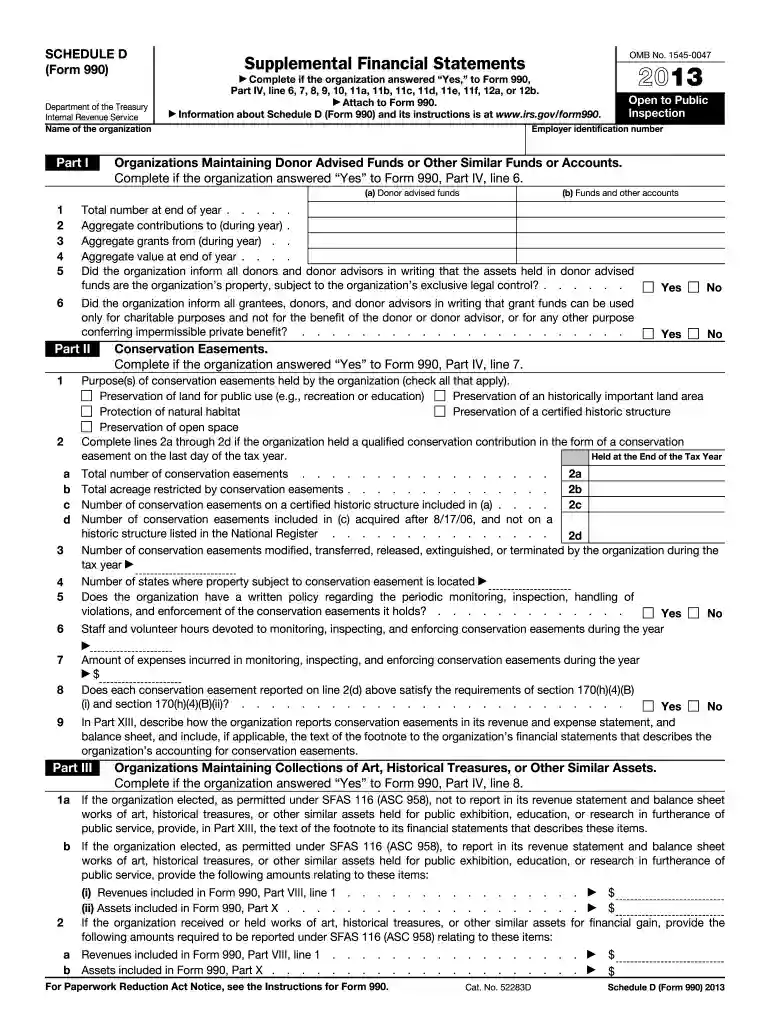
Schedule D (Form 990) serves as a supplemental financial statement required by the Internal Revenue Service (IRS) for nonprofit organizations engaged in specific financial activities. These activities include maintaining donor-advised funds, handling conservation easements, or managing endowment funds. The schedule demands detailed reporting on contributions, grants, assets, liabilities, and reconciling revenue and expenses. By requiring this information, the IRS aims to ensure the transparency and compliance of these organizations with federal tax regulations.
To effectively use Schedule D (Form 990), organizations must collect comprehensive financial data relevant to their specific activities. This includes details about managing donor-advised funds, conservation easements, or any collections of art or historical treasures they might own. Nonprofits should focus on accurately reporting assets, liabilities, and any reconciliation of revenue and expenses. This data is used to fill out the various parts of the form, which are organized into sections that address specific types of financial information.
The 2013 Schedule D (Form 990) can be accessed online through the IRS website or requested from local IRS offices. Many tax preparation software suites, like TurboTax or QuickBooks, also offer this form. Organizations can download it, print it, or use digital forms within the software for easy editing and submission.
Completing the 2013 Schedule D (Form 990) involves several steps designed to ensure accurate and complete financial reporting:
Schedule D (Form 990) is typically used by nonprofit organizations required to file a Form 990 with the IRS. These organizations include those with tax-exempt status under section 501(c)(3) of the Internal Revenue Code. They use this form to report supplemental financial details that are not captured in the main Form 990, providing transparency and compliance with IRS regulations.
Schedule D (Form 990) is structured into several parts, each addressing specific elements of an organization’s financial activities:
The IRS has specific guidelines for the completion and submission of Schedule D (Form 990). Nonprofits are expected to file by the 15th day of the fifth month after the end of their accounting period, typically corresponding to May 15 for calendar-year filers. Late submissions may incur penalties, emphasizing the importance of adhering to these deadlines and ensuring all information provided is thorough and accurate.
Non-compliance with IRS filing requirements for Schedule D (Form 990) can result in penalties for nonprofit organizations. Failure to file on time or inaccuracies in reporting can lead to fines and potential audits. Maintaining accurate records and adhering to IRS guidelines helps prevent these penalties.
Many organizations utilize tax preparation software, such as TurboTax or QuickBooks, to assist in accurately completing Schedule D (Form 990). These platforms offer tools to ensure that the form is filled out accurately, often providing step-by-step guidance tailored to an organization’s specific financial activities. Utilizing such software can streamline the process and enhance the accuracy of the information submitted.
We've got more versions of the 2013 form 990 schedule d form. Select the right 2013 form 990 schedule d version from the list and start editing it straight away!
| Versions | Form popularity | Fillable & printable |
|---|---|---|
| 2024 | 4.5 Satisfied (39 Votes) | |
| 2023 | 4.3 Satisfied (40 Votes) | |
| 2022 | 4.9 Satisfied (48 Votes) | |
| 2021 | 4.8 Satisfied (171 Votes) | |
| 2020 | 4.4 Satisfied (138 Votes) | |
| 2019 | 4.3 Satisfied (93 Votes) | |
| 2018 | 4.2 Satisfied (79 Votes) | |
| 2017 | 4.2 Satisfied (114 Votes) | |
| 2016 | 4.2 Satisfied (72 Votes) | |
| 2015 | 4 Satisfied (43 Votes) | |
| 2014 | 4 Satisfied (32 Votes) | |
| 2013 | 4 Satisfied (59 Votes) | |
| 2012 | 4 Satisfied (50 Votes) | |
| 2011 | 4 Satisfied (28 Votes) | |
| 2010 | 4 Satisfied (58 Votes) |
At DocHub, your data security is our priority. We follow HIPAA, SOC2, GDPR, and other standards, so you can work on your documents with confidence.
Schedule D (Form 990) 2013. BAA For Paperwork Reduction Act Notice, see the Instructions for Form 990. EAST CENTRAL COLLEGE FOUNDATION, INC. 43-1062435. X. 1.Read more
Form 990-T trusts. Complete this part only if both lines 18a and 19 are gains, or qualified dividends are included in income in Part I of Form 990-T,.Read more


