




01. Edit your form online
Type text, add images, blackout confidential details, add comments, highlights and more.

Type text, add images, blackout confidential details, add comments, highlights and more.

Draw your signature, type it, upload its image, or use your mobile device as a signature pad.

Send it via email, link, or fax. You can also download it, export it or print it out.
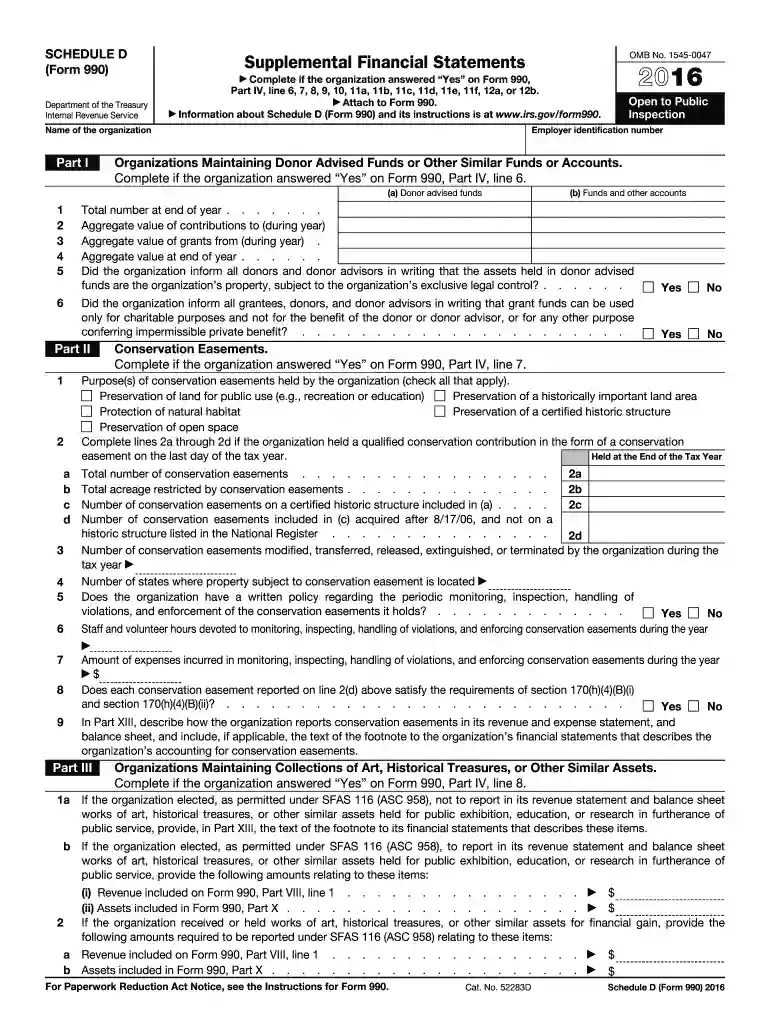
Schedule D (Form 990) is a supplemental financial statement mandated by the IRS for certain tax-exempt organizations. This form is essential for entities that responded 'Yes' to specific inquiries on Form 990, covering various aspects like donor-advised funds, conservation easements, and collections of art. The primary goal of Schedule D is to ensure transparency and compliance by providing detailed financial disclosure about the organization’s diverse assets and obligations.
When using the Schedule D Form, organizations must first determine their eligibility based on their responses to Form 990. The process involves downloading the form from the IRS website or accessing it via platforms like DocHub. Once obtained, organizations can follow detailed instructions to complete each section accurately, addressing segments relevant to their operational and financial circumstances. Each part of the form caters to different reporting requirements, thus demanding a meticulous approach to ensure compliance.
Schedule D is primarily used by tax-exempt organizations, including charities, foundations, and non-profits that need to file Form 990. It applies to entities managing complex assets or financial arrangements, such as donor-advised funds and conservation easements. Organizations reporting these elements are required by the IRS to use this form to ensure comprehensive financial disclosure.


The IRS sets clear guidelines for filing Schedule D, emphasizing detailed financial disclosure and transparency. Organizations must adhere to strict deadlines aligned with Form 990 submissions, typically by the 15th day of the 5th month after the end of their accounting period. Missing these deadlines can result in penalties or loss of tax-exempt status.
Failing to file Schedule D when required can lead to significant repercussions for organizations. The IRS may impose financial penalties and potentially revoke tax-exempt status if non-compliance is severe. It is crucial for organizations to ensure timely filing and accurate completion of the form to avoid these penalties.
Both digital and paper versions of Schedule D are available; however, many organizations prefer the digital format for its convenience and compatibility with tax preparation software. Digital submission through platforms like DocHub allows for easier handling of form requirements, real-time updates, and direct IRS submission, streamlining the compliance process.
Software such as TurboTax and QuickBooks can facilitate the completion of Schedule D by integrating with digital tax forms. These tools assist in accurately reporting an organization's financial data, ensuring compliance with IRS requirements, and simplifying the overall filing process. They offer guided instructions to help users navigate complex sections efficiently.
This content is structured to offer detailed insights into various aspects of the 990 Schedule D Form, focusing on its purpose, user demographic, completion steps, critical requirements, and compliance considerations. Comprehensive instructions and guidelines aim to assist organizations in achieving accurate and timely submissions.
We've got more versions of the 990 schedule dDocHubcom 2016 form form. Select the right 990 schedule dDocHubcom 2016 form version from the list and start editing it straight away!
| Versions | Form popularity | Fillable & printable |
|---|---|---|
| 2024 | 4.5 Satisfied (39 Votes) | |
| 2023 | 4.3 Satisfied (40 Votes) | |
| 2022 | 4.9 Satisfied (48 Votes) | |
| 2021 | 4.8 Satisfied (171 Votes) | |
| 2020 | 4.4 Satisfied (138 Votes) | |
| 2019 | 4.3 Satisfied (93 Votes) | |
| 2018 | 4.2 Satisfied (79 Votes) | |
| 2017 | 4.2 Satisfied (114 Votes) | |
| 2016 | 4.2 Satisfied (72 Votes) | |
| 2015 | 4 Satisfied (43 Votes) | |
| 2014 | 4 Satisfied (32 Votes) | |
| 2013 | 4 Satisfied (59 Votes) | |
| 2012 | 4 Satisfied (50 Votes) | |
| 2011 | 4 Satisfied (28 Votes) | |
| 2010 | 4 Satisfied (58 Votes) |
At DocHub, your data security is our priority. We follow HIPAA, SOC2, GDPR, and other standards, so you can work on your documents with confidence.
This comprehensive format allows students to gain practice experience in constructing a program proposal by breaking up each section and receiving feedback ...
The latest versions of IRS forms, instructions, and publications. View more information about Using IRS Forms, Instructions, Publications and Other Item ...


