




01. Edit your form online
Type text, add images, blackout confidential details, add comments, highlights and more.

Type text, add images, blackout confidential details, add comments, highlights and more.

Draw your signature, type it, upload its image, or use your mobile device as a signature pad.

Send it via email, link, or fax. You can also download it, export it or print it out.
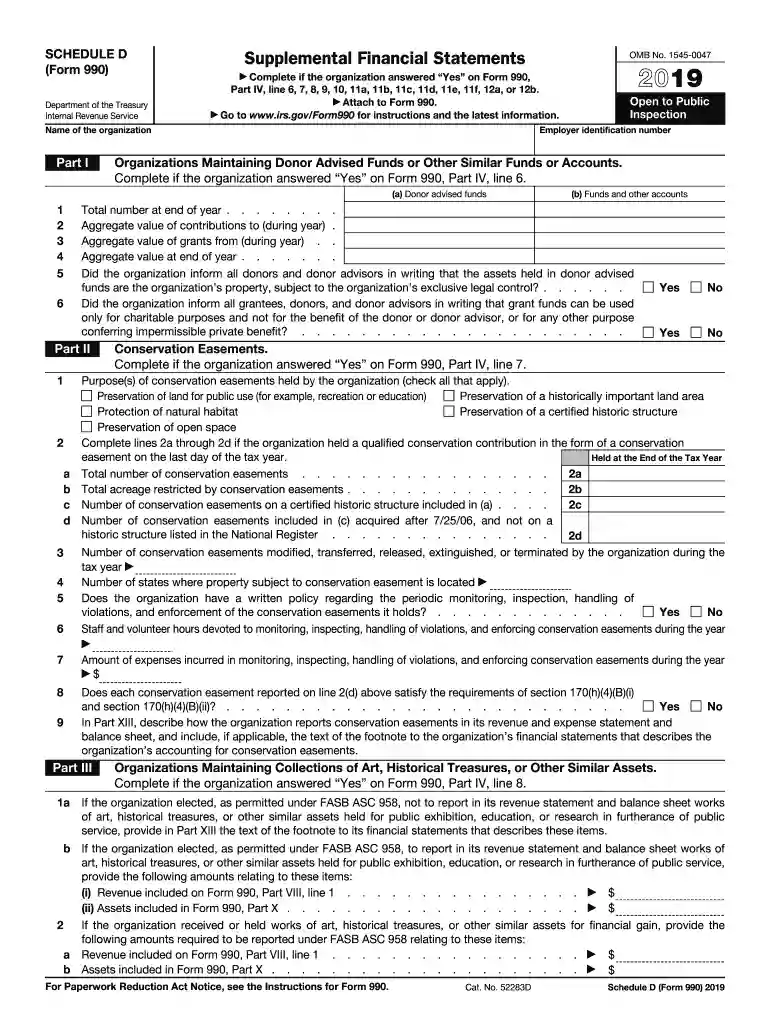
Schedule D (Form 990) is an auxiliary financial disclosure document required by the Internal Revenue Service (IRS) for specific nonprofit organizations to supplement their Form 990 filings. This form serves to furnish detailed information about certain financial activities and asset holdings of the organization. It includes sections related to donor-advised funds, conservation easements, collections of art or historical treasures, escrows, custodian accounts, endowment funds, and other significant holdings. The principal objective of Schedule D is to ensure that organizations maintain transparency and adhere to compliance standards in their financial dealings and asset management.
Schedule D comprises multiple parts, each focusing on a specific category of financial activities or assets. Key components include:
Donor Advised Funds and Other Similar Funds or Accounts: This part requires organizations to elucidate the management of donor-advised funds and other similar accounts, outlining contributions, distributions, and ending balances.
Conservation Easements: Organizations must describe contributions related to conservation spots and easements, specifying donation dates and fair market values.
Collections of Art, Historical Treasures, and Similar Assets: This section demands information about the nature and value of these collections, including acquisition and preservation costs.
Endowment Funds: Organizations need to detail their endowment funds, including the beginning balance, contributions, earnings, distributions, and ending balance during the reporting period.
Completing Schedule D involves a series of methodical steps to ensure precise reporting:
Gather Financial Data: Compile detailed financial records pertinent to donor-advised funds, endowments, collections, and other assets indicated in the form.
Assess Asset Categories: Determine the categories applicable to your organization and collect the requisite data for each applicable section.
Data Entry: Enter the collated data into the respective sections of Schedule D. Ensure accuracy in recording financial details such as contribution amounts, fair market values, and ending balances.
Review and Verify: Cross-check the entered information with the organization’s financial statements to verify alignment and accuracy.
Submit with Form 990: Attach the completed Schedule D to the organization’s Form 990 filing.
The primary users of Schedule D include nonprofit organizations that fall under the tax-exempt status and are subjected to regulatory financial disclosures. Examples include:
Charitable Organizations: Those maintaining donor-advised funds or high-value assets requiring additional scrutiny.
Cultural Institutions: Museums and similar entities with collections of art or historical treasures.
Environmental Nonprofits: Organizations involved in conservation efforts, particularly those managing conservation easements.


The IRS provides guidelines to aid the accurate completion of Schedule D. Key points in these guidelines include:
Adherence to the fair market value assessment procedures for valuing assets, ensuring fairness in reported amounts.
Requirements for disclosing specifics about any escrow or custodian arrangements, providing transparency in fund handling.
Instructions on reporting cumulative endowment funds balances and their utilization throughout the tax year.
For organizations required to file Form 990 with the IRS, the deadline for Schedule D submission aligns with that of Form 990. Generally:
The standard filing deadline is the 15th day of the fifth month after the fiscal year-end. For instance, for calendar-year filers, the due date is typically May 15 of the following year.
Extensions for filing may be granted; however, it is crucial to adhere to these deadlines to avoid penalties.
Non-compliance or inaccuracies in filing Schedule D can result in penalties, including:
Financial Penalties: Monetary fines imposed for late filings or inaccuracies, potentially impacting the organization’s financial standing.
Revocation of Tax-Exempt Status: In severe cases, failing to furnish accurate and complete information may lead to the revocation of the organization's tax-exempt status by the IRS.
Organizations have the option to file Schedule D in digital or paper format:
Digital Filing: Utilizes IRS e-filing systems, offering faster processing and reduced risks of errors in data entry.
Paper Filing: Traditional method, which may be used by smaller organizations with limited digital access. Consideration of processing times when choosing this option is essential.
Integrating this document with platforms like DocHub can streamline digital collaboration and secure sharing of documents, enhancing the efficiency of the filing process.
We've got more versions of the 2019 form 990 schedule d form. Select the right 2019 form 990 schedule d version from the list and start editing it straight away!
| Versions | Form popularity | Fillable & printable |
|---|---|---|
| 2024 | 4.5 Satisfied (39 Votes) | |
| 2023 | 4.3 Satisfied (40 Votes) | |
| 2022 | 4.9 Satisfied (48 Votes) | |
| 2021 | 4.8 Satisfied (171 Votes) | |
| 2020 | 4.4 Satisfied (138 Votes) | |
| 2019 | 4.3 Satisfied (93 Votes) | |
| 2018 | 4.2 Satisfied (79 Votes) | |
| 2017 | 4.2 Satisfied (114 Votes) | |
| 2016 | 4.2 Satisfied (72 Votes) | |
| 2015 | 4 Satisfied (43 Votes) | |
| 2014 | 4 Satisfied (32 Votes) | |
| 2013 | 4 Satisfied (59 Votes) | |
| 2012 | 4 Satisfied (50 Votes) | |
| 2011 | 4 Satisfied (28 Votes) | |
| 2010 | 4 Satisfied (58 Votes) |
At DocHub, your data security is our priority. We follow HIPAA, SOC2, GDPR, and other standards, so you can work on your documents with confidence.
Schedule D (Form 990) 2019. (continued). (Column (d) must equal Form 990, Part Schedule F (Form 990) 2019. Schedule F (Form 990) 2019. Page. Provide theRead more
Schedule D (Form 990) 2019. IGNITE. 38-3819049. ** PUBLIC DISCLOSURE COPY **. Page 22. Schedule D (Form 990) 2019. Page 2. Organizations Maintaining CollectionsRead more
1. Total number at end of year . . . . . . . . 2. Aggregate value of contributions to (during year) . 3. Aggregate value of grants from (during year) .Read more


