




01. Edit your 2022 form 990 schedule d online
Type text, add images, blackout confidential details, add comments, highlights and more.

Type text, add images, blackout confidential details, add comments, highlights and more.

Draw your signature, type it, upload its image, or use your mobile device as a signature pad.

Send 990 schedule d via email, link, or fax. You can also download it, export it or print it out.
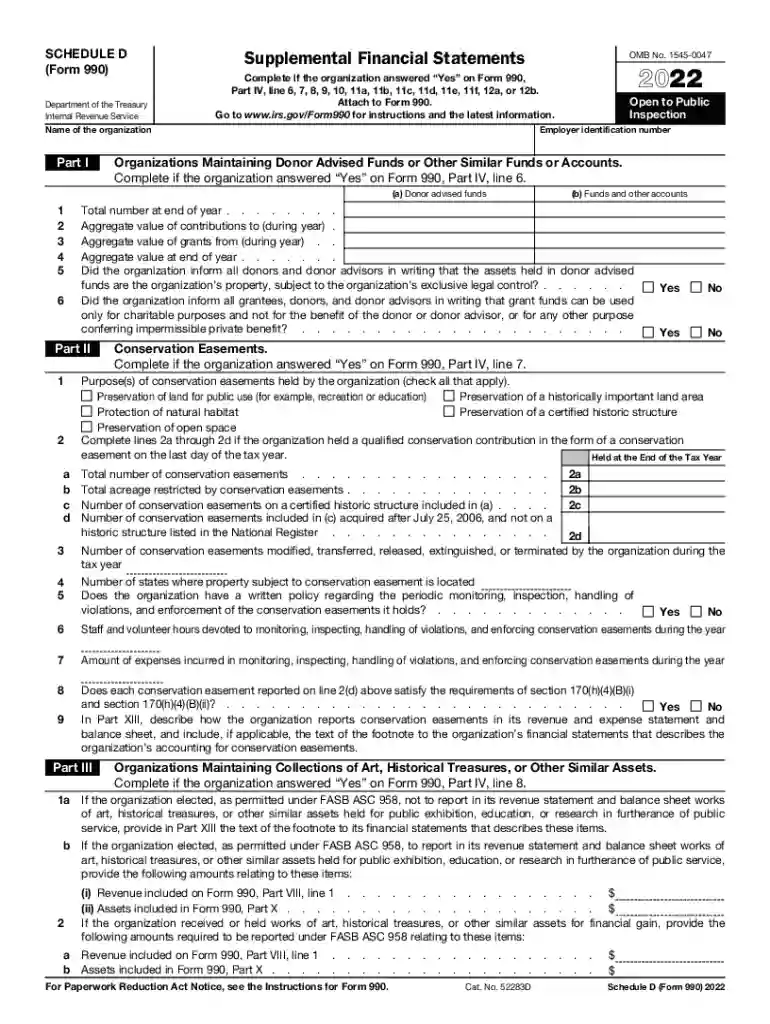
Schedule D (Form 990) is a critical supplemental financial statement required by the IRS for specific organizations. It serves to ensure transparency and compliance, particularly for non-profit entities. This form provides detailed reporting on various financial aspects such as donor-advised funds, conservation easements, collections of art, and historical treasures. The primary objective is to maintain accountability in financial reporting and ensure that organizations adhere to tax regulations. Organizations required to fill out Schedule D usually manage assets that demand a robust disclosure process to ensure public trust and regulatory compliance.
Successfully navigating the 2022 Schedule D involves understanding its structure and purpose. Organizations use this form to report on specific assets and financial transactions that require additional documentation beyond what is typically included in Form 990.
Clear and accurate records ensure compliance and assist the IRS in evaluating fund management practices within these organizations.
Filling out Schedule D requires careful attention to detail.
Several critical components make up the form:
These elements allow the IRS to obtain a thorough understanding of the financial dealings and asset management of the filing organization.
Schedule D must be filled out accurately to comply with federal regulations. Misreporting or omissions can lead to penalties, legal challenges, and potential audits. It is essential to understand that providing complete and honest financial disclosures on this form is not just about regulatory adherence but also about sustaining public confidence and organizational integrity.
This form is predominantly used by non-profit organizations recognized under section 501(c) of the IRS tax code. These organizations typically manage donor-advised funds, conservation easements, or possess significant collections of art. Its use helps in maintaining transparency about their financial management to donors, regulatory bodies, and other stakeholders.


The IRS provides comprehensive instructions outlining how organizations should approach their financial reporting obligations with Schedule D. The guidelines emphasize the necessity for transparency, complete data disclosure, and adherence to specific instructions included with each section of the form. Organizations should regularly consult these IRS instructions to remain compliant.
Organizations filing Schedule D must observe strict deadlines to avoid penalties:
Failing to submit the form in a timely manner can result in financial penalties and increased scrutiny from the IRS.
We've got more versions of the 2022 form 990 schedule d form. Select the right 2022 form 990 schedule d version from the list and start editing it straight away!
| Versions | Form popularity | Fillable & printable |
|---|---|---|
| 2024 | 4.5 Satisfied (39 Votes) | |
| 2023 | 4.3 Satisfied (40 Votes) | |
| 2022 | 4.9 Satisfied (48 Votes) | |
| 2021 | 4.8 Satisfied (171 Votes) | |
| 2020 | 4.4 Satisfied (138 Votes) | |
| 2019 | 4.3 Satisfied (93 Votes) | |
| 2018 | 4.2 Satisfied (79 Votes) | |
| 2017 | 4.2 Satisfied (114 Votes) | |
| 2016 | 4.2 Satisfied (72 Votes) | |
| 2015 | 4 Satisfied (43 Votes) | |
| 2014 | 4 Satisfied (32 Votes) | |
| 2013 | 4 Satisfied (59 Votes) | |
| 2012 | 4 Satisfied (50 Votes) | |
| 2011 | 4 Satisfied (28 Votes) | |
| 2010 | 4 Satisfied (58 Votes) |
At DocHub, your data security is our priority. We follow HIPAA, SOC2, GDPR, and other standards, so you can work on your documents with confidence.


