
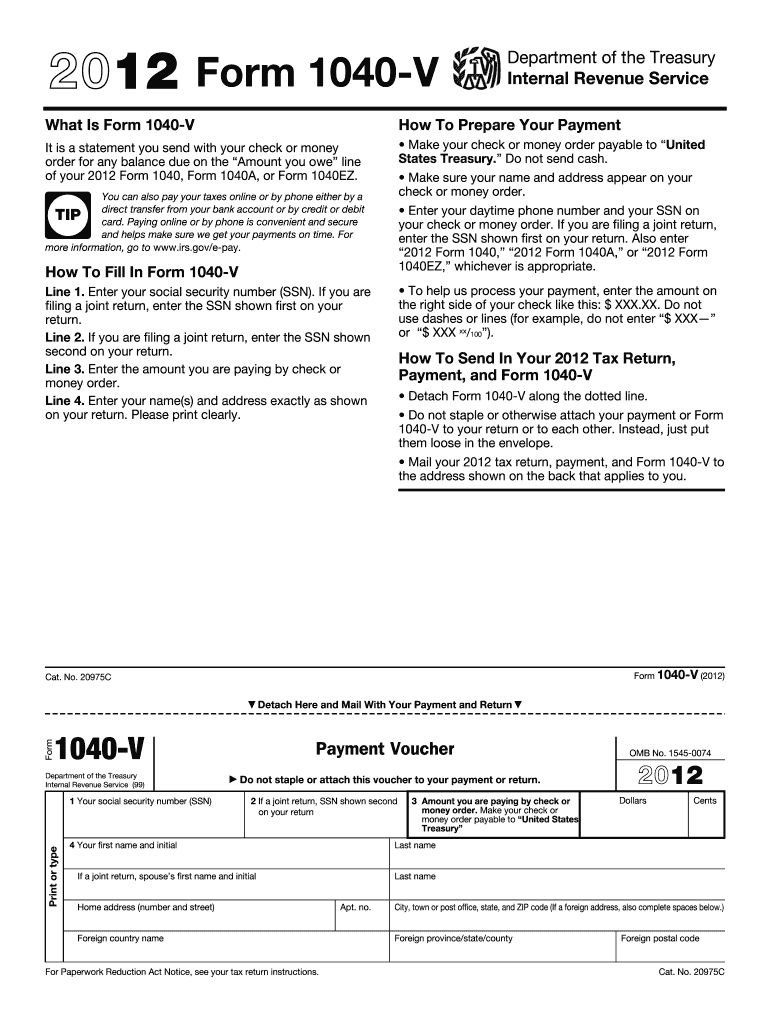







Definition and Purpose of Form 1040-V
Form 1040-V acts as a payment voucher for individuals who owe a balance on their federal income tax returns. It's used to submit payments for any remaining tax liability after calculating taxes for the year 2012 using Forms 1040, 1040A, or 1040EZ. When providing a payment, taxpayers must include Form 1040-V with their check or money order to ensure it lands in the right account and facilitates smoother processing by the IRS.
How to Utilize Form 1040-V
Understanding how to correctly use Form 1040-V is crucial. Taxpayers need to include the form with their payment to the IRS, making sure to enter personal details accurately such as Social Security numbers and address information. This ensures that the payment can be attributed correctly to the specific taxpayer and avoids potential misapplications of funds.
Steps to Complete Form 1040-V
-
Provide Personal Details:
- Write your name and address on the form.
- Include your Social Security number.
-
Enter Payment Amount:
- Clearly indicate the payment amount you are sending.
- Ensure it matches the amount owed on your return.
-
Attach to Payment:
- Attach Form 1040-V to your check or money order.
- Ensure the payment is made payable to the "United States Treasury."
-
Mail the Document:
- Send the completed form and payment to the appropriate IRS address listed on the 1040-V instructions, which varies based on your location.
How to Obtain Form 1040-V
Taxpayers can easily access Form 1040-V in several ways:
- IRS Website: Downloadable directly from the IRS website.
- Tax Software: Often included in tax preparation software like TurboTax or QuickBooks.
- Local IRS Office: Paper copies can be obtained from local IRS offices for those who prefer non-digital formats.
Critical Elements in Form 1040-V
The key components of Form 1040-V that need attention include:
- Taxpayer Identification: Full legal name and Social Security number must be included.
- Payment Amount: Clearly indicated to prevent discrepancies during processing.
- Correct Address: Essential if opting for a paper check or money order to ensure delivery to the appropriate IRS location.
IRS Guidelines for Using Form 1040-V
The IRS provides specific guidelines to assist taxpayers in using Form 1040-V for efficient processing:
- Verification: Upon submission, verify all details for accuracy.
- Separate Payments: Each form must correspond to a single payment.
- Deadlines: Follow the filing deadline strictly; typically aligned with the April 15 tax filing deadline.
IRS Mailing Addresses for Form Submission
Mailing addresses varry based on geographic location. It's crucial to follow IRS instructions to determine the correct mailing location for your area, ensuring your payment is processed without delays.
Penalties for Non-Compliance
Failing to submit Form 1040-V with the payment, or not paying taxes owed in a timely manner, can result in penalties or additional interest charges. These penalties are imposed on balances due and grow over time until the IRS receives full payment.
Legal Uses of Form 1040-V
The legal application of Form 1040-V is limited to supporting payments related to individual tax returns. The form itself is not used to address business tax liabilities or other governmental fees outside of personal taxation.
Alternatives and Variants
While the form largely remains consistent for individual payments, it is essential for individuals to ensure the version used corresponds to the correct tax year. Using a prior year’s form can result in processing delays or misapplication of payments. For those who prefer electronic payments, IRS Direct Pay or Electronic Federal Tax Payment System (EFTPS) serve as alternatives.
Example Scenarios for Using Form 1040-V
-
Individual Taxpayer: A taxpayer who completes their return and finds a balance due would use Form 1040-V to remit payment.
-
Freelancers: Completely their tax filings and remitting outstanding amounts with Form 1040-V attached to their checks to avoid penalties.
Special Considerations for Taxpayers
- Self-Employed Individuals: Often utilize estimated payments throughout the year; ensuring end-of-year payments are accurately matched with Form 1040-V is vital.
- Retired Individuals: Using this form when submitting payments if tax was under-withheld from retirement benefits.
Such detailed understanding of Form 1040-V helps ensure compliance and facilitates smoother interactions with the IRS.




